
On the evening of May 22, a major gas explosion occurred at the Liushenyu Coal Mine of Tongzhou Coal Industry Group in Qinyuan County, Changzhi City, Shanxi Province, resulting in significant casualties. Reports indicate that the mining accident in Shanxi involved “outsourced teams”, some of whom were owed wages. Videos reflecting the plight of Chinese miners have been circulating widely in recent days.
According to a report by mainland media New Jing Bao, some miners stated that they were part of “outsourced teams” and not officially contracted as “regular employees” directly with the coal mine. Outsourced workers alleged that the implicated coal mine had likely withheld their wages, with some workers claiming they hadn’t been paid since the end of February.
Xinhua News Agency also reported that multiple miners identified themselves as part of outsourced teams. They mentioned having to purchase their own work uniforms, safety helmets, and even water shoes, with not even a pair of gloves being provided by the team.
It was reported by mainland media that at 7:29 p.m. local time on the 22nd, a carbon monoxide sensor at the mine suddenly issued an alarm for exceeding the standard level. However, a survivor interviewed by Central Broadcasting Network said he didn’t notice any abnormalities at the time of the explosion. He only received notification to evacuate around 10 p.m. that night and his self-rescue oxygen machine ran out of oxygen after just seven to eight minutes. According to the Coal Mine Safety Regulations, the protection time of the isolated self-rescue device for underground personnel should not be less than 30 minutes.
Dafeng News, another mainland media outlet, reported that some miners claimed to have self-rescue equipment, but it had not been replaced in “four or five years.”
During a press conference held around 10:30 p.m. on May 23, local officials confirmed that the accident had resulted in 82 deaths, 2 missing persons, and 128 injuries. This revised figure raised questions as the previous official data had reported 90 deaths.
Mainland media reported that at the site of the coal mine explosion, a sign displayed the entrance personnel count as 124 at the time of the explosion. However, after verification from various sources, the actual number of people underground was 247, with 123 individuals having no valid information in the system.
Data indicates that China is the world’s largest coal producer, but historically, its coal mining fatality rate has been much higher than in developed countries. In the early 2000s, the death rate per million tons of coal reached several individuals, peaking at over 5, while the United States has consistently remained between 0.02 to 0.05 individuals.
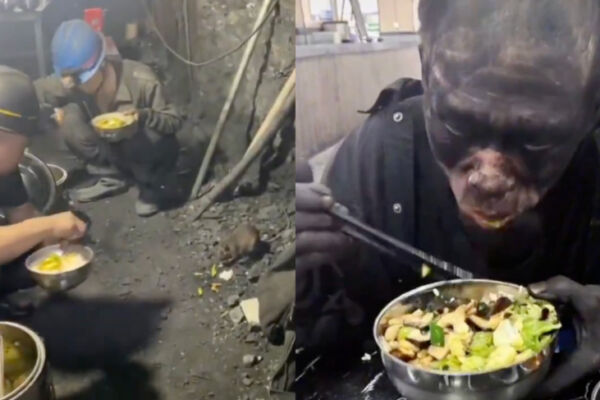
This incident has drawn attention to the hardships faced by Chinese miners. Following the Shanxi mining accident, netizens compiled and edited operation videos of coal miners. Working underground without sunlight, covered in coal dust, they burrow through narrow mine tunnels, descending hundreds of meters below the surface every day. After finishing work and resurfacing, they are exhausted and hungry, neglecting to wash off the coal dust as they eagerly devour their meals, coal dust mixing with their food.
In the video footage, some workers are seen sitting together below ground, surrounded by coal dust, sharing a meal. There is also a scene in which a worker, alongside a rat, shares some food with the rodent. The sight of humans and rodents dining together underground in the coal mine strikes a poignant chord.
Netizens commented: “This video depicts a relatively better condition.” “The sacrifice of these workers is too real. Has safety supervision truly improved?” “Human life is treated as worthless.” “Typical case of risking lives for money.” “After studying a bunch of robots that only dance on the Spring Festival Gala, this is where robots are most needed.”
A Shanxi miner blogger with 76,000 followers shared a video on May 15, showing miners, their faces covered with coal dust, gathered around to eat after finishing their underground work. The closing line of most of his videos often carries a simple yet profound wish: “Go to work happily and return home safely.”
Another blogger posted a video expressing the hardships endured by Chinese coal miners, noting that they are so miserable that they don’t dare to kill rats, interpreting the presence of rats as an indication of airflow and a sign of hope for survival.
On May 23, a woman shared a post recounting the hardships her father faced working in the coal mining industry. Due to poverty, her father began working in the mines at 18 and continued until the age of 47. As the pillar of the family, he used his hard work to send them to good schools, buy a house in the city, and provide a better life. Her father endured constant insults and oppression from leaders, faced delayed wages, and lived without dignity.
The woman mentioned that her father had to work underground in the dark mines for 20 years before he could retire. Despite wanting to relieve him of work, she lacked the ability as the entire family relied on him. Reflecting on the recent gas explosion at the Shanxi Qinyuan Coal Mine, she thought of her father and countless other fathers.
Furthermore, this mining disaster has exposed longstanding issues within the Chinese system. The Qinyuan Coal Industry Co., Ltd. of Tongzhou Group was confirmed to have achieved a Level 2 standard in the standardized management system for safe production. Despite being penalized twice in 2025, the mine still carried the badge of “achieving the standard for the Level 2 standardized management system for safe production.”