
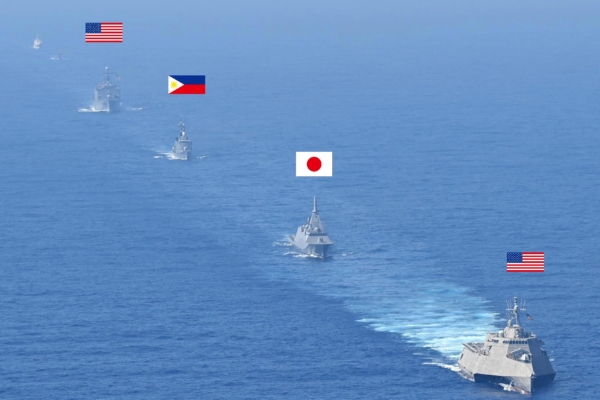
The President of the Philippines is scheduled to make an official visit to Japan next week, where both sides are expected to engage in formal negotiations for the General Security of Military Information Agreement (GSOMIA) and deepen cooperation in defense procurement and trilateral security fields.
According to a report from Nikkei, Japan and the Philippines will officially start negotiations to establish a legal framework for exchanging confidential security information.
President Ferdinand Marcos Jr. of the Philippines will visit Japan from May 26 to 29. Japanese Prime Minister Sanae Takaichi is expected to meet with Marcos on the 28th and agree to kick off formal negotiations for the GSOMIA.
The agreement will set rules to ensure the protection of confidential defense information shared between the two governments, preventing disclosure to third parties.
The United States has signed similar agreements with Japan and the Philippines. If Japan and the Philippines reach an agreement, it will establish a trilateral intelligence-sharing framework among the three countries — also the first of its kind between Japan and Southeast Asian nations.
In April of this year, Japan comprehensively reformulated its arms export laws, lifting the ban on exporting lethal weapons, which received positive responses in Manila.
Japanese Defense Minister Shinjiro Koizumi subsequently visited Manila, where he met with Philippine Defense Secretary Gilberto Teodoro Jr. to discuss defense equipment transfers and the implementation of the Reciprocal Access Agreement (RAA).
During Marcos’ visit, it is expected that Japan’s defense exports to the Philippines will become a key agenda at the summit. Both parties have planned to establish a working group of defense authorities to explore the possibility of providing Japan’s Osumi-class escort ships or TC-90 training aircraft to the Philippines.
Koizumi has publicly stated multiple times that Japan and its regional allies are facing the most severe and complex security environment since World War II.
The Philippines has long been at loggerheads with Beijing over territorial claims in the South China Sea, its geographical proximity to Taiwan making its strategic position crucial.
Japan, which has hinted at co-defending Taiwan, has exported surveillance radar systems to the Philippines and enhanced cooperation in security and intelligence fields through acquiring monitoring data in Manila.
Since the RAA came into effect in 2025, the frequency and depth of joint military exercises between the two countries have significantly increased. Japan has sent 1,400 personnel to participate in trilateral exercises such as the U.S.-Philippines-Japan exercise in February and the “shoulder-to-shoulder” exercise (Balikatan) in 2026.
Apart from security issues, the Japan-Philippines summit is also expected to sign a new bilateral tax agreement, specifying tax scopes and expanding provisions to prevent double taxation, enhancing tax predictability for Filipino-Japanese businesses.
It is anticipated that both sides will also reach an agreement to provide support through the “POWER Asia” initiative to assist the Philippine National Oil Company in advancing its fuel reserve plan.
The Japan-Philippines summit is likely to announce the elevation of the bilateral relationship from a strategic partnership to a comprehensive strategic partnership, confirming deepened cooperation in a wide range of areas including security, economic trade, and energy.
Japan has been the largest official source of development aid for the Philippines for many years, with both countries having diplomatic relations for over 70 years. 70% of Filipinos hold a positive view of this relationship.