
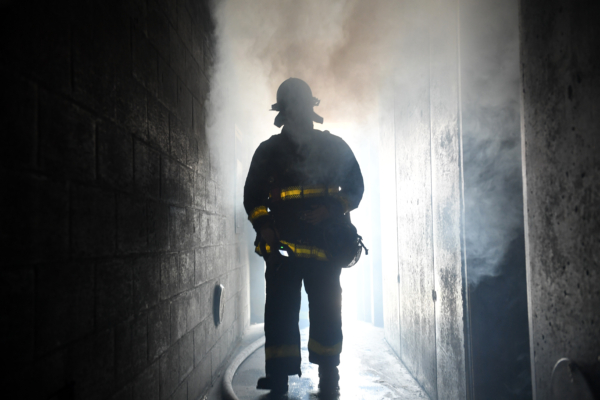
A fire broke out at a shipyard in Staten Island, New York City on Friday afternoon, May 22, escalating to a second-alarm fire with two subsequent explosions. Fire officials stated that the incident resulted in 35 injuries, with the majority being firefighters and other first responders, while one civilian died on-site.
Firefighters and emergency personnel were conducting search and rescue operations inside, above, and around the building to locate trapped workers when they were hit by a second explosion, causing multiple injuries. Around 70 fire and emergency medical units were swiftly dispatched to the scene for disaster relief efforts. The fire has been preliminarily brought under control.
The incident took place at a metal structure building behind a dock at 3075 Richmond Terrace on Staten Island.
The Fire Department received a call around 3:27 pm reporting two workers trapped in a confined space in the building’s basement. The first group of firefighters arrived on-site within 6 minutes, finding thick smoke hindering visibility inside the building. As the fire spread, the incident commander declared a second alarm at 4:08 pm to dispatch additional manpower and resources.
A large explosion occurred at the scene at 4:19 pm. New York City Mayor Zohran Mamdani stated at a press conference later in the evening, “This was a complex and rapidly evolving emergency situation.”
He noted that there were over 200 first responders and approximately 70 fire and emergency medical units at the scene conducting a “full mobilization” rescue operation.
Fire officials reported at a press briefing that 36 casualties were treated at the scene, including 34 members of the New York City Fire Department and 2 civilians. Tragically, one civilian has been confirmed deceased on-site.
Among the most severely injured were a Fire Marshal. Medical experts explained that the injuries sustained by these two critically injured Fire Department members were not from flying debris but from the “explosive energy” within the confined space.
Dr. David Prezant, Chief Medical Officer of the New York City Fire Department, explained at the press briefing, “In a confined space, this energy can impact the body and potentially penetrate organs.”
“Fortunately, both firefighters did not sustain penetrating injuries, and their hearts, lungs, or abdominal areas were not damaged by the explosion,” he said.
The Fire Marshal suffered a minor skull fracture on the right temporal area and a minor cerebral hemorrhage on the left side due to the impact of the explosive energy wave. He is currently receiving tube treatment in critical but stable condition.
Doctors stated that they will closely monitor him for the next 24 hours to check for brain swelling; as long as there is no swelling, he should recover well. The other firefighter was in critical condition upon arrival at the hospital but showed significant improvement by Friday night and remains in the hospital for observation.
The location of the explosion holds a deep historical significance. The shipyard is situated in the traditional waterfront industrial area on the north shore of Staten Island, now operated by May Ship Repair; its site was formerly part of the Staten Island shipyard of Bethlehem Steel Company. During World War II, this shipyard constructed vessels for the U.S. Navy and was a part of the wartime shipbuilding and repair industry in the New York Harbor.
Chief of the New York City Fire Department, John Esposito, confirmed that the fire is now under control, and all searches have been completed with no reported missing persons. He emphasized, “Confined spaces are extremely dangerous working environments for any rescue personnel.”
The New York City Department of Buildings, Environmental Protection Agency, and Hazardous Materials Response Team have been notified. Once the fire is fully extinguished, Fire Department investigators will conduct a comprehensive investigation into the cause of the fire and explosions.