
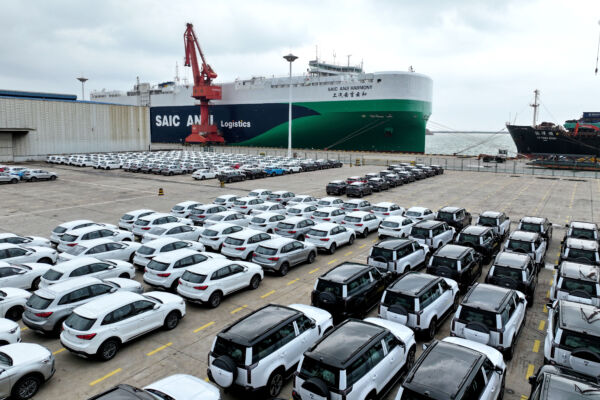
In recent times, the Chinese fuel vehicle market has once again started promotions and price reductions, with the Land Rover Range Rover Evoque L seeing a price drop of 49%. Industry experts attribute this trend to factors such as the impact of electric vehicles, high inventory levels of fuel vehicles, among others. This news became a hot topic on May 26th.
According to various Chinese media outlets including the “Daily Economic News”, BMW in China recently introduced a promotional policy where buyers can purchase the 2026 model X3 long-wheelbase version for an upfront payment of 49,900 yuan (RMB equivalent) and monthly installments of 1599 yuan. This new financing and leasing offer from BMW has garnered attention from many prospective buyers. Numerous netizens below the news expressed their interest in fuel vehicles again due to the attractive pricing.
From the beginning of the year until now, the promotional efforts for fuel vehicles have remained strong, covering luxury car brands such as Mercedes-Benz, BMW, Audi, Jaguar Land Rover, joint venture brands like Volkswagen, Nissan, Honda, and domestic brands like Changan and Geely. Many fuel vehicles have recorded their highest promotional discounts in recent years. For instance, the official maximum discount for Mercedes-Benz’s C-Class, GLC, and other top-selling models this year is up to 69,000 yuan; the base price of the old version of Audi A6L C8 has dropped from around 450,000 yuan to about 260,000 yuan. Among the second-tier luxury brands, Jaguar XEL was originally priced at 349,600 yuan but is now being sold at only 174,800 yuan, a 50% discount; the Land Rover Range Rover Evoque L has been discounted by 226,000 yuan, a reduction of 49%.
In terms of joint venture brands, the 2026 model Volkswagen Golf starts from 145,900 yuan, while the actual landing price of the Mazda B9 ranges from 150,000 to 170,000 yuan; the base price of the Dongfeng Nissan Xuan Yi Classic version starts at 79,900 yuan, but the lowest invoice price for owners can go down to just over 50,000 yuan; the price of the Honda Civic has dropped by over 24%, falling below 100,000 yuan.
Chinese domestic brands also offer significant discounts. Changan Yidong has a discount of around 65,000 yuan after subsidies; Geely Bin Yue has a minimum landing price of about 49,400 yuan; Chery offers a comprehensive subsidy of up to 40,000 yuan.
The “Daily Economic News” stated on May 25th that the impact of electric vehicles is the core reason for the price reduction of fuel vehicles. Currently, the penetration rate of electric vehicles in China has surpassed 50%, with over half of car buyers preferring pure electric or hybrid models. Faced with competition from electric vehicles, fuel vehicles must reduce prices; otherwise, they will face the risk of stagnant sales, halting production, and ultimately being phased out of the market.
According to the data published by the National Bureau of Statistics of the People’s Republic of China in April, in that month, automobile consumption decreased by 15.3% compared to the previous year, making it one of the most severely affected sectors.
In April, the sales volume of fuel vehicles was only 530,000 units, with only one fuel vehicle remaining in the top ten in terms of sales volume.
Furthermore, the overcapacity of fuel vehicle production has led to a backlog of inventory, forcing automakers to clear stock. China’s annual automobile production capacity has exceeded 50 million units, while the actual market consumption capacity is limited, resulting in a long-standing overcapacity situation. This has led to a large number of fuel vehicles accumulating in inventory, causing dealership inventory ratios to exceed critical levels.
The data from the China Automobile Dealers Association show that in April, the inventory warning index of Chinese automobile dealers was 62.1%, indicating an inventory warning above the boom-or-bust line. The inventory ratios of dealerships are at 1.89 for joint venture brands, 2.24 for high-end luxury and imported brands, and 1.99 for independent brands, all far exceeding the alert level of 1.5.
Moreover, the tightening environmental policies by the Chinese authorities, with continuous upgrading of emission standards, have compelled fuel vehicle manufacturers to invest heavily in optimizing engines, emission control systems, and exhaust hardware, leading to a passive increase in manufacturing costs. Consequently, they are forced to reduce prices to maintain their market presence.
Reportedly, according to industry experts quoted by the “DaXiang News” on May 25th, this year’s price reductions on fuel vehicles differ from previous years, where promotions were mainly dealer-driven; this year, most manufacturers have taken the lead, aiming to clear inventory of old models before the launch of new models. As the fuel vehicle market continues to shrink, price reductions may only serve as a temporary measure to delay decline.
Starting from the beginning of the year, BMW of China initiated the wave of price reductions, with BMW China lowering prices across over 30 vehicle models in China, including sedans, SUVs, electric vehicles, among others, with the largest reduction reaching 301,000 yuan. From the beginning of the year, BMW has adjusted the prices of 31 models, with over 80% of them experiencing reductions of over 10% and many models having reductions exceeding 20%. Subsequently, in March, FAW-Volkswagen’s Audi A6 saw a price drop of 91,000 yuan, a reduction of 29%. Toyota Camry and Passat also saw general price reductions of 40,000 to 50,000 yuan.