
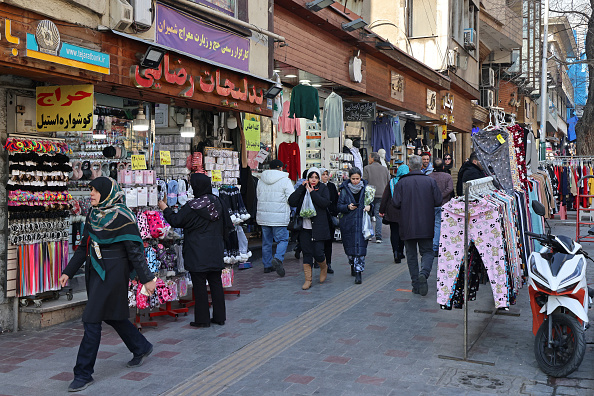
According to official statistics from Iran, the economic losses caused by the war have reached 270 billion US dollars within 40 days. Civilian media reports stated that with the United States blocking Iranian ports leading to intensified trade disruptions, it is expected that the economic situation will become even more challenging in the future.
Iranian government spokesperson Fatemeh Mohajerani stated on Tuesday, April 14th, that the estimated losses due to US military actions are around 270 billion US dollars.
The New York Times cited three Iranian officials and two economists reporting that the initial estimates are consistent with this figure, suggesting losses around 300 billion US dollars or possibly higher.
Preliminary estimates from the Foundation for Defense of Democracies also suggest that Iran’s economic losses are between 150 billion to 300 billion US dollars.
Iran has a population of about 92 million. Based on the lower estimate of war losses of 150 billion US dollars, this equates to an average per capita loss of about 1600 US dollars; whereas the higher estimate approaches an average per capita loss of 3250 US dollars.
Looking at different sectors, the petrochemical industry has suffered the most severe losses. With Iran’s petrochemical industry having an annual sales volume of 29.1 billion US dollars, approximately 85% of export capacity has been affected since major hubs like Mahshahr and Bandar Pars were targeted, resulting in estimated losses ranging between 30 billion to 50 billion US dollars.
Additionally, the energy infrastructure has also been severely impacted. Refineries, oil storage facilities, and natural gas installations have been attacked, weakening the industry. The sector’s export revenue in 2024 was around 78 billion US dollars, with estimated losses ranging between 15 billion to 25 billion US dollars.
Steel production, being a cornerstone for industrial output and reconstruction, has significantly decreased with about 70% of production capacity affected, leading to estimated losses between 5 billion to 10 billion US dollars.
Apart from material losses, the war has also caused a sharp contraction in output. Experts estimate that Iran’s GDP has dropped by over 10%, equivalent to economic activities losses of 34 billion to 44 billion US dollars, further exacerbating the already dire economic situation prior to the conflict.
To prevent the crackdown on civilians and leakage of military information, Iranian authorities have implemented a nationwide internet shutdown since February 28th, resulting in additional losses for the service and financial industries.
The direct losses from the internet blackout are estimated to reach 37 million to 42 million US dollars per day. After five weeks of continuous shutdown, cumulative losses reach between 1.5 billion to 2.5 billion US dollars.
Afshin Kolahi, a member of the Iranian Chamber of Commerce, stated on Monday that due to the interruption in online business, indirect losses may result in a daily loss of 70 million to 80 million US dollars.
During the shutdown, online sales dropped by about 80%, and the Tehran Stock Exchange fell by 450,000 points within four days.
Economic analyst Masoumeh Taherkhani expressed concerns that the internet shutdown has simultaneously affected various aspects of the economy.
Taherkhani told the Iranian International News Agency, “The internet blackout has damaged the Iranian economy on three levels: first, the digital core, which employs four to five million people. Then the platform collapses, ultimately affecting the entire economy, with this impact spreading to production and service sectors.”
Taherkhani worries that widespread unemployment may follow.” When the economy comes to a complete standstill, the result is job losses, and such situations are difficult to reverse,” she said.
With over 90% of its trade relying on the Persian Gulf, Iran is highly susceptible to the impact of ongoing trade disruptions. The US blockade of Iranian maritime trade routes is expected to exacerbate losses.
Over the past five weeks, trade disruptions related to the Strait of Hormuz have heightened economic pressures on Iran, with estimated losses ranging between 5 billion to 15 billion US dollars. These restrictive measures have affected imports of essential goods, weakened non-oil exports, and disrupted the entire economic supply chain.
Sanctions expert and former US Treasury official Miad Maleki estimates that cutting off maritime trade could lead to approximately 435 million US dollars in economic losses per day, equivalent to approximately 13 billion US dollars per month.
The cessation of Iran’s daily exports of around 1.5 million barrels of oil (average daily revenue of about 1.39 billion US dollars) may nearly come to a complete halt, causing the country to lose a significant source of foreign currency.
According to the Iranian International News Agency, insiders revealed that the Central Bank of Iran has warned President Masoud Pezeshkian that post-war economic reconstruction may require more than ten years.
Insiders disclosed that in a recent stark evaluation report submitted to the president, senior Iranian economic officials stated that the 40-day ongoing war with the US, combined with Iran’s already fragile economic situation, may take up to 12 years to repair.
So far, as the current Iranian regime refuses to abandon its uranium enrichment program and never acquire nuclear weapons, the initial negotiations last week between the US and Iran broke down, indicating that the war may continue.
If this fund were not used for warfare, but for the construction of a large-scale combined cycle power plant with an installed capacity of 1000 to 1500 megawatts, approximately 300 to 500 such plants could be built, enough to eliminate domestic power shortages in Iran and significantly enhance export capacity.
If used for housing construction, it could create around 6 to 10 million housing units, addressing the housing shortage issues in major urban areas.
If allocated for building railways, up to 15,000 kilometers of railway could be constructed, connecting all major cities nationwide.
If invested in hospital construction, potentially up to 1,500 hospitals could be built, expanding the coverage of medical services across the country.
If this fund were distributed to the Iranian citizens, it would approximately cover 12 to 20 months of living expenses for an average household. Families could use it for housing expenses, including down payments or completing housing purchases in smaller cities.
Since the beginning of the war, rallies supporting US military actions against Iran have been seen in the streets of Sweden, Switzerland, France, and Finland, where Iranian expatriates have been calling for regime change in Iran.
Mehdi, an engineer from the northern Iranian city of Tabriz now in exile, told Agence France-Presse, “We never thought our country would plunge into war. It is the cruel rule of the clerics that has brought us to this situation.”
“We want freedom and democracy, but it’s not an easy road,” Mehdi said. “The days ahead will be very challenging, but the Iranian people will overcome. We will get through this.”