
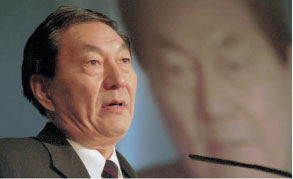
Former Chinese Premier Zhu Rongji passed away in Beijing at the age of 98 today, August 12th, sparking discussions on his achievements and controversies during his time in office. Speculations had arisen regarding the delicate relationship between Zhu Rongji and current Chinese leader Xi Jinping in his later years.
Official Chinese media reported Zhu Rongji’s passing in Beijing today, August 12th, describing him as an “outstanding leader” of the party and the nation. While some refer to Zhu Rongji as the “Iron-faced Premier” or the “Economic Czar,” there are differing opinions online, with some pointing out controversies surrounding him.
Many have taken to social media platforms to express their thoughts on the news:
– Political commentator Luo Ying commented, “The vacation in Beidaihe was disrupted, Zhu Rongji passed away, and Jiang Zemin celebrates his hundredth birthday. A busy August!”
– Netizen Luo Yufeng remarked, “Zhu Rongji has passed away, and these Chinese officials have lived too long. The average lifespan of ordinary people is around 65 years. These officials have extended their lives by organ transplants for 30 years!”
– Another user wrote, “With the 21st National Congress of the CCP approaching, any elders hindering Xi Jinping’s reappointment will conveniently pass away. Following Zhu Rongji, it will be Hu Jintao, Wen Jiabao, Zeng Qinghong, Wang Qishan…”
Critiques of Zhu Rongji’s legacy vary among those outside the official discourse. During his tenure, he spearheaded the “state-owned enterprise reforms,” triggering massive waves of layoffs. This reform has been criticized for not being thorough enough.
Reflecting on Zhu Rongji’s actions during the late 1990s era of state-owned enterprise reform, a user on a cyber platform expressed, “Zhu Rongji’s encounters with laid-off workers are the most painful memories of the 1990s state-owned enterprise reform. For a long time, I thought those stories were mere internet memes. Only later did I realize that regions like the old industrial area of Tie Xi in Shenyang indeed witnessed a similar desolate reality: husbands escorting their wives to work in nightclubs to make ends meet. It’s not just a meme; it was a period of transition where the common people faced helplessness and dignity predicaments – from being masters to being sacrifices. The state-owned enterprise reform facilitated China’s economic structural transformation but came at a significant cost to many. While some welcomed new opportunities, others never fully recovered.”
However, the same user also noted Zhu Rongji’s hands-on approach during the 1998 Yangtze River floods. He criticized the poor quality of the flood defenses, coining the term “tofu-dreg projects” that resonated with the public. This complexity in Zhu Rongji’s character – driving massive reforms and causing waves of layoffs, yet publicly addressing issues during crises – illustrates the nuances of historical figures where achievements and shortcomings coexist, ultimately subject to historical judgment.
Quoting Zhu Rongji’s famous saying, “I have prepared a hundred coffins – ninety-nine for corrupt officials and one for myself.”
In response, another user commented, “It is regrettable that he prepared a hundred coffins but dared not leave a single one for this cannibalistic system. He was merely a system maintainer who exhausted the strength of the people to ‘protect the party,’ rather than a revolutionary figure capable of advancing history.”
After Xi Jinping assumed power, former leaders such as Hu Jintao, Wen Jiabao, and Zhu Rongji made numerous public appearances in support of Xi. However, following the 19th National Congress of the CCP, Xi’s regime took a full shift to the left, leading to dissatisfaction among the moderate officials and intellectuals who had previously supported Xi.
In March 2022, overseas Chinese media reported that on March 10th, Zhu Rongji submitted a memorandum to the central government containing nine sharp criticisms directly aimed at Xi Jinping. The ninth point stated, “Advocate speaking the truth. I, Zhu Rongji, am not afraid of audits, detention, or affecting my descendants. Speak your mind.”
On March 15th of the same year, the Wall Street Journal published an article titled “China’s Economic Slowdown Exposes Cracks in Xi Jinping’s Power,” citing insider sources from the CCP who revealed that some retired CCP elders with remaining political influence openly opposed Xi Jinping’s desire to break the established leadership succession system — including Zhu Rongji.
Zhu Rongji is widely seen to have had a mentor-protege relationship with Wang Qishan. In recent years, Wang Qishan, who previously served in the Central Commission for Discipline Inspection and the financial sector, faced investigations, with rumors of him being under soft detention. Xi Jinping’s ongoing cleansing of the financial sector, seen as Zhu and Wang’s domain of interest, continues.