
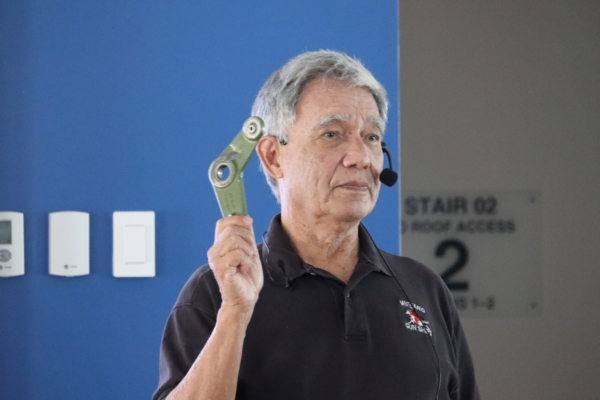
Frans VandenBroek, a Vietnam War veteran, was invited to speak at the “Hall of Heroes” exhibition hall in Costa Mesa, Southern California on June 27. The social environment has made him reluctant to recall the days filled with gunpowder smoke, and he has not been in contact with his former comrades.
VandenBroek said, “I am proud of my service and my country, but I have found that society does not honor us. Like many Vietnam War veterans, we have encountered indifference, suspicion, and even hostility.” This sense of disappointment or resentment has led him to close off memories of the Vietnam battlefield, helicopters, units, comrades, and everything related to it. On Memorial Day, “I prefer to forget everything on those days that should be remembered.”
As the years passed, the memories he tried to erase did not disappear. 35 years later, during a business trip to Washington D.C., VandenBroek felt a strong impulse while staying alone in a hotel – the name of pilot Paul Hill suddenly rushed into his mind. He then visited the “Vietnam Veterans Memorial,” where Hill’s name was etched on the wall.
VandenBroek began searching, wanting to find news about his comrades and their families. He learned that Hill was buried in Circleville, Ohio, his hometown. In May 2011, he visited Hill’s memorial grave, met his niece and wife, and reminisced about the past with them.
In 2012, VandenBroek found pilot Charles Allen’s grave in Vermont and placed an American flag beside it. He said, “He was a brave and dedicated pilot. I wish I had known him better. He had no direct relatives, and I only met two distant relatives.”
After all these years, VandenBroek most wanted to meet Scott Alwin, the helicopter pilot on his last mission, but he had passed away. On June 26, 1976, Captain Alwin was driving from Fort Benning in Georgia to the Army War College in the outskirts of Washington D.C. when he died in a car accident at the age of 31.
Alwin was the most decorated helicopter pilot in the Vietnam War, completing five tours and rising to the rank of captain. He received the Silver Star, Distinguished Flying Cross with four Oak Leaf Clusters, Bronze Star with Valor, Purple Heart, and a record-setting 136 Air Medals. In Vietnam, helicopter pilots could earn an Air Medal for every 25 hours of combat mission.
With the ongoing aerial combat, the failure of the helicopter’s tail rotor function increased. Alwin, with the assistance of a safety officer, developed a low-altitude autorotation landing procedure, saving many lives and valuable aircraft. He was a second-generation aviator with a father who was a bomber instructor in the Oklahoma Army Aviation Unit. The documentary “Honor in the Air” tells the story of Captain Alwin.
“The ‘reunion’ with these two pilots made me contemplate the meaning of their service, the legacy they left behind, and what we will leave behind in the world as we age. These are tough questions to answer,” VandenBroek said. Vietnam veterans, unlike those who returned from foreign battlefields before and after the war, do not receive the same level of respect. They are considered “black sheep,” labeled with various malicious tags. To cope with this situation, many of us have learned to hide our service experiences and not mention them to others.
Some individuals have suffered irreparable trauma to their psyche in this environment. Jim Dissell, who joined the infantry at the age of 17 and later moved to the helicopter unit, exhibited phenomenal skills as a machine gunner, holding the record for the most enemy kills in his unit. However, towards the end of his service, Dissell began experiencing hallucinations and later endured nightmares, leading a near reclusive life.
Another pilot who carried out missions with them was 24-year-old Ed Strazzini. “He had a Canon camera with excellent performance, capturing great photos,” VandenBroek said. Strazzini returned home and sought success in his career but faced setbacks. After 24 years, he retired as a colonel from the army, devoid of ambition, and flew for another 20 years in civilian life.
Strazzini found Dissell, and they reunited 40 years later. Being in the company of those who shared the same experiences can help people lower their guard, VandenBroek said. “But we were concerned that past events might affect Dissell’s current life, so we hesitated to invite him to reunions.”
VandenBroek expressed, “At that time, we were in peril, facing the threat of communism. We fought for America, for righteous, honorable, and free ideals. We risked our lives to save the lives of comrades wholeheartedly, fighting for each other. Their sacrifices led to our survival, a legacy reflected in the over 58,000 heroes remembered on the Washington D.C. memorial wall.”
VandenBroek showcased two helicopter components to the audience. One was a link mechanism controlling the pitch angle of the helicopter’s tail rotor – if it broke, the tail rotor would droop, causing the helicopter to crash due to imbalance. The other was a trophy made from a Jesus’ nut, which is a nut that secures the rotor system to the axle providing lift to the helicopter. He explained that the nut is incredibly strong and can even support the weight of lifting and moving an entire helicopter when necessary.
The “nut trophy” was a gift from a pilot made from discarded objects, which VandenBroek cherishes. He has always wanted to do something for his comrades but has been hesitant to return to Vietnam. However, “Some of my neighbors are Vietnamese. They are hardworking, generous, and hospitable,” VandenBroek said. One family escaped by boat, and the husband, a former lawyer, became a skilled assembly worker upon arriving in the U.S. They bought a house and paid off their mortgage, now enjoying a comfortable life traveling the world frequently.