
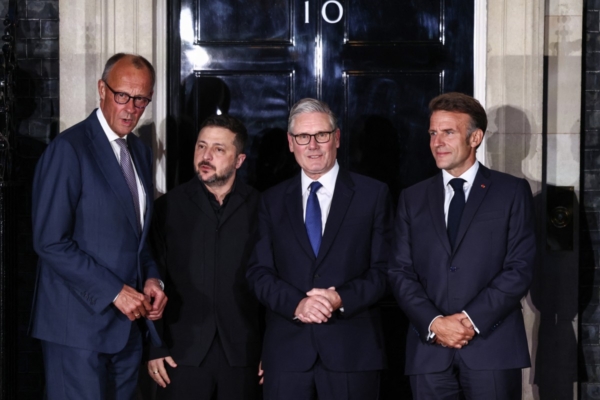
Leaders from the United Kingdom, France, Germany, and Ukraine held a meeting in London on Monday (June 8th) to discuss the situation in Ukraine. They unanimously supported Ukrainian President Zelensky’s proposal to meet directly with Russian President Putin to promote ceasefire negotiations. They emphasized the need for Europe and the United States to jointly engage in promoting a ceasefire and peace talks between Russia and Ukraine.
The meeting, hosted by UK Prime Minister Keir Starmer at 10 Downing Street, also included French President Macron, German Chancellor Merz, and Ukrainian President Zelensky. A joint statement released after the meeting expressed the four countries’ support for ending the war through diplomatic means and praised Zelensky’s recent efforts to engage in direct dialogue with Putin.
However, the Kremlin responded to the proposal with skepticism. Putin recently stated that he currently sees no need to meet with Zelensky and questioned Ukraine’s sincerity in the proposal, emphasizing the importance of focusing on long-term arrangements for any peace agreement, rather than just a temporary ceasefire.
During the London meeting, the leaders of the four countries outlined the basic conditions for achieving “fair and lasting peace,” with an immediate and comprehensive ceasefire being the top priority.
The statement highlighted that future negotiations should start from the current frontlines, provide Ukraine with legally binding security guarantees—including the deployment of multinational forces for security—and proposed that Western frozen assets of Russia should not be unfrozen until compensation is made for the losses caused by the war. Furthermore, any peace agreement should take into account the security interests of Ukraine and Europe as a whole.
Zelensky, in a statement on the social media platform X, mentioned that the focus of the discussions with European leaders was on reviving diplomatic efforts and the role of Europe in the future negotiation process. He stressed that Ukraine always insists on having a strong and influential position at the negotiation table in Europe.
Starmer reiterated the UK’s continuous support for Ukraine when necessary. He stated, “Our support for Ukraine is rock solid. Ukraine’s security is Europe’s security.”
Another significant issue discussed at the meeting was how to address Russia’s recent intensified missile and drone attacks.
According to a statement from the UK Prime Minister’s office, the leaders of the four countries condemned the recent large-scale missile and drone attacks by the Russian military on Ukrainian cities, especially the repeated use of the “Oreshnik” hypersonic intermediate-range ballistic missile, which resulted in significant civilian casualties. They also criticized Russian drones for repeatedly entering NATO airspace, including an incident last month in Romania.
The leaders unanimously agreed on the urgent need to enhance the production capacity for intercepting missiles, accelerate joint research and development on anti-ballistic missile and long-range strike capabilities to counter Russia’s increasing missile threats. However, the statement did not disclose specific funding amounts or implementation details.
Zelensky revealed that he had raised the need to increase the supply of air defense missiles with Starmer. Recently, the Russian military conducted one of the largest airstrikes on cities such as Kyiv since the full-scale invasion in 2022, and Ukraine is facing increasing pressure on defense due to a shortage of air defense systems and intercept ammunition.
The current situation on the Russia-Ukraine frontline remains at a standstill. With the extensive use of drones in combat, both sides struggle to make significant breakthroughs on the ground, leading Russia and Ukraine to continue intensifying their long-range strikes on each other’s strategic targets.
Recently, Kyiv, the capital of Ukraine, and other regions experienced some of the most intense airstrikes since the full-scale Russia-Ukraine war erupted in 2022, causing damage to multiple infrastructures and an increase in civilian casualties. At the same time, the Ukrainian military has been escalating its long-range drone strikes on targets within Russia, with St. Petersburg, Russia’s second-largest city, becoming one of the recent targets.
Furthermore, the Ukrainian military reported that Russian drones attacked a fuel-deprived storage facility in Kyiv Oblast recently, resulting in a fire. The facility is located approximately 15 kilometers from the Chernobyl Nuclear Power Plant. The fire has been extinguished, and monitoring results indicate that the local radiation levels remain within a safe range.
The Director-General of the International Atomic Energy Agency (IAEA), Rafael Grossi, expressed serious concern about the incident and announced plans to dispatch a team to investigate the situation.
(This article references relevant reports from Reuters and the Associated Press)