
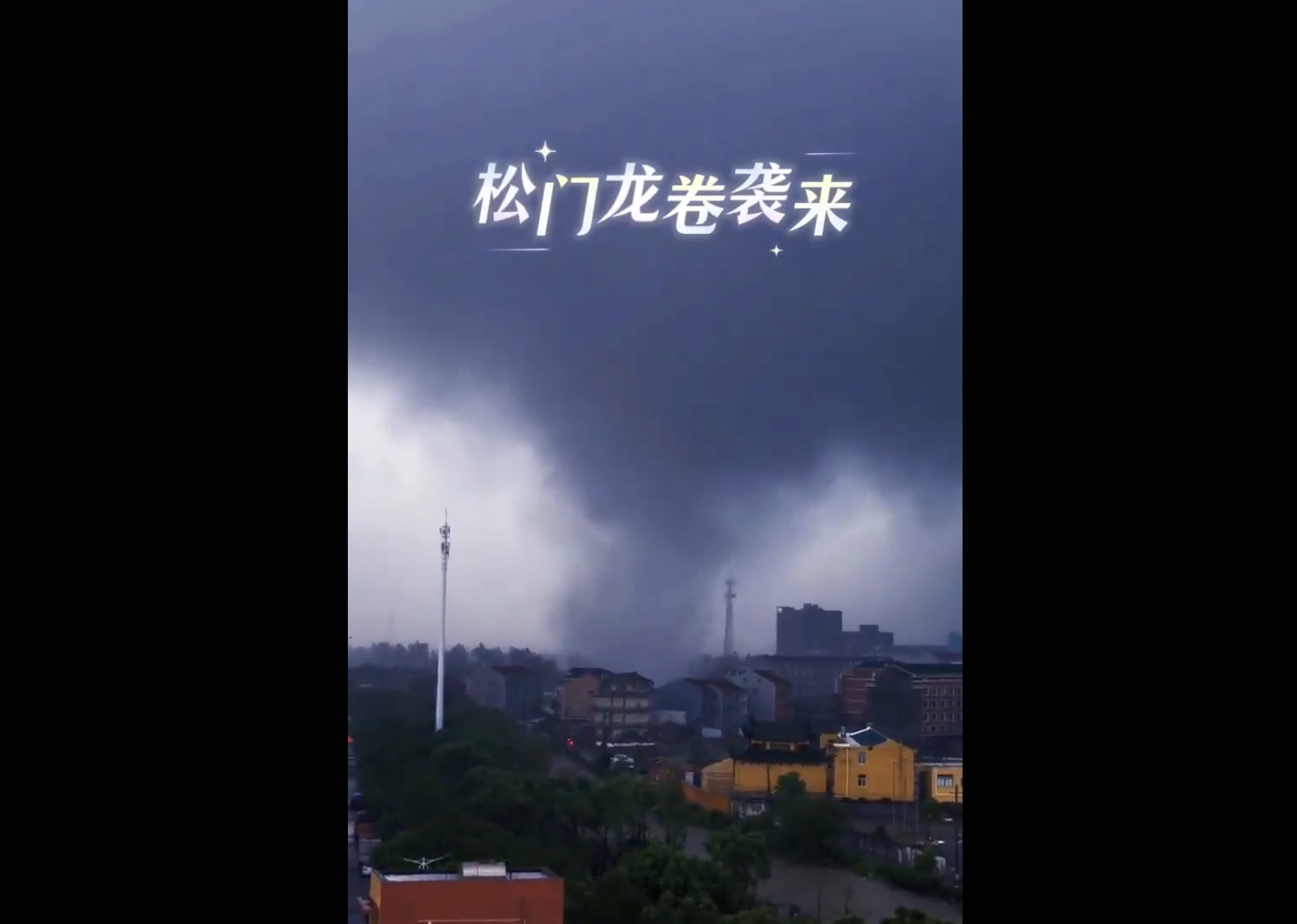
Due to the impact of Typhoon “Baijiadun,” many coastal areas in China have been severely affected. In Wenzhou City, Zhejiang Province, Songmen encountered a tornado, and seawater surged into Shitang.
On the afternoon of August 10, a tornado suddenly struck Songmen at the south gate of Wenzhou. Some netizens said, “This typhoon came with great force, and it’s the first time I’ve felt so scared.”
One netizen said: “Typhoon Baijiadun caused the sea to surge into Shitang in my hometown Wenzhou, with tornadoes in Songmen, turning the whole city into a sea.”
Chinese media reported that from August 7 to 10, due to the circulation of Typhoon No. 13, “Baijiadun,” Wenzhou, Zhejiang Province experienced severe storm surges, with seawater surging into coastal areas and dangerous situations with dike waves in Shitang Town. On the afternoon of August 10, a tornado hit Songmen Town, causing damage to multiple houses, vehicles being smashed, and trees along the roads breaking.
Typhoon “Baijiadun” has caused severe damages in many parts of mainland China.
After the typhoon passed, videos from August 10 showed that a high-rise residential building in Zhejiang was damaged during the typhoon. Many windows, glass, and exterior components were blown away by strong winds. Some window frames on several floors were visibly deformed and fell off.
After Typhoon “Baijiadun” passed, many buildings in various parts of Zhejiang suffered damages. Videos from the scene showed a large number of roof tiles and building components being blown off by strong winds, streets covered in broken tiles, and several parked cars being hit by falling debris. Some building roofs were blown open over large areas, with beams exposed, and large metal structures collapsed by the roadside.
Shanghai experienced severe flooding, with Suzhou River, an inner river in the city, rapidly rising, nearing its peak level, while the level of Huangpu River was also high. To ease the pressure of rising river waters, Shanghai used water pumps for the first time to artificially drain water from Suzhou River into Huangpu River.
On August 10, Shanghai continued to experience heavy rainfall, leading to severe waterlogging on many streets, submerged vehicles, and flooded residential areas. Heavy rain began in Xujiahui Station on August 9, and by 4:00 pm on August 10, it had been raining continuously for 40 hours, reaching the highest level of recorded rainfall in history.
By the evening of August 9, Typhoon “Baijiadun” made landfall in Zhejiang, bringing heavy rain to many cities, flooding the area with massive water releases from numerous reservoirs, resulting in extensive damage to houses, vehicles, and crops.
In Huangnikan River segment, Ningbo Fenghua, Zhejiang, the river’s flow surged, overflowing the weir dam, submerging much of the riverbank fence.
Mr. Chen, a resident of Wenzhou, Taizhou, Zhejiang, said to NTD: “The rain was too heavy, water came down from the mountain, the river couldn’t drain it fast enough, we were inundated for a whole night, our garage was flooded, the water level rose above the ankles, quite deep. Cars on the road were submerged, causing significant economic losses to the entire Taizhou area.”
Public records show that Taizhou City has a total of 17 large and medium-sized reservoirs, along with numerous small reservoirs and hillside ponds. Locals revealed that in Tiantai County, both Lishimen Reservoir and Longxi Reservoir were releasing water, as well as Zhuxi Reservoir in Xianju County, leading to flooding of many houses and vehicles downstream.
In Yongjia County, Wenzhou, the water levels of rivers such as Nanxi River rose rapidly, with small reservoirs located in the upper mountainous areas contributing to the surge.
Mr. Lin, a resident of Dongcheng Street, Yongjia County, Wenzhou, said: “The entire Yongjia County is flooded, most of the surrounding villages are submerged, the river is surging back, when it rains heavily, the water from the mountains flows down, causing flooding of over 1 meter at the village entrance, small cars can’t leave, many trees are knocked down, all the banana trees in my house were snapped.”
Many reservoirs are located in Ruian City, with severe damage reported in towns such as Huling and Taoshan, where locals suspect there was no prior warning of the reservoirs releasing water, leading to rapid floods in the middle of the night.
Ms. Yang, a resident of Huling Town, Ruian City, Wenzhou, said to NTD: “The water has risen to about 2 meters on the first floor, if I go down, it’s probably reaching my head, I can’t sleep, who can save me? No one, I’m about to starve to death.”
As Typhoon “Baijiadun” approached, reports emerged that a 9-year-old boy in Wenzhou went missing after being swept into the sea. However, the official authorities did not report any casualties.
On August 10, as the typhoon hit the eastern region of China, some residents’ homes were flooded. Netizens claimed that two people died from electric shocks in a residential community in Shanghai. Netizens strongly recommended that in case of home flooding, the household power should be immediately cut off to prevent accidents caused by leaking sockets at low levels.
According to footage captured by netizens, a man’s body was washed away by floodwaters in Chu River in Tiantai County, Taizhou, Zhejiang.
Due to the Communist Party’s tendency to conceal information, the actual extent of casualties is unknown.
Recently, natural disasters and man-made calamities have struck various regions of China, leading to an escalation of official stability maintenance measures. At the onset of Typhoon “Baijiadun,” the Communist Party authorities once again employed methods to censor so-called “rumors” online.
The Ministry of Public Security’s Internet Security Agency previously twice released typical cases of so-called network rumors related to floods and disasters on August 10. These cases involved Guangdong, Anhui, Gansu, and other regions.
The authorities claimed that some internet users, seeking attention and followers, were still maliciously fabricating false content related to floods and disasters, some even using AI tools to tamper with safety notices issued by local governments, leading to penalties for the individuals involved. Overseas, netizens on X platform criticized, stating: “Communist Party official media are the biggest rumormongers, monopolizing information and fabricating fake data to deceive the public.”
An insider from within the Communist system previously informed Epoch Times that there had been continuous criticisms of local governments amid the severe flood prevention situations nationwide, which the top Communist Party officials were most unwilling for the public to see. While various regions were deploying flood prevention measures, they were also increasing stability maintenance efforts.
The unnamed insider from within the system stated, “What the authorities fear most now is for ordinary people to film scenes and post them online. Where there’s stagnant water without anyone managing it, delays in rescue operations, or local officials not showing up, once these videos are shared, soon someone will demand accountability. Not only are videos being deleted, but also investigations into who filmed them, who shared them, and who said what in group chats. Many people are using VPNs to access information outside [of China] and authorities are also on high alert.”
It’s worth noting that on the same day that “Baijiadun” made landfall in eastern China, Typhoon No. 16, “Peilou” (tropical storm level; English name: PEILOU), generated in the northwestern Pacific Ocean on August 9, moving in an eastward direction at a speed of 25 to 30 kilometers per hour, slowly intensifying.
Previously, Typhoon No. 15, “Canhong,” was generated on the ocean surface of the northwestern Pacific Ocean on August 5.
The China Meteorological Administration introduced that at present, though the intensity of Typhoon “Canhong” on the east side of “Baijiadun” is not very strong, it is only a tropical storm level, but its circulation is vast, and the northeasterly winds on its north side are significant, transporting warm and moist water vapor from the northwestern Pacific Ocean to mainland China.