
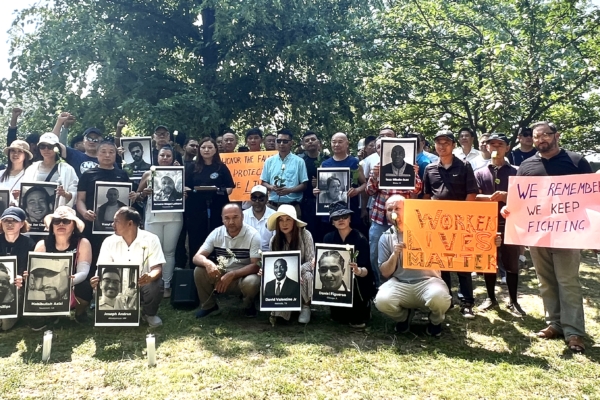
On July 1st, a memorial service for ride-hailing drivers and delivery workers was held at Flushing Meadows-Corona Park in New York, organized by the Justice for App-Based Workers Alliance (JFAW). Numerous ride-hailing and delivery drivers’ organizations participated in the event to mourn the drivers who lost their lives in recent years due to violence, shootings, accidents, and overwork.
The gathering also called on the government and platform companies like Uber, Lyft, and DoorDash to address the safety issues faced by workers in the gig economy and push for reforms. Dinara Zhanpeissova, a member of JFAW and founder of NOMAD Drivers, who served as the event’s host, emphasized that each name they read aloud represented more than just a statistic but a father, a mother, a child, a partner, or a friend. She stressed that every worker deserves to return home safely and highlighted that these tragedies are not isolated incidents but a result of the system’s failure to adequately protect platform workers.
Over the past decade, ride-hailing and delivery drivers have played a crucial role in sustaining city operations by providing rides to passengers, delivering meals, and supporting the daily lives of communities. Despite their significant contributions, many have tragically lost their lives due to violence, shootings, traffic accidents, and overwork. The platform companies, with multi-billion-dollar valuations, have long neglected to provide sufficient safety measures and failed to take appropriate responsibility. During the event, the organizers read out the names of several ride-hailing and delivery drivers who lost their lives while working in 2026.
Zhang Huilai, a representative from the Independent Drivers Guild, stated that ride-hailing drivers are the “capillaries” of urban transportation, transporting thousands of passengers daily and being an indispensable force in keeping the city moving. However, this group is often overlooked in the glamorous urban life. The memorial was not just to remember the deceased but to ensure that those still alive can return home safely in the future.
JFAW put forward six reform demands, including establishing a panic button and real-time GPS tracking system, enhancing measures to prevent passenger assaults and harassment, combating driver fatigue, providing death insurance and compensation for families, implementing passenger identity verification, and adopting a zero-tolerance policy towards violent incidents to comprehensively enhance the safety of drivers and delivery workers.
Regarding preventing driver fatigue, JFAW pointed out that many drivers work long hours to maintain their income, leading to fatigue and inadvertently increasing the risk of accidents. They urged platforms to implement fair labor policies to prevent excessive working hours and oversaturation of orders.
JFAW recommended that platforms should provide adequate insurance compensation and bereavement benefits to families if a driver tragically dies while on duty, instead of solely burdening the families with responsibility.