
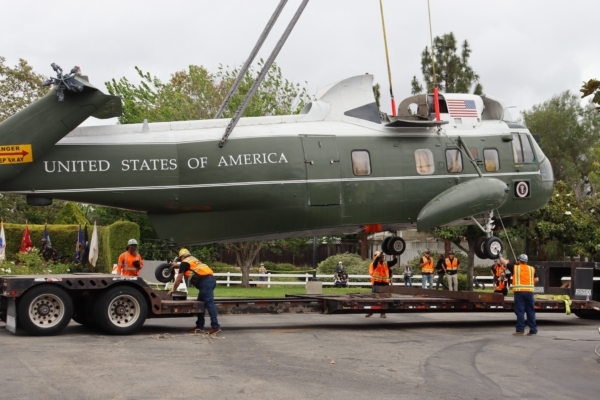
On June 29, the Nixon Library held a grand ceremony for the relocation of the presidential helicopter “Sea King.” Over 200 residents gathered to witness the historic moment of the helicopter being lifted by a crane and transported by trailer.
This legendary helicopter, which served four U.S. presidents, will be safely transferred to the March Field Air Museum in Riverside County for an extensive two-year restoration. Once the “Citizen Education Center” at the library’s original site is completed, the helicopter will be relocated back.
Designed and manufactured by Sikorsky Aircraft Corporation, this VH-3A “Sea King” helicopter served as the official aircraft for Presidents Kennedy, Johnson, Nixon, and Ford from 1961 to 1976, earning the nickname “the Oval Office in the sky.” The helicopter had dual designations: known as “Marine One” when operated by the Marine Corps and as “Army One” when operated by the Army. During his presidency, Nixon flew on it for 181 international and domestic missions, spanning the globe.
The helicopter is primarily military green with the top painted white and adorned with the American flag. The exterior features a prominent circular “Presidential Seal” symbol by the cockpit. After it was decommissioned in 1976, it served as a training aircraft for the Secret Service; following its first round of restoration at March Field Air Museum in 2006, it was loaned by the Marine Corps Museum for long-term outdoor display at the Nixon Library.
During a prayer led by Chaplain Tyler Cruz, he expressed the hope that the helicopter would stand as an eternal witness, reminding people of the sacrifices made in defense of freedom.
Brigadier General Matthew Tracy of the Marine Corps Training Command noted that the helicopter, which transports high-level officials, must be equipped with top-notch armor and communication systems. He mentioned that the President carries a nuclear button card known as the “Biscuit,” while the military aide carries the emergency briefcase known as the “Football.” There have been three extremely close calls to nuclear war in U.S. history – the Cuban Missile Crisis in 1962, the Yom Kippur War in 1973, and the Able Archer ’83 exercise in 1983. The third incident occurred during Nixon’s presidency, with the “Biscuit” representing a significant responsibility for global security.
“Restoring this helicopter holds great symbolic significance, inspiring future generations to continue building a better nation,” Tracy stated. In an age dominated by social media, serving as a public servant is more challenging than ever; the trend leans towards dismantling and destruction, which is often easier than construction.
After the helicopter’s relocation, the original site will be developed into the “Citizen Education Center,” projected to be completed by 2028. Jim Byron, President and CEO of the Nixon Foundation, mentioned that the new center will feature historical learning settings akin to Philadelphia’s “Independence Hall,” utilizing interactive projects to help students grasp the concept of checks and balances and government operations, enhancing civic literacy.
Upon the completion of the new museum area, aside from the “Sea King” helicopter returning for indoor display at a controlled temperature, there will also be exhibits of the 1969 Lincoln Presidential limousine known as the “Oval Office on Wheels” and the 1950 classic “Woody” station wagon driven by Nixon during his campaign for the U.S. Senate.
Michael Ellzey, Director of the March Field Air Museum, stated that the restoration is estimated to take 18 to 24 months, with Rudy Lerma, the manager who participated in the helicopter’s restoration 21 years ago, returning as a volunteer. The museum currently houses 122 aircraft (including the U-2 reconnaissance plane) and 60,000 artifacts, showcasing 120 years of U.S. aviation history.
The success of this restoration project is largely attributed to the generous funding and efforts of Charles Keller, founder of the Colten Cowell Foundation. Keller, out of distress from seeing this historically valuable presidential helicopter exposed to the sun outdoors for an extended time, took on the responsibility of the restoration and personally ensured the meticulous preservation of the artifacts, as a way to give back for the care he received during his time in government service.