
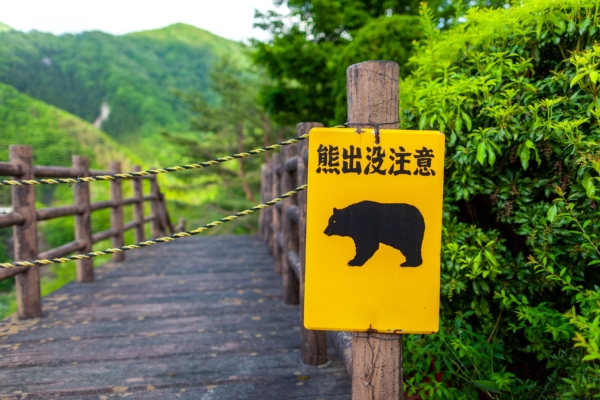
In recent years, Japan has been plagued by frequent bear sightings, with over 134,000 related reports to date. From June 6th, more than 40 bear sightings have been reported in Utsunomiya City, Tochigi Prefecture, Japan. To ensure safety, all 94 municipal elementary and junior high schools in the city have temporally suspended classes on Monday (June 8). Fortunately, no casualties have been reported so far.
Residents in Utsunomiya City first spotted bear traces in a residential area near a park on Saturday (June 6) evening. In the early morning of June 7, residents witnessed bears multiple times in a commercial area about 2 kilometers from JR Utsunomiya Station; on June 8, more sightings occurred about 500 meters from Nishikawatanaka Junior High School.
According to police estimates, the bears spotted had a body length of about 1 meter. Since the morning of June 6, there have been over 40 cumulative sightings reported in residential and commercial areas of Utsunomiya City.
On June 8, a witness told Japanese media NTV NEWS24, “The bear climbed over the fence from over there. It was really big! I don’t think it’s just 1 meter long. I can’t believe it ran all the way here!”
Utsunomiya City is located about 100 kilometers north of Tokyo and is home to half a million residents. Local hunting associations and police are conducting patrols in the area but have not captured the bear yet. Residents are urged to immediately seek shelter in cars or buildings and report any bear sightings to the city government or police.
In addition, the government of Iwaki City in Fukushima Prefecture received a report around 10 a.m. on the 8th that residents in Shibahara-machi, Ogawa-cho found traces suspected to be bears. The city government verified the photos taken by witnesses and confirmed the animal to be an “Asian black bear.”
Just last week, Fukushima had a bear attack incident that left at least 4 people injured. Surveillance footage from Fukushima Steel Co., Ltd. showed a black bear chasing a worker at the factory entrance and knocking him down.
Japan is home to two main types of bears: the “brown bear” inhabiting Hokkaido, with a larger size and more aggressive nature, and the “Asian black bear” found in Honshu, Shikoku, and other areas.
While the “Asian black bear” is listed as a globally vulnerable species, its population in Japan has doubled since 2012 due to a decrease in hunting activities. Experts suggest that abnormal climate conditions and frequent extreme weather events have reduced the natural food supply such as acorns and beech nuts for bears, coupled with a declining rural population and increasing abandoned farmland, making bears more likely to venture into human habitats in search of food.
Amidst the surge in bear sightings, the Japanese government urges the public to prioritize “avoiding encountering bears” and familiarize themselves with proper self-defense methods.
The government emphasizes that the most effective way to protect oneself is to “not encounter bears.” Therefore, it is recommended that individuals check local “bear sightings maps,” official warnings, or apps like Kuma Map before heading out, avoid high-risk routes, refrain from going alone, especially entering mountain areas during dawn and dusk.
According to travel website Travelcontents and the Ministry of the Environment of Japan, when entering forests, farmlands, or rural areas, it is essential to carry bear bells, bear spray, a whistle, or regularly clap hands, speak loudly, or play music to alert bears, ensuring they avoid human encounters and achieve the goal of “avoiding meeting bears.”
If one unfortunately encounters a bear, avoid running, screaming loudly, turning your back, climbing trees, or playing dead as these actions may provoke the bear or provoke an attack.
The correct approach is to remain calm. If the bear is a considerable distance away (over 50 meters), it is best to face the bear without making eye contact (to avoid provocation) and slowly retreat. Raise both arms to appear larger, and calmly speak in a low, steady voice to indicate human presence as bears typically leave on their own.
If the bear continues to approach (within 50 meters), be prepared with bear spray. Furthermore, if the bear shows signs of charging, wait until it is about 5 to 10 meters away, aim at its face and eyes, spray for about 3 seconds to create a stimulating mist barrier, and swiftly withdraw during the opportunity.
If one is unfortunately attacked, immediately lie face down, curl up the body, protect the head and back of the neck with hands or a backpack (as bears often target the head and face), and try to remain still until the bear leaves. This position can effectively reduce the risk of fatal injuries. Once rescued, seek medical help as soon as possible, and report to local authorities.
If encountering a bear while driving, close the car windows tightly, stay in the vehicle until the bear leaves, never curiously exit the car or feed the bear. Additionally, when outdoors, do not discard food remnants or garbage to avoid attracting bears with their sensitive sense of smell.