
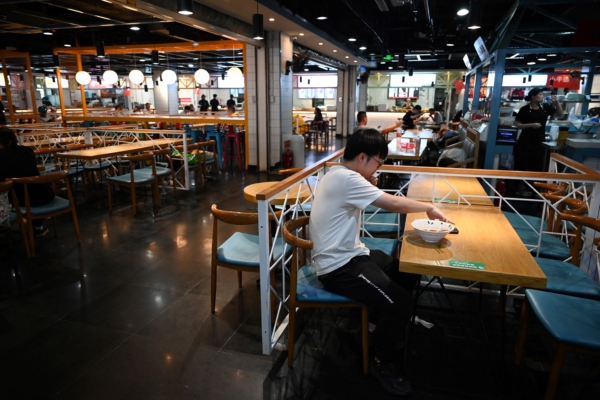
Recently, Singaporean food court brand “Food Republic” announced that its last store in Beijing will cease operations on June 15th. Concurrently, General Mills from the United States is planning to sell its Häagen-Dazs ice cream stores in China, adding to the trend of foreign food and retail brands accelerating their retreat from the Chinese market.
According to a report by the South China Morning Post on Tuesday, based on a notice posted outside the store at the end of May, the final “Food Republic” store in Beijing, located in the Wangfujing Oriental Plaza, will shut down on June 15th. This store was the first store opened by the brand when it entered the Beijing market 25 years ago.
“Food Republic” is a well-known chain food court brand operated by the BreadTalk Group from Singapore, established in 2005. It is famous for its themed design, retro atmosphere, and a collection of authentic street food from various regions. The brand integrates traditional flavors into high-end shopping centers and operates over 50 stores in Singapore, mainland China, Hong Kong, Taiwan, Malaysia, and other locations.
As of 2016, the brand had over 40 stores in mainland China, scattered across Beijing, Shanghai, Tianjin, and Chongqing. With the closure of the Beijing store, the brand will only have 4 remaining stores in China, all located in Shanghai.
Fu Yifu, a contracted researcher from the Su Merchants Bank, pointed out that the departure of “Food Republic” from Beijing highlights the challenges facing the Chinese food court industry. He emphasized that changing consumer habits, the rapid rise of food delivery platforms, and adjustments in shopping center formats are gradually weakening the competitive advantages of food court brands.
In the 1990s, food courts flourished in China due to their affordability, clean environment, and diverse dining options. Operators typically leased spaces in large shopping malls and sublet them to various food stalls. However, as young consumers increasingly prefer branded dining, delivery services, and personalized consumption, the food court model is losing its appeal.
Meanwhile, General Mills announced on Monday that it will sell its Häagen-Dazs ice cream store business in China to an investor consortium, including the Chinese tea company Ningji. After the completion of the transaction, the consortium will obtain the authorization to use the Häagen-Dazs brand in China. The deal is expected to be finalized within the year, with the specific amount undisclosed.
Häagen-Dazs entered the Chinese market in 1996 and currently has over 170 stores in China. Jessica Gleeson, CEO of retail consultancy Brighter Beauty and former Starbucks executive in China, noted the intensifying competition in the high-end ice cream market in China and the lack of recent innovation from the Häagen-Dazs brand.
In recent years, more and more foreign brands have chosen to sell their Chinese businesses to cope with market competition and economic challenges. Apart from Food Republic and Häagen-Dazs, several other foreign and Hong Kong brands have also been closing their stores in China, including Galeries Lafayette from France, Lane Crawford from Hong Kong, Triumph from Germany, Ikea from Sweden, Guess from the United States, and Aeon and Ito-Yokado from Japan.