
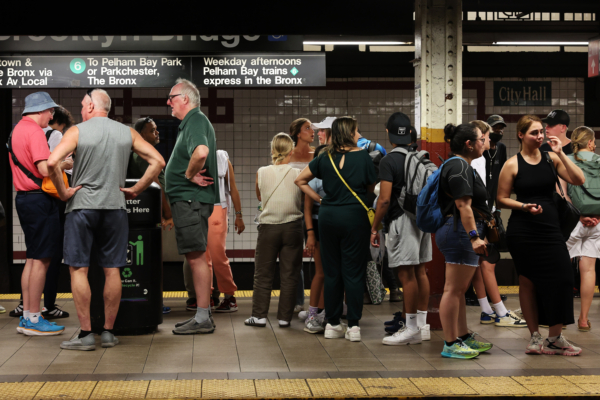
Governor Ho Chu, Mayor Mamdani, and the Metropolitan Transportation Authority (MTA) jointly announced on August 10th a plan in New York to conduct a study aimed at exploring the feasibility of creating the first public transit “Thermal Energy Network” (TEN) in Manhattan’s downtown subway stations in the United States. The purpose of this network is to harness excess heat from the platforms and store it underground to provide heating for nearby municipal buildings during the winter.
Governor Ho stated that New Yorkers have long endured the sweltering heat on subway platforms during the summer. This study aims to utilize the previously discomforting heat by cooling the stations in the summer and providing heat to municipal buildings in the winter.
The pilot sites selected are Brooklyn Bridge-City Hall station on the 4, 5, 6 lines, and the adjacent Chambers Street station on the J, Z lines. Brooklyn Bridge-City Hall station is one of the hottest subway stations in the city, with an average temperature of 96 degrees Fahrenheit in the summer of 2025. As it is also the terminus of the 6 line, the continuous heat emitted during train stops further exacerbates the stifling heat inside the station.
Cooling the New York subway, which has been in operation for over a century with numerous entrances and ventilation points, is not as simple as installing a few air conditioners. According to the current concept, researchers will evaluate the use of “radiant cooling” technology, where cold water panels or pipes on walls and ceilings absorb heat from the platforms, then transport it through pipes to geothermal wells beneath the abandoned central platforms at Chambers Street station for storage and use during the winter.
This technology is reported to be 25% to 35% more energy efficient than traditional air conditioning. Similar thermal energy networks have been used in some hospitals and universities, and if this project is completed, it will be the first implementation in the U.S. public transportation system.
The feasibility study is expected to cost $800,000 and will evaluate how much temperature reduction the system can achieve and how much energy cost savings can be realized.
Mayor Mamdani mentioned that heating only the David Dinkins Municipal Building in Manhattan costs the city about $1.4 million annually. By harnessing the heat wasted by the subway, there is potential to improve passenger waiting environments and possibly reduce city energy expenses.
The contract for the feasibility study is expected to be signed in the fall of this year. If the local geothermal conditions are deemed suitable, the engineering design could potentially begin as early as the beginning of 2027.