
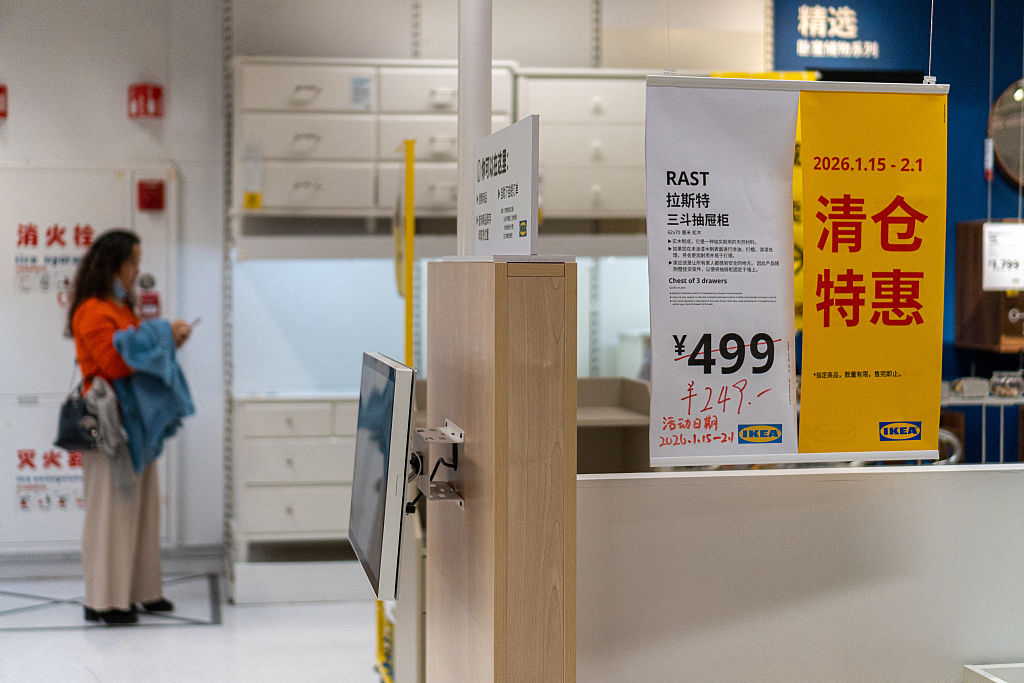
Swedish furniture giant IKEA is currently focused on selling its self-owned properties in eight cities in China, marking its largest asset disposal in nearly 30 years since entering the Chinese market. This move further shrinks IKEA’s mega-store model in China.
According to mainland media reports, commercial real estate services firm CBRE revealed on July 14 that they have been appointed by IKEA’s parent company, Ingka Group, to sell eight self-owned properties located in Shanghai, Guangzhou, Tianjin, Harbin, Nantong, Xuzhou, Guiyang, and Ningbo.
These properties are all vacant, without lease restrictions, and can be delivered as-is. Investors have the option to purchase individual properties or acquire multiple assets in a bundle.
Among them, the properties in Shanghai Baoshan, Guangzhou Panyu, Tianjin Zhongbei, Harbin, Nantong, Xuzhou, and Ningbo correspond to the seven large stores that IKEA closed in February this year; while the Guiyang store ceased operations as early as 2022.
The total property area of the eight properties is close to 500,000 square meters. The Shanghai Baoshan store is approximately 105,000 square meters, while the Ningbo and Tianjin stores are around 96,000 and 79,000 square meters respectively. The remaining properties range from 24,000 to 66,000 square meters.
IKEA has long adopted a heavy asset management model focused on suburban land acquisition and construction of large warehouse-style stores in China. However, with the continuous sluggishness of the Chinese real estate market, cautious consumer spending habits, and the diversion of customer traffic to e-commerce platforms, the fixed costs of land ownership, property maintenance, and labor for large stores have continued to squeeze profit margins.
Ingka Group’s financial data shows that IKEA China’s sales in the 2024 fiscal year decreased by 7.6% compared to the previous year, dropping to 11.15 billion yuan, nearly 30% smaller than 15.77 billion yuan in the 2019 fiscal year.
Assistant Professor of Economics at Cheung Kong Graduate School of Business, Fan Xinyu, analyzed on the university’s English website on January 19 this year that the Chinese e-commerce system has diverted a significant amount of standard, price-oriented consumer demand, making it increasingly difficult for offline retail stores to compete with online platforms based solely on rich product categories and shopping convenience.
Fan Xinyu also mentioned that the sluggish overall economy and the challenges in the real estate market are dragging down furniture sales, leading to a dispersed demand for home furnishings that varies depending on the consumer’s life stage.
IKEA stated that this sale is part of the follow-up disposal of self-owned properties of closed stores. The company plans to focus on Beijing and Shenzhen as key markets, with plans to open over ten small format stores in the next two years while continuing to strengthen its online presence.
However, IKEA’s previously tested Yangpu small mall and Jing’an city store in Shanghai have both closed. After the closure of IKEA in Guiyang, the related properties have appeared multiple times on the local state-owned property transaction platform, but no new takers have been found.
Zhou Changqing, General Manager of commercial real estate consulting firm RCH, pointed out that the current commercial real estate supply in China is oversaturated. Most of the properties IKEA is selling are not located in core areas of first-tier and new first-tier cities, making it challenging to convert them into other commercial uses.
An article in Interface News mentioned that although warehouse-style retail enterprises like Sam’s Club and METRO Cash & Carry have hardware conditions that match IKEA’s properties, the possibility of directly acquiring such bulk properties is low. Zhou Changqing believes that real estate funds are more likely to take over, but the buyers may require IKEA to include more prime location assets in the sale portfolio, and property splitting and usage adjustments may also require local policy support.