
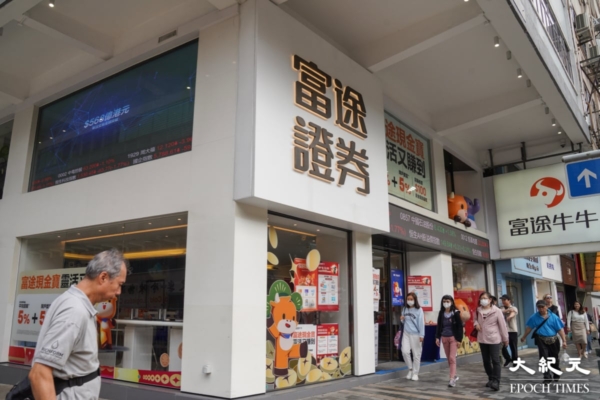
On May 22, the Chinese Securities Regulatory Commission (CSRC) started cracking down on so-called illegal cross-border securities activities. Three brokerage firms under scrutiny have successively issued notices that mainland Chinese investors will not be able to increase their positions in the future and will also not be able to transfer funds. However, there are still many mainland Chinese rushing to open accounts in Hong Kong before the new regulations are fully implemented. A senior industry insider stated that many people are clinging to a sense of luck, but people should see through the essence of the problem, which is that the authorities want to control everything, and now it is a case of “luring the snake out of the hole,” where what is considered “compliant” can turn “non-compliant” at any time.
On May 22, the CSRC, in conjunction with seven ministries, announced a plan to completely crack down on illegal cross-border operations of overseas securities and futures funds institutions within two years. Existing onshore clients will only be allowed to sell out and transfer funds unilaterally, and domestic websites, trading software, and related servers will be completely shut down. The Hong Kong Securities and Futures Commission and the Hong Kong Monetary Authority have also updated rules for mainland customers opening brokerage accounts in Hong Kong.
Punished securities firms such as Tiger Brokers, Futu Securities, and Changqiao Securities have all halted opening accounts for individuals only holding mainland Chinese identification cards.
The gray area of mainland Chinese residents engaging in cross-border stock trading is facing comprehensive restrictions. However, some individuals are rushing to open accounts in Hong Kong before the new regulations are fully implemented.
According to a report by Caixin, on June 4, crowds gathered outside the storefronts of Futu Securities and uSMART Yingtai Securities located on Level B2 of the West Kowloon High-Speed Rail Station in Hong Kong, with many individuals only holding mainland Chinese identification cards. Brokerage staff stated that as long as the necessary account opening documents are provided, it is still possible to open compliant Hong Kong and U.S. stock investment accounts.
According to the latest guidelines issued by the Hong Kong Securities and Futures Commission and the Hong Kong Monetary Authority on May 22, it is not completely prohibited for individuals holding only mainland Chinese identification cards to open accounts in Hong Kong. Licensed brokerages and banks are required to open stock trading accounts for mainland investors and confirm that investment funds come from legal channels outside mainland China.
As reported by Ming Pao, currently, Futu, Tiger, and Changqiao impose strict requirements for Hong Kong identification when opening accounts. Some small brokerages in Hong Kong are still soliciting customers during this window of opportunity. Just four days after the new regulations were introduced, on May 26, there were long queues outside the Futu Securities storefront at the West Kowloon High-Speed Rail Station, and the HSBC bank along the route to Elements Mall also had long lines.
Caixin reported that HSBC Bank at the West Kowloon High-Speed Rail Station had over a dozen people lining up to open new accounts. Some in the queues mentioned starting with a savings account and then proceeding with a stock trading account if possible. Near Harbour City in Tsim Sha Tsui, sales agents promoting Hong Kong insurance now also promote “free bank account opening and brokerage account opening” opportunistically. Recently, visitors from Beijing and Shanghai specifically flew to Hong Kong to open U.S. stock brokerage accounts.
According to reports, the documents required for mainland Chinese investors to open accounts at Futu Securities include mainland Chinese identification cards, customs receipts upon entry to Hong Kong, mainland residents’ exit-entry permits for Hong Kong and Macau, and the account holder must already have a Hong Kong bank account. Similar documents are required for opening accounts at uSMART Yingtai Securities. The brokerage also indicated that if the Hong Kong bank account has not been successfully opened, an application for a securities account opening can be submitted for approval. Once the bank account is established and funds are deposited, the securities account opening will be automatically completed.
In recent days, there has been a wave of posts on social platforms such as Xiaohongshu and WeChat urging individuals to quickly open up access to Hong Kong and U.S. stocks before the new regulations take effect. Xiaohongshu announced on the 3rd that 539 posts and 146 comments related to “seizing the opportunity to open Hong Kong and U.S. stock accounts” were penalized for violations.
Some internet users shared on social media platforms strategies for dealing with the new regulations, such as choosing smaller brokerages not included in the current penalty list. The most discussed topic among internet users is whether future operations such as increasing positions overseas and transferring funds will still be feasible and whether acquiring overseas identities will be necessary for stock trading.
Fund manager Kevin told BBC Chinese that people who trade stocks in the gray area are those with spare money, seeking security and investment targets, such as middle-class programmers from cities like Beijing, Shanghai, Guangzhou, and Shenzhen. He believes that in the future, there will still be space, albeit smaller and more complicated procedures.
However, a private banker in Hong Kong told Caixin that mainland investors signing up for accounts must provide written declarations stating that if the source of funds is found to not be from the legal channels specified in the declaration, regulatory authorities will hold them accountable.
The report also mentioned that currently, mainland Chinese individuals have an annual equivalent of $50,000 convenience quota for buying foreign exchange. This does not fall under legitimate overseas funding sources and is generally only used for consumer expenses, not for buying properties overseas, securities investments, life insurance, and investment dividends which are not yet opened for capital projects. In addition, mainland China signed the Common Reporting Standard (CRS) in 2015, and since 2018, it has initiated tax-related information exchanges concurrently with Hong Kong. While the core goal of CRS is to combat cross-border tax evasion, it also enables mainland regulatory authorities to “see” which mainland tax residents have actually opened securities accounts in Hong Kong.
Currently living overseas, a Chinese national named Wu Ji, who used to trade U.S. stocks through Hong Kong for many years, told Epoch Times on June 6 that those rushing to open accounts in Hong Kong now are “foolish” for harboring a sense of luck, as the Chinese authorities are “luring the snake out of the hole” and will target you at any time.
“It’s like closing all doors and then telling you there’s still a window. Fools flock to the window, thinking it’s allowed and legal, without thinking why the doors were closed in the first place. What is the purpose of opening a small window? Will they not keep a record of every person climbing through the window?” he said.
Wu Ji stated that this is not a technical issue, it’s about seeing the essence of the problem; the Chinese authorities aim to monitor everything and control everything. “Today, it might be considered compliant and legal, but tomorrow, these same actions may be deemed non-compliant and illegal.” He believes that this is fundamentally similar to the promises of freedom that the Chinese authorities made to Hong Kong.
Regarding the crackdown on cross-border stock trading by the Chinese authorities, American economist David Huang previously told Epoch Times that this is a national-level “encircling the sheepfold” operation conducted under the guise of financial compliance.
As early as May 7, the trading volume of put options for the stocks of Futu and Tiger suddenly surged, indicating that privileged individuals within the system had obtained insider information and made last-minute profits before the crackdown.