
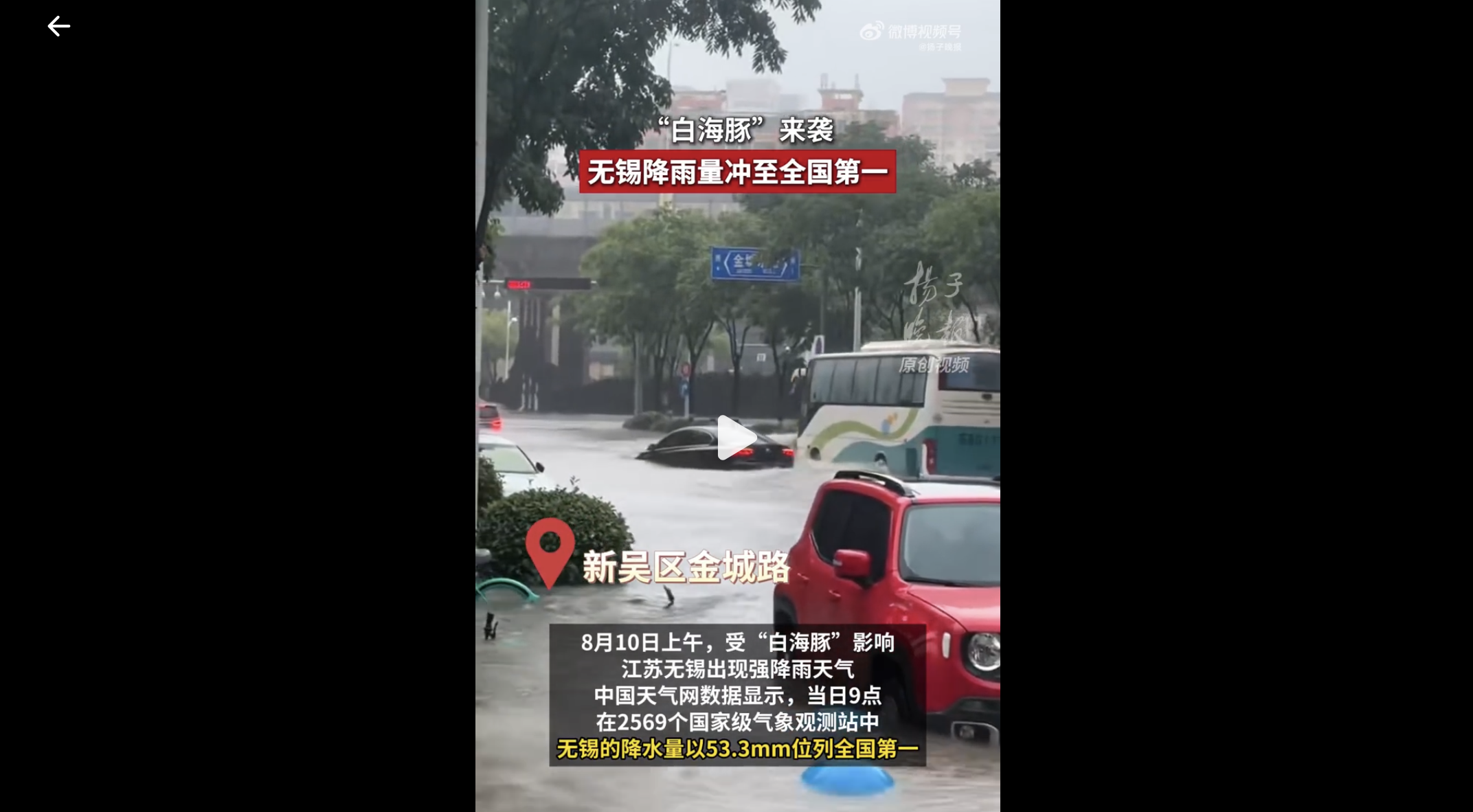
On August 10, 2026, due to the influence of Typhoon “Baihaidun”, Wuxi, Jiangsu encountered record-breaking heavy rain during the morning rush hour. Within an hour, the rainfall reached 53.3 millimeters, ranking first nationwide. The urban areas experienced severe internal flooding, leading to temporary paralysis in traffic.
Reports from Modern Express indicated that during the peak hours of commuting around 8 a.m., the sudden heavy rainfall caused flooding and road blockages, prompting commuters to share images and videos, jokingly referring to the journey as the “long, long way to work.”
According to Yangzi Evening News, the persistent heavy rain resulted in severe waterlogging in various road sections within the city, giving rise to situations where cars seemed to be “driving in water.”
“Wow, even buses are at risk in this heavy rain!” Around 8 a.m., on a company shuttle bus heading towards Xingu District in Wuxi, commuters watched the pouring rain outside with a mix of relief and worry. The excessive water accumulation on the roads led some private vehicles to move slowly or even stop, with water levels surpassing half the height of their wheels. Opening the car door would result in water gushing in, adding to the anxiety of the commuters wondering how they would manage the rest of their journey on foot.
A resident, Ms. Li, described how during the morning rush hour, significant water accumulation was evident at the intersection of Wenhua Road and Wenhan Road in Liangxi District. The central area of the road was flooded, creating a large “pond.” Despite the water not receding, some pedestrians opted to wade through wearing slippers, while several electric scooter riders cautiously navigated their way through the middle of the road, affecting traffic flow.
As per reports, Victory Gate Station of Metro Line 1 was temporarily closed. Dozens of bus routes within the urban area suspended operations due to flooding at stations and on roads. Trains at Wuxi Station, Wuxi East Station, and several other stations were partially halted.
Main roads like Cultural Road and Gonghu Avenue in Liangxi District had water levels reaching above the wheels of vehicles, causing many to stall in the water. In Huishan District, several private cars stalled while passing under an overpass. Rainwater invaded the underground parking lot at Qingqi Road, submerging numerous vehicles, and residents in some older residential areas were urgently relocated due to water seepage into basements.
Wuxi began experiencing flooding on the night of August 9, and the continuous rainfall until noon on August 10 exacerbated short-term flooding across various districts of Wuxi.
According to the Central Meteorological Observatory’s 9 a.m. report, Wuxi received an hourly precipitation of 53.3 millimeters, ranking first nationwide.
By late morning, the Wuxi Metro issued a notice stating that Victory Gate Station of Metro Line 1 was temporarily closed due to the impact of Typhoon “Baihaidun,” with subsequent adjustments based on the situation.
On the night of August 9, Wuxi Station announced that several trains at Wuxi Station, Wuxi East Station, Xinqiao Station, Huishan Station, and Jiangyin Station were suspended on August 10 due to Typhoon “Baihaidun.”
Apart from Wuxi, Kunshan City Meteorological Observatory in Jiangsu Province issued a red alert for heavy rain early on August 10. It was forecasted that Kunshan City would experience heavy rainfall exceeding 100 millimeters per hour during the day.
Today and tomorrow (August 10 and 11), the risk of geological disasters in eastern Zhejiang and other areas in China is high. Mainland official media stated that Typhoon “Baihaidun” has several unusual features, with its timing and impact exceeding expectations.
In comparison to Typhoon “Bavi,” which made landfall in mid-July on the East Coast of China, the impact of Typhoon “Baihaidun” has been more prolonged, with a higher cumulative risk of precipitation. Suzhou City experienced heavy to torrential rain from the night of the 9th to the 10th, with maximum gusts reaching force 8-9.
According to CCTV News, for the next three days, the risk of flash floods is high in eastern Zhejiang and central-northern Henan Province.
In the evening of August 9, Typhoon “Baihaidun” successively made landfall in Yuhuan and Leqing on the coast of Zhejiang. It was reported that intense rainfall on the 10th would affect Shandong, Henan, Hubei, Anhui, Jiangsu, Shanghai, Zhejiang, and other regions. By the 11th, southern Hebei, Henan, Shandong, Hubei, and other areas would become the core regions of heavy rainfall. On the 12th, heavy rainfall would extend to the Beijing-Tianjin-Hebei region.