
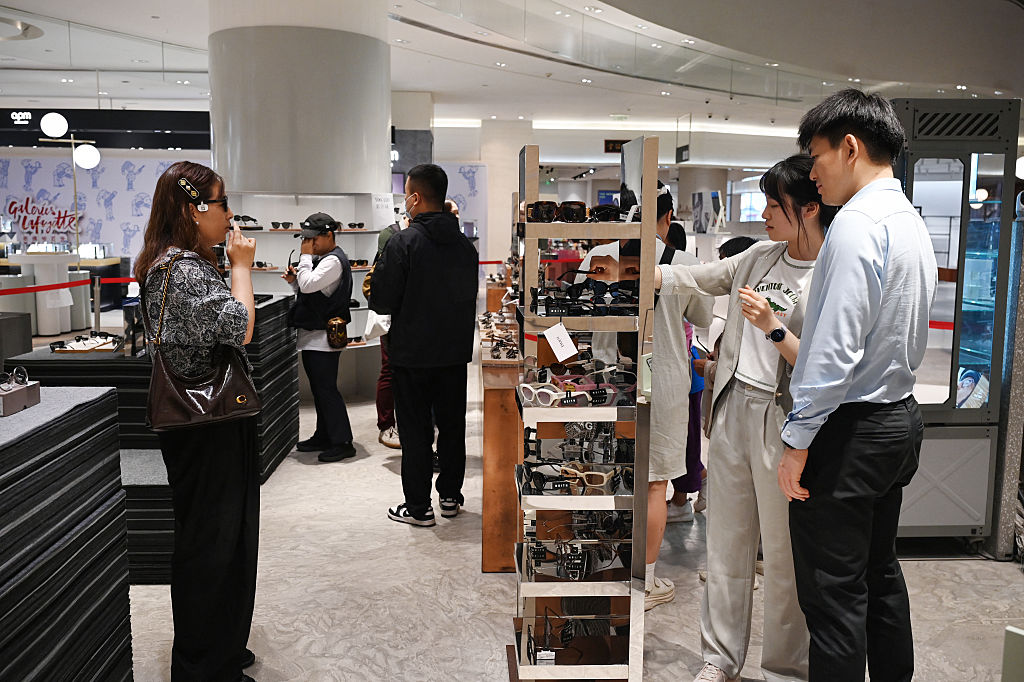
Recently, the mainland China sunglasses market has been exposed with issues such as missing labels and falsely marked parameters. Out of 10 sunglass samples sent for inspection, only 1 pair passed the test. Some manufacturers have admitted that plastic sunglasses with a cost of mere cents are difficult to achieve UV400 protection.
According to reports from mainland Chinese media on August 9th, among the 10 sunglass samples sent for inspection, 4 pairs costing a total of 410 yuan did not have labels indicating compliance with standards, manufacturer information, or certification of qualification.
The test results revealed that 6 pairs had no labels at all, 2 pairs had unclear label information, and 1 pair falsely claimed to have Category 3 lenses but only allowed 76.6% visible light transmission, belonging in fact to Category 1. This indicates that although the product was marketed as suitable for bright light conditions, it actually only had lightly tinted lenses. Out of the 10 samples, only 1 pair met the standards.
Some salespeople in the market have mistakenly equated “UV-1” to UV400. Industry experts state that “UV-1” comes from outdated standards and only covers UV rays within 380 nanometers, while UV400 refers to blocking UV rays below 400 nanometers. In current standards, there is no equivalence between “UV-1” and UV400.
A salesperson from one manufacturer admitted that plastic sunglasses with low-cost materials have difficulty achieving UV400 protection, while another manufacturer claimed that even products not meeting mandatory standards could still be labeled as qualified.
Liu Bao, director of the Nanjing Product Quality Supervision and Inspection Institute, mentioned that the darkness of the lens color does not directly correlate to the UV protection level. Poor quality dark lenses that fail to block UV rays may cause pupils to dilate due to increased darkness, allowing more UV rays to enter the eyes, potentially resulting in long-term damage to the cornea, crystalline lens, and retina.
One consumer shared that she wore a pair of sunglasses purchased on the roadside to the beach, despite feeling dizzy, she wore them all day, only to experience swollen and sore eyes that evening.
The related news has sparked discussions among netizens. Some expressed, “Now I suddenly understand what it means by wearing sunglasses that are as good as not wearing any, let’s not be fooled by cheap sunglasses costing 20-30 yuan anymore.” Others mentioned that when buying sunglasses, it is crucial not only to consider the lens color and style but also to pay attention to UV protection labels and product information.