
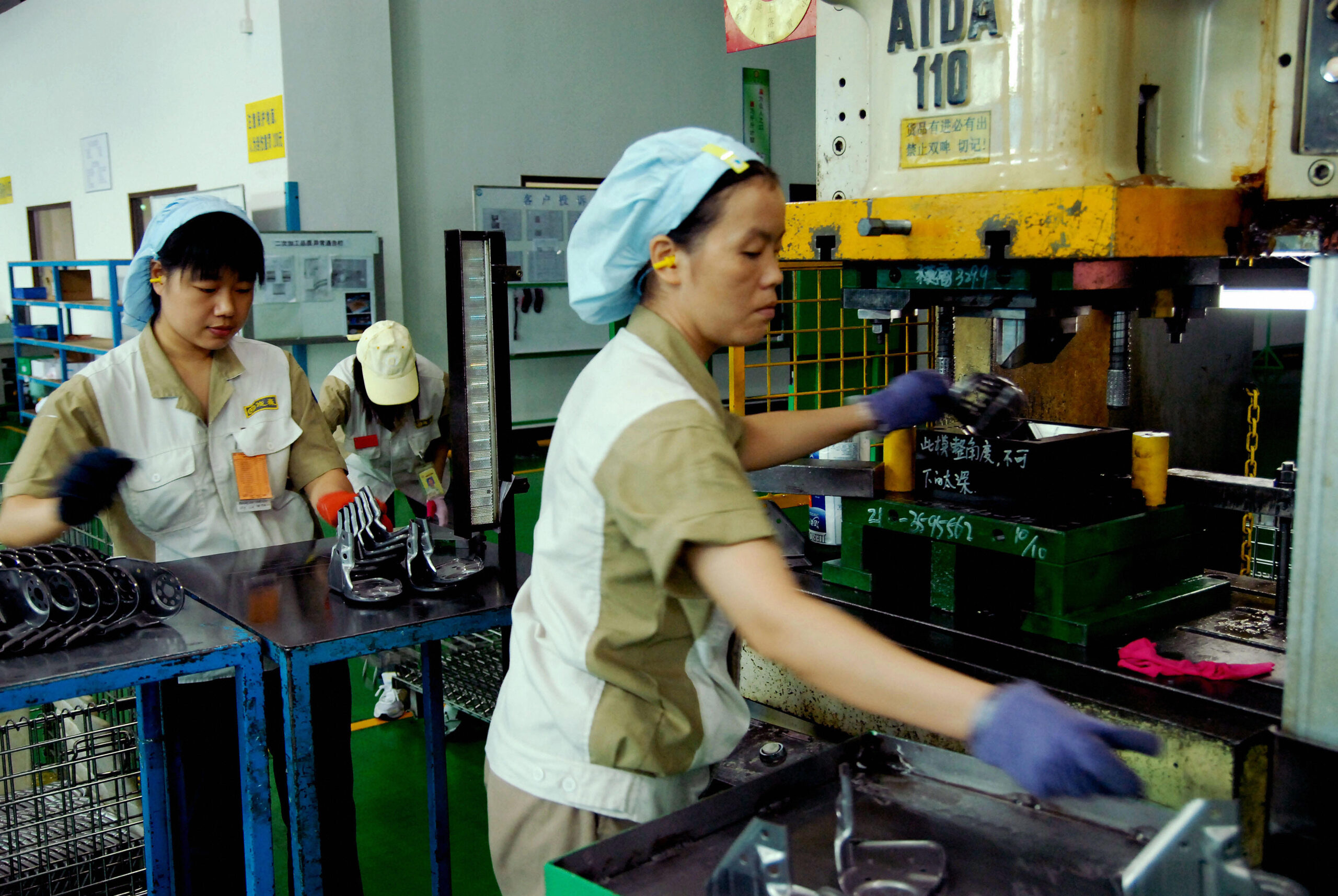
China’s foreign trade data shows that the growth in imports and exports has slowed down recently. Exports are mainly being driven by the AI industry chain and automotive sector, but signs of weakness in the manufacturing industry are becoming more evident.
According to the data released by the General Administration of Customs of the Communist Party of China on August 7, in July 2026, China’s goods trade exports amounted to $397.85 billion, representing a year-on-year increase of 23.9%, which was lower than the expected 27.0% growth rate. Goods trade imports reached $285.35 billion, with a year-on-year increase of 27.5%, also below the expected 36.0% growth rate. The growth rates for both imports and exports in July were slower compared to the previous month.
In terms of specific export categories, the growth rate of high-value export goods has slowed down, with the export growth rate of integrated circuits dropping by 5.3 percentage points compared to June, marking the first slowdown this year. The overall AI industry chain continues to maintain a relatively high level of prosperity, with equipment exports such as ships and automobiles showing faster growth. In terms of export markets, the growth rates to the United States, South Korea, and ASEAN countries have further increased from June, while the growth rates to the European Union, Latin America, and Africa have declined due to factors such as high base effects and trade disputes.
Bloomberg’s report indicates that the surge in overseas shipments of AI-related electronic products and other items like electric vehicles has mitigated a deeper slowdown in China’s economy this year. It has also exacerbated the long-standing internal economic imbalances, as domestic demand remains weak. As China’s presence in global supply chains increases, tensions with European and American countries have heightened, particularly in areas such as electric vehicles, manufacturing, and the emerging field of data center hardware.
Governments around the world are increasingly concerned about China’s reliance on exports to drive economic growth. European leaders have criticized the Chinese government for unfairly subsidizing industries, resulting in overcapacity and a flood of Chinese products into Europe.
Regarding China’s foreign trade situation in July, a research report released by Luo Zhiheng, Chief Economist at Yuekai Securities, and his team suggests that geopolitical conflicts and disruptions in energy supply have pushed up energy prices, further impacting the costs of some midstream and downstream manufacturing industries. Since China imports a significant proportion of energy and semiconductor intermediate goods, and faces intense international competition in downstream manufacturing, the overall pressure from rising import costs outweighs the benefits from increased export prices, leading to uneven distribution of price increases and cost pressures along the industrial chain.
The report highlights that the benefits of price increases are mainly concentrated in a few upstream industries, while the majority of China’s manufacturing sector operates in the midstream of global supply chains with limited ability to pass on price increases downstream. For small and medium-sized manufacturing enterprises, weak bargaining power and compressed profit margins are major challenges, especially as upstream price hikes predominantly benefit resource-exporting countries. In the semiconductor industry chain, price increases are concentrated in categories such as storage chips, impacting some high-end equipment and advanced materials segments where China’s position in the industrial chain is relatively weak.
The data released by the National Bureau of Statistics of the Communist Party of China on August 9 also indicates a noticeable weakness in the manufacturing sector. In July 2026, the Producer Price Index (PPI) for industrial producers rose by 3.5% year-on-year but fell by 0.7% month-on-month. The Purchaser Price Index for industrial producers increased by 5.5% year-on-year but decreased by 1.0% month-on-month. From January to July, the average PPI increased by 1.8% compared to the same period last year, while the Purchaser Price Index rose by 2.8%. The fact that the Purchaser Price Index exceeds the Producer Price Index implies that the overall profit margins of industrial enterprises are shrinking.
An article in The Wall Street Journal titled “Chinese Manufacturing Faces a ‘Challenging Summer'” points out that the official Purchasing Managers’ Index (PMI) for the manufacturing sector showed contraction for the first time in five months in July, exacerbating the economic challenges facing China. The country has recently been hampered by weak consumer demand and declining investment. In the second quarter, the Gross Domestic Product (GDP) grew by only 4.3% year-on-year, marking the slowest pace since 2022. However, the Chinese government has shown little willingness to adopt the stimulus measures advocated by some economists, such as significantly expanding social welfare spending and increasing support for the struggling real estate sector.