
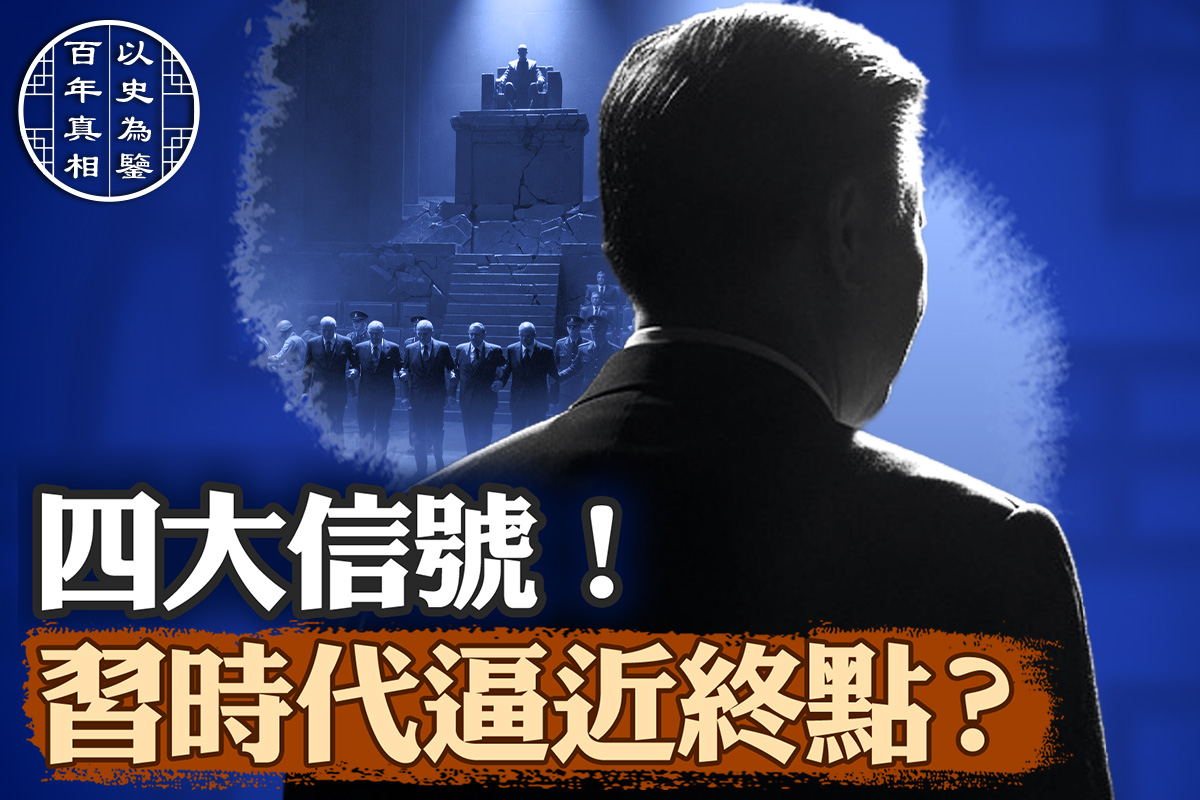
Hello, viewers! Welcome to “The Truth of a Century”.
In 2012, the 18th National Congress of the Communist Party of China was held, and a leader widely considered “mild-mannered and steady in style” stepped onto the highest stage of power in the CCP. He is Xi Jinping. At that time, many people believed that there might be some degree of relaxation and adjustment in Chinese politics.
However, fourteen years have passed, and when people look back, they find that the CCP’s power has become more centralized, political control has tightened comprehensively, and the political atmosphere is unusually tense.
There is a sarcastic nickname for Xi Jinping that has emerged on the internet – the “Chief Acceleration Officer”.
If we carefully observe a series of political operations by Xi Jinping since he took office, we will find at least four key events that are undermining the operation mechanism of the CCP’s regime.
Today, let’s take a look at how the “Chief Acceleration Officer” is unwittingly accelerating the CCP’s self-destruction process.
The first thing is the cleansing of the military, leading to discord among generals, undermining the power base of the CCP.
After Xi Jinping took office in 2012, the first thing he did was to clean up the CCP’s military. Initially, this cleansing had clear shades of power struggle, mainly aimed at regaining military power long controlled by Jiang Zemin’s faction.
As Xi Jinping successively took down the two deputy chairmen of the military commission affiliated with Jiang’s faction – Guo Boxiong and Xu Caihou – under the guise of anti-corruption, what was originally seen as “anti-corruption to seize power” gradually evolved into an almost unstoppable cleansing within the military.
According to preliminary statistics from outside sources, as of February 2026, the number of generals investigated by Xi Jinping may have reached as high as 415. Just after the 20th National Congress of the CCP in 2022, the number of generals under investigation could have reached 142. A significant proportion of them were generals promoted by Xi Jinping himself.
What does this mean? It means that this cleansing has shifted from “clearing opponents” to “clearing the entire system”.
On January 24, 2026, a shocking news broke: Vice Chairman of the Central Military Commission Zhang Youxia and Chief of Staff of the Joint Staff Department Liu Zhenli, were unexpectedly announced to have fallen.
The simultaneous downfall of these two top figures in the military is extremely rare in the history of the CCP’s military. This also signifies that this military purge has escalated to an unprecedented scale and level.
A very intriguing contrast is: since Xi Jinping took office, he has not engaged in any wars, but the number of generals he has purged surpasses the total number of generals who fell in internal wars, external wars, and the chaos of the Cultural Revolution since the founding of the CCP’s military in 1927.
This purge is rapidly hollowing out the top-level structure of the CCP military. As of February 2026, there are only seven members left in the Central Military Commission, with Xi Jinping and Zhang Shengmin. There are only four active generals left: Vice Chairman of the Central Military Commission Zhang Shengmin, Minister of National Defense Dong Jun, Commander of the Central Theater Command Han Shengyan, and Commander of the Eastern Theater Command Yang Zhibin.
However, the purge is not over yet, and the situation is very delicate.
Zhang Shengmin, as the only general among the seven members of the Central Military Commission, has never been trusted by Xi Jinping. As early as 2023, there were rumors that he was being secretly investigated and his career was at risk.
Minister of National Defense Dong Jun was recommended to Xi Jinping by the former head of the Military Commission’s Political Work Department, Miao Hua. Due to this relationship, Dong Jun’s career seems to have been frozen, as he has not been further promoted to a member of the Central Military Commission.
As for Han Shengyan and Yang Zhibin, they were both promoted from Major General to General at the end of December 2025. These two individuals were not mainstream figures in the military before and had long been marginalized. In a sense, it was because almost all the generals had been purged that they had the opportunity for promotion.
The consequences of this purge are disastrous for the CCP.
The trust between Xi Jinping and the military leaders is rapidly eroding, discord among generals is spreading, everyone in the military is insecure, and the CCP’s control over the military is quickly disintegrating.
The “political power comes from the barrel of a gun” is the power logic of the CCP. Once the control over the military begins to waver, it signifies that the regime has entered a highly unstable phase.
If the first issue, the military purge, is shaking the long-standing military power base on which the CCP relies, exposing security issues related to power, then the next issue exposes another deeper problem – the crisis of governance within the CCP.
Many high-ranking officials personally promoted by Xi Jinping have fallen from grace in a short period. Such phenomena are almost unprecedented in the history of the CCP.
Let’s take a look at the diplomatic system first.
The Foreign Minister is the highest spokesperson for the CCP internationally. Xi Jinping personally bypassed protocol and promoted Qin Gang at lightning speed, elevating him from ambassador to the US to Foreign Minister and swiftly entering the central leadership of the CCP, becoming one of the youngest leaders in the party and the country.
However, just six months into his tenure, Qin Gang suddenly “disappeared” and was subsequently relieved of all duties, becoming the shortest-serving Foreign Minister in the CCP’s 76-year history.
Now let’s look at the military system.
The Minister of National Defense is the representative of the CCP military internationally. General Li Shangfu, who served as a member of the Central Military Commission, State Council, and Minister of National Defense, was investigated within half a year of taking office, then dismissed, expelled from the party and the military, stripped of his rank as a general, and handed over for judicial trial. He also became the shortest-serving Minister of National Defense in the CCP’s 76-year history.
If the downfall of individual high-ranking officials can still be explained as isolated “incidents,” the subsequent events are more shocking.
The Rocket Force is Xi Jinping’s personally crafted strategic military branch. It is responsible for launching medium-range, long-range, and intercontinental missiles for China, many of which can carry nuclear warheads and are considered crucial strategic assets for deterring the US and reunifying Taiwan through military means.
Normally, the highest commander of such a force would be chosen with extreme caution.
However, the four Rocket Force commanders personally appointed by Xi Jinping – Wei Fenghe, Zhou Yaning, Li Yuchao, and Wang Houbin – were all investigated and eventually categorized as “severely corrupt individuals.” This situation is rare in any military in the world, right?
Corruption issues among officials under Xi Jinping’s rule do not stop there.
Miao Hua, head of the Military Commission’s Political Work Department, was the core operator of Xi Jinping’s “political army-building” and was a key figure in the selection and appointment of senior military leaders. He was known as Xi Jinping’s “Second Trust inside the military.”
However, Miao Hua was eventually accused of “collapsed faith, disloyal behavior”, “seriously damaging the principle of party command of the gun and the system of the Chairman of the Military Commission,” and deemed a “severely corrupt individual” under investigation.
Let’s move up the hierarchy.
He Waidong, a member of the CCP’s Politburo and Vice Chairman of the Central Military Commission, was considered Xi Jinping’s “First Trust inside the military” and a general personally and hurriedly promoted by Xi.
Yet, after just over two years in office, He Waidong was similarly accused of “collapsed faith, disloyal behavior,” “seriously undermining the principle of party command of the gun and the system of the Chairman of the Military Commission,” and was eventually dismissed and investigated.
Vice Chairman of the Central Military Commission, Zhang Youxia, was selected by Xi Jinping in the spirit of placing “political standards first, strictly managing political and clean standards” before the 20th National Congress. However, just over three years after the 20th Congress, Zhang Youxia was determined to have “seriously trampled and destroyed the system of the Chairman of the Military Commission, seriously jeopardized the Party’s ruling foundation,” and subjected to investigation.
So, we see this very ironic phenomenon:
From the Foreign Minister to the Minister of National Defense, from the commanders of the Rocket Force to the head of the Military Commission’s Political Work Department, and then to the Vice Chairman of the Central Military Commission, a batch after another of high-ranking officials personally promoted and favored by Xi Jinping, ultimately being categorized as “severely corrupt individuals.”
In contrast, throughout history and across different cultures, has any ruler termed as an “enlightened leader” performed so poorly in selecting and promoting personnel?
Xi Jinping once said: “The corruption of governance is the greatest corruption.” If we follow this standard, then who should bear the primary responsibility for the corruption of governance in the CCP? Isn’t it Xi Jinping himself, the “Chief Acceleration Officer”?
If the first two phenomena primarily manifest in turmoil within the military and bureaucracy, the next problem directly relates to the fundamental structure of the CCP’s political system.
In the history of the CCP, the most extreme period of personal dictatorship was during Mao Zedong’s launching of the “Cultural Revolution” of ten years. During that decade, Mao’s personal power had virtually no constraints. The entire country revolved around one person’s will, and Chinese society was pushed to the brink of collapse by Mao’s actions.
Many people initially thought that after Mao Zedong’s death, the CCP would gradually avoid re-establishing such a system of personal dictatorship. However, after Xi Jinping took office, this trend reappeared. Through wave after wave of purges under the guise of “anti-corruption and tiger hunting,” Xi Jinping gradually consolidated power, eventually establishing what is known as the “Xi Core.”
Yet this did not seem to be enough; he further proposed to “place himself as the center.” Whether it is in the selection and appointment of personnel, domestic and foreign policies, or even major strategic decisions, everything has to be finalized by him.
In order to establish this power structure, Xi Jinping has used court intellectuals to theoretically construct a set of political slogans. For instance, the so-called “Two Establishments” – establishing Xi Jinping’s core position in the Party Central Committee and the entire party, establishing Xi Jinping Thought’s guiding position. There are also the “Two Safeguards” – safeguarding Xi’s core position, safeguarding the authority of the Party Central Committee and centralized unified leadership. And the “Four Consciousnesses” – political consciousness, overall situation consciousness, core consciousness, alignment consciousness.
These political slogans may seem complex, but in summary, they all point to one thing: that everything in the party, government, military, academy, and the people, everywhere, is centered on Xi.
In addition to theoretical shaping, Xi Jinping has further strengthened his power institutionally.
According to the CCP party regulations, the main duty of the General Secretary of the CCP Central Committee is to convene meetings of the Politburo and the Standing Committee of the Politburo, and oversee the work of the Secretariat of the Central Committee.
However, after the 19th National Congress, Xi Jinping introduced a new system – requiring all top officials of the CCP to submit an “annual written report” directly to him personally. These officials include Political Bureau members, Secretariat members of the Central Committee, party group members of the National People’s Congress Standing Committee, the State Council, and the Chinese People’s Political Consultative Conference, as well as the party group secretaries of the Supreme People’s Court and the Supreme People’s Procuratorate.
This system has been in place since 2018 and continues to this day.
Before Xi Jinping took office, whether in local governance or central work, his achievements were not outstanding, and his abilities were not highly evaluated externally. The most notable label on him was just one – the son of CCP elder Xi Zhongxun.
Yet, in just over a decade after taking office, he has been transformed into a symbol of “utmost wisdom” for the entire party, military, and even the entire populace. Everything is decided by him.
And the results? You can imagine.
For any political system, the succession of supreme power is one of the most central and sensitive issues.
Since its founding in 1921, for the past 105 years, the CCP has not resolved the problem of the lawful, orderly, and smooth succession of supreme power.
Before Xi Jinping took office, although the issue of a successor was unresolved, the highest levels of the CCP would still tend to select two individuals: one to succeed as Premier of the State Council, and one as General Secretary of the Central Committee. So, for a considerable period, predictable “succession combinations” appeared, such as Jiang Zemin and Zhu Rongji, Hu Jintao and Wen Jiabao, and later Xi Jinping and Li Keqiang.
But in the Xi Jinping era, this tradition was thoroughly shattered.
For 14 years since Xi took office, he has not designated any clear successor. In the 18th National Congress of the CCP in 2012, two young officials born in 1963 – Hu Chunhua and Sun Zhengcai – both entered the Communist Party’s Politburo. According to previous political rhythms, they were generally regarded as future candidates for Prime Minister and General Secretary. However, before the 19th National Congress in 2017, Xi Jinping suddenly arrested Sun Zhengcai under the guise of anti-corruption. By the time of the 20th Congress, Hu Chunhua was excluded from the Politburo and retired prematurely to the Chinese People’s Political Consultative Conference.
Thus, a very rare situation arose: the succession team of CCP’s highest power was emptied.
There were countless analyses and speculations both domestically and internationally before the 20th Congress: who would be Xi Jinping’s successor? After much speculation, many observers came to the conclusion that Xi Jinping’s successor was Xi Jinping himself.
After the 20th Congress, Xi Jinping secured his third consecutive term. This signifies that if one day he suddenly passes away due to illness or a major accident, the highest power of the CCP would instantly become vacant. By then, the top levels could immediately plunge into intense power struggles.
Looking back at Xi Jinping’s political trajectory over the past 14 years, we can see four very clear trends:
First, the large-scale purge in the military is shaking the military power base that the CCP relies on to sustain its regime.
Second, the downfall of various high officials reveals severe governance crises in the CCP system.
Third, highly concentrated personal power has pushed China back into extreme personal autocracy.
Fourth, the succession mechanism has been completely shattered, leaving the future of the entire regime filled with uncertainty.
These four issues may seem independent of each other on the surface, but they all point to one reality – the internal stability of the CCP’s political system is continually weakening.
The “Chief Acceleration Officer” – this nickname not only points to Xi Jinping’s successive policy failures but more deeply signifies that under Xi’s rule, the various long-standing contradictions accumulated within the CCP are rapidly magnifying.
And when a regime is facing problems such as military instability, governance collapse, excessive centralization of power, and a broken succession mechanism simultaneously, it often encounters not just another political crisis but potentially the end of an era.
Alright, that’s all for today’s program. Thank you for watching. If you enjoyed our program, don’t forget to like, subscribe, and share. See you next time.
Production Team of “The Truth of a Century”