
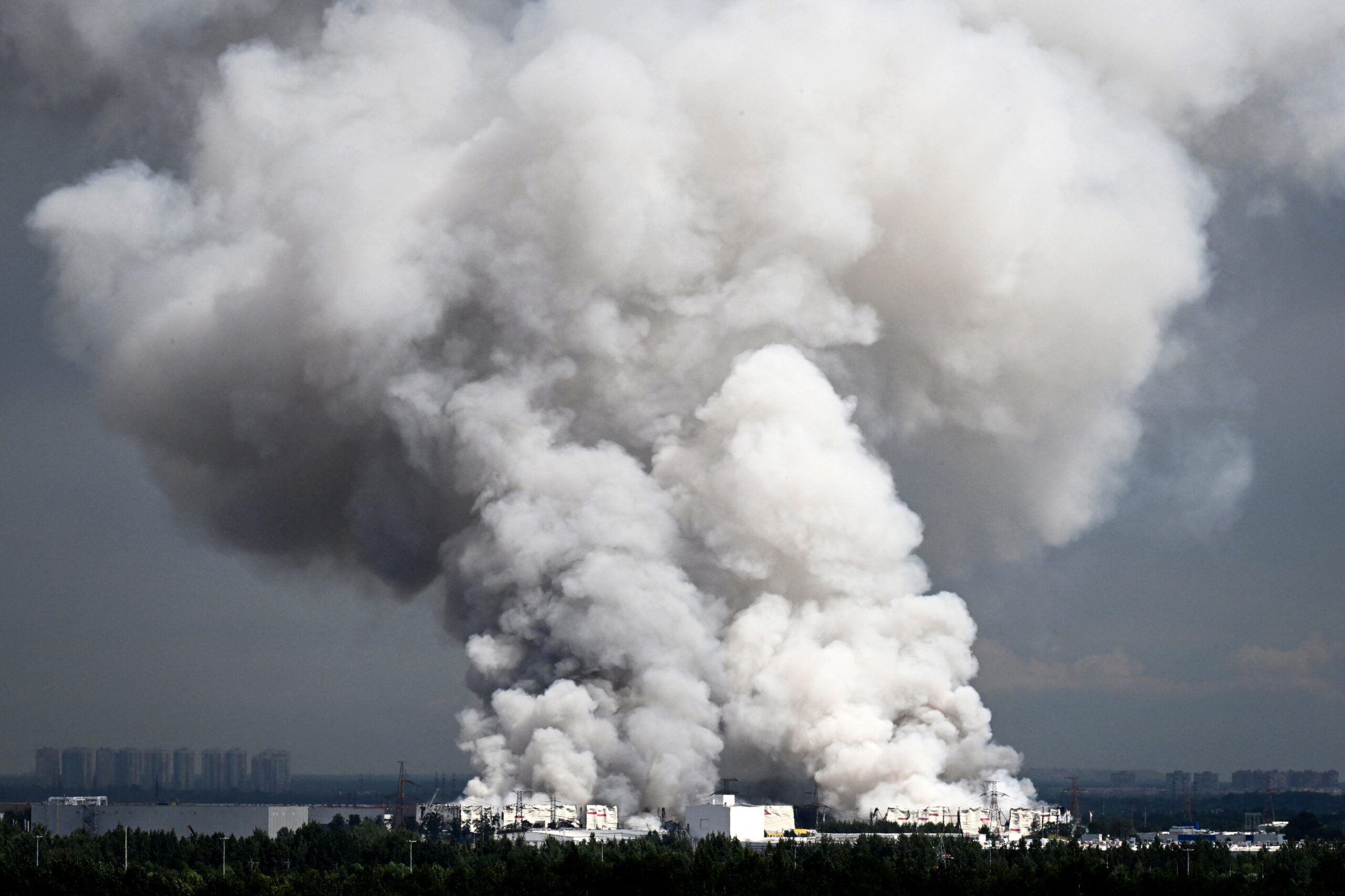
Recently, Ukraine has been using long-range drones to target the logistics facilities of Russia’s largest online retailer, Wildberries. The attacks have extended deep into Russian territory, severely disrupting the logistics network and putting thousands of small businesses and franchise pickup points at risk of closure.
On Friday, August 7th, a Wildberries warehouse located in Ekaterinburg in the Urals, over 2,000 kilometers from the Russia-Ukraine border, was hit by three drones and caught fire, prompting the emergency evacuation of around 800 people, fortunately without any injuries.
This is the latest in a series of attacks on Wildberries in recent weeks. Since July 18th, Ukraine has targeted about 20 Wildberries facilities, with several large warehouses being engulfed in flames.
After analyzing satellite images, Reuters estimated that at least 1.18 million square meters of warehouse space have been damaged or destroyed, equivalent to more than one-fifth of Wildberries’ total warehouse capacity.
Reuters pointed out that the value of goods and services processed by Russian e-commerce platforms, including Wildberries, accounts for 8.5% of the Russian economy, making the impact of these attacks on large logistics centers far-reaching, exceeding the impact on a single company alone.
Following the latest attack, Russian President Putin chaired a Security Council meeting on Friday. In his televised opening remarks, he stated that the meeting would discuss further measures to strengthen the protection of infrastructure but did not disclose specific details.
Satellite images taken by the American space intelligence company Vantor in early August also show severe damage or complete destruction of multiple Wildberries facilities in Russia, including warehouses in Simferopol, Volgograd, Elektrostal, and Krasnodar.
Ukraine stated that in addition to selling ordinary clothing, cosmetics, and electronic products, Wildberries also sells military or dual-use items such as night vision devices, tactical vests, ammunition pouches, helmets, and drone control goggles, accusing the company of supporting Russian military operations through its logistics system. Wildberries and the Kremlin deny supplying goods to the Russian military.
As of now, the series of attacks on Wildberries warehouses have resulted in at least 13 deaths. Ukraine denies targeting civilians and states that their actions aim to raise the cost of Moscow’s war-mongering.
The Ukrainian Ministry of Defense stated after one attack, “Russia’s logistics system is being dismantled hub by hub.”
Ukrainian defense enterprise Fire Point stated that their FP-1 long-range drones were used in some of the attacks. These fixed-wing drones can penetrate hundreds of miles into Russian territory, strike targets, and detonate.
Fire Point revealed that the logistics center in Krasny Bor near Saint Petersburg, one of Wildberries’ largest facilities in northwestern Russia, was targeted this week. It could store over 57 million items.
The impact of these attacks is now spreading from warehouse logistics to the retail industry and small businesses in Russia.
Wildberries has about 98,000 pickup points in Russia and neighboring countries, with tens of thousands of small businesses relying on its platform to sell goods. The company stated that 95% of orders are collected by customers at pickup points.
Vasily Klimov, a Wildberries franchise pickup point owner in Moscow, told Reuters that his sales have dropped by around 50% in the past month, with daily package deliveries decreasing from about 400 to around 150.
“Sales have dropped by about 50% in the past month because hardly any goods are being delivered,” Klimov said. “I’ve been operating at a loss for the past month.”
Due to insufficient funds to sustain operations, Klimov plans to sell the pickup point, even jokingly telling Reuters reporters that he would sell it for 1 ruble.
As of Wednesday, over 3,100 Wildberries franchise pickup points have been listed for sale on the Russian online trading platform Avito.
Wildberries stated that the company has increased discounts, allowed deferred payments, and provided compensation to over 97,000 sellers who suffered inventory losses due to the attacks.
Some businesses have suffered significant losses. Fashion brand Finn Flare stated that the value of goods lost exceeded 100 million rubles after a Wildberries warehouse in Elektrostal, east of Moscow, was hit by drones and caught fire in July.
The supply disruptions caused by the attacks have also started to draw the attention of Russian financial institutions and the central bank.
Russia’s largest lending institution, Sberbank, stated at the end of July that the credit quality of some online retailers and sellers deteriorated after the Wildberries attacks, and banks may need to increase provisions for loan losses, with around 300 companies currently seeking loan restructurings.
A source close to the Kremlin informed Reuters that many small and medium-sized enterprises will be affected.
“A wave of bankruptcies is coming,” the source said. “No one has enough funds to support these sellers; we’re talking about hundreds of billions of rubles. This is a major blow to the economy.”
Russian Central Bank Governor Elvira Nabiullina stated on July 24th that the Central Bank is monitoring whether the supply disruptions caused by these attacks will further raise inflation.
Elina Ribakova, an economist at the Kyiv School of Economics and the Peterson Institute for International Economics in Washington, noted that these attacks may make it difficult for the Central Bank to further lower the current 14% interest rate.
She said, “Although the Russian economy is likely to record zero growth this year and has already seen a contraction in the first quarter, inflation remains high, so any minor shock could force the Central Bank to significantly slow down rate cuts or even halt them altogether.”