
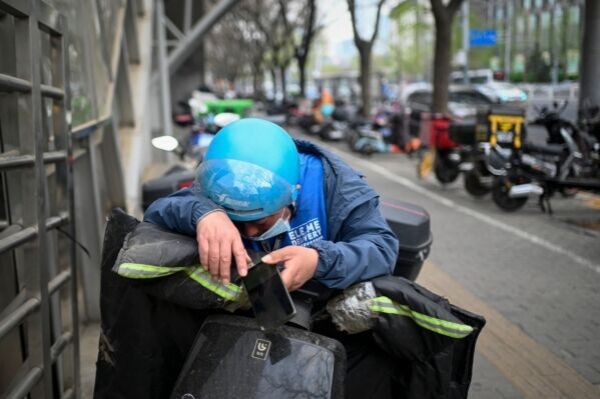
China is facing a serious problem of unemployment, with many people turning to food delivery and ride-hailing services. However, according to the latest data, there is an excess of over 16 million food delivery riders in China, leading to a situation where five riders are competing for a single order. The ride-hailing market is also fiercely competitive, with the Shenzhen city government warning that the ride-hailing market has reached saturation. Netizens are pointing out that this is not just a problem in Shenzhen, but a nationwide issue.
On May 29th, several mainland Chinese media outlets, including Phoenix News and East Money, reported that following the intense competition in the food delivery sector since last year, the problem of “excess riders” in the industry has become increasingly apparent as platform subsidies continue to decline. Industry statistics show that there are currently nearly 20 million instant delivery riders nationwide, while only about 4 million skilled riders are needed to support the daily average of approximately 110 million orders. This means there is an excess of over 16 million riders, with five riders fighting for a single order.
Rider incomes are generally declining. In Shanghai, some riders’ monthly income has dropped from a peak of 15,000 RMB to about 12,000 RMB, with a daily average order volume decreasing by nearly 20 orders. Meanwhile, in Beijing, riders’ daily order volume has dropped from 35 orders in 2020 to 20 orders, while their working hours have extended from 8 to 12 hours. Basic delivery fees have been slashed from 6-9 RMB during the peak period to 3-4 RMB, with some short-distance orders dropping below 2 RMB.
According to a report from Caixin on May 31st, the Shenzhen Transportation Bureau recently issued operational dynamics and risk alerts for the ride-hailing industry in Shenzhen in April 2026. According to data from various platforms, the daily average number of completed bicycle orders for ride-hailing in the city in April was about 13.01 orders. The demand for ride-hailing in the Shenzhen market has already reached saturation. Companies and practitioners intending to engage in ride-hailing operations were advised to make investment and employment decisions rationally and cautiously.
Mainland netizens have expressed their dismay, commenting, “Ride-hailing, food delivery, express delivery… all saturated, right?””Another item has been added to the ‘unemployment trio.'””Food delivery workers are saturated, express delivery recruitment isn’t as strong, order volumes are falling, equipment automation is increasing, and now they are starting to use robots.””This is why young people are becoming less willing to marry and have children, a life full of exhaustion and insanity.””With ride-hailing and food delivery already saturated, ordinary people have fewer options for work.””It’s not just the ride-hailing market in Shenzhen that’s saturated, in many first-tier cities, there are too many ride-hailing cars which causes problems… though during holidays, there aren’t enough ride-hailing cars available.”
A ride-hailing driver in Shenzhen shared a video summarizing his six months of work: working diligently for 16 hours a day, after deducting rental fees and traffic violation fines, he only takes home just over 5,000 RMB per month. If calculated based on an 8-hour workday, the monthly income is only just over 2,000 RMB. Some netizens pointed out that this is Shenzhen, known as one of the best cities in China, and the situation in other cities can be imagined.
A semi-official survey conducted by the Chinese Communist Party last year showed that 77% of ride-hailing drivers in China entered the industry after becoming unemployed, with 62.8% of drivers being the sole employed individuals in their entire families.