
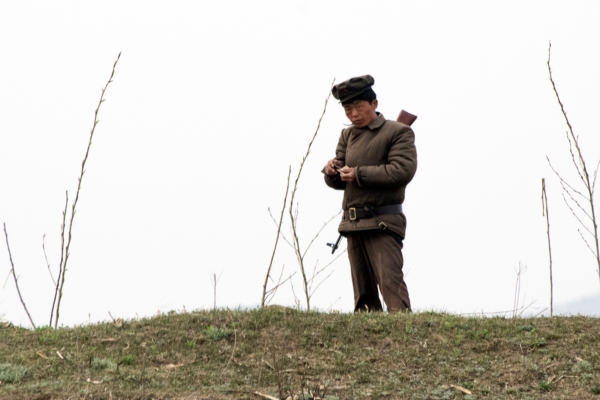
Ukraine and the United States recently announced that North Korea has dispatched tens of thousands of soldiers to Russia to support the country in its conflict against Ukraine. In response to this, some defectors from North Korea stated that North Korean soldiers are brainwashed from a young age to sacrifice everything for their supreme leader, which explains why they are willing to become “cannon fodder.”
According to a report by The Wall Street Journal, former North Korean soldiers revealed that almost all North Korean units sent to Russia, including special forces, share similar motivations. They are indoctrinated from a young age to sacrifice everything for the supreme leader. School textbooks even teach students to voluntarily become imaginary artillery targets to prove their loyalty to the regime.
These North Korean units’ deployment to Russia is seen as a rare opportunity to bring back wealth and glory for the Kim Jong-un regime, as claimed by the former North Korean soldiers. Those who die will be valued; those who survive will be hailed as heroes.
Previous reports by Da Ji Yuan suggested that the South Korean National Intelligence Service mentioned Russia would pay each North Korean soldier sent for support a monthly salary of $2,000. However, it remains unclear how much each soldier will actually receive.
The Wall Street Journal report mentioned that despite being labeled as mercenaries, cannon fodder, and second-rate by being sent to Russia, many of these soldiers have already prepared themselves for death, as well as how much they desire to escape from their homeland.
Former North Korean soldier Ryu Seong-hyeon, who defected to South Korea by passing through the Demilitarized Zone in 2019, shared his experiences. He expressed that when he was in North Korea, he was young, often hungry, and knew little about the outside world, much like the North Korean soldiers currently being sent to Russia.
Ryu Seong-hyeon, now 28 years old and having served nearly 10 years in North Korea, revealed that before choosing to escape North Korea, he worked at a construction site carrying bricks and shivered from the cold while on guard duty. He mostly ate watery porridge mixed with corn and could only have meat on special occasions.
He stated that if he were sent to fight in Russia during his service, he would have gratefully said “Thank you.” His reason being, “Well, at least I would get to eat better, right?”
Due to being indoctrinated from an early age, North Korean soldiers firmly believe they should do anything for Kim Jong-un, according to Ryu Seong-hyeon.
Lee Hyun-seung, a defector from North Korea who served in the elite North Korean unit “Storm Corps” at the age of 39, shared that he underwent daily ideological education during his service, having to memorize Kim Jong-un’s directives and repeatedly express willingness to die for him.
He believes that the current North Korean soldiers sent to aid Russia have undergone the same brainwashing training. “While they may sacrifice even when it is of no help in the battle, they dare not question the leader’s order to go to Russia,” he added.
Former South Korean Army Major General Bang Jong-kwan stated that due to language barriers and unfamiliar terrain, the roles the North Korean soldiers may play in Russia might be limited to infantry.
Bang Jong-kwan commented, “They will suffer significant casualties because Russia is unlikely to provide advanced equipment or intelligence.”
Sim Ju-il, who served as a military officer in North Korea for 30 years before defecting to South Korea in 1998, expressed his desire to go to the frontline of the Russia-Ukraine battlefield to break the North Korean soldiers’ blind loyalty to the Kim regime.
He mentioned that around 300 defectors are also willing to go. If deployed to the frontline, they hope to persuade North Korean soldiers to surrender or defect by distributing anti-regime leaflets and broadcasting, causing “psychological confusion.”
He remarked, “I want them to know they have been deceived. They do not have to sacrifice themselves for their loyalty.”