
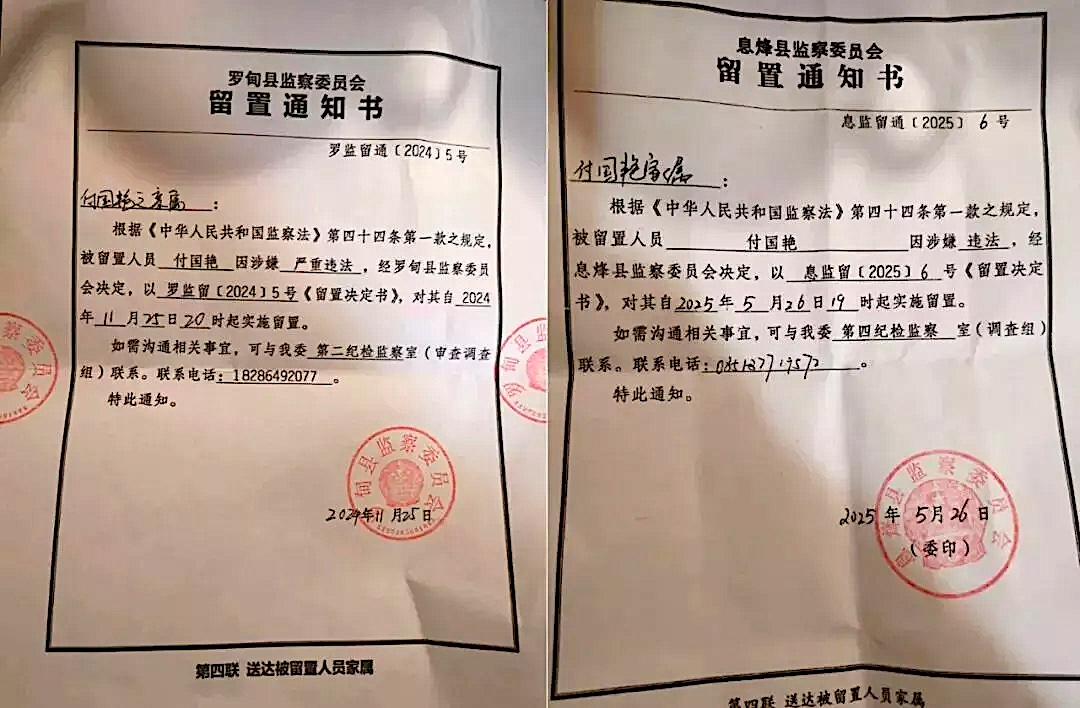
In Guizhou province, the privately-owned company Qian Cui Xing, led by chairman Fu Guoyan, has fallen into a state of near closure after multiple detentions of Fu Guoyan. Recently, Fu Guoyan’s son, Ma Xianghong, publicly wrote a letter to the Governor of Guizhou Province, Li Bingjun, expressing the willingness to donate all the company’s assets to the government to save the livelihoods of nearly a hundred employees and tens of thousands of embroidery artisans in the mountains. This incident has attracted public attention.
Qian Cui Xing National Cultural Development Co., Ltd. (“Qian Cui Xing”) was founded by Fu Guoyan’s mother Ma Xianghong in 1989. Initially just a “store-front factory,” it later grew into a company with a more comprehensive range of products in the field of Guizhou ethnic tourism merchandise, including wax printing, embroidery, local fabric, silver jewelry, and more.
Ma Xianghong, in his open letter, mentioned that during the Shanghai World Expo in 2010, “more than 90% of the exhibits in the Guizhou Pavilion were provided by Qian Cui Xing.” Additionally, Chinese Communist Party leaders have visited Qian Cui Xing, and some of the company’s products were selected by the Chinese Ministry of Foreign Affairs as “national gifts” and presented to figures including the UN Secretary-General Ban Ki-moon.
From Ma Xianghong’s perspective, this brand is no longer just a regular commercial enterprise; it has become a hallmark of Guizhou’s ethnic cultural industry. However, this brand, after 37 years of establishment, now finds itself in a state of “near closure.” Ma Xianghong hopes the government can take over the company, stating, “Do not let this brand that carries the memory of Guizhou’s culture vanish.”
What makes Qian Cui Xing unique is that it does not solely rely on factory production but has long connected with a large number of artisans in the mountainous regions of Guizhou. Ma Xianghong stated that the company had driven the development of over 600 upstream specialty micro-enterprises and handicraft workshops, collaborating with two to three thousand farmers in the long term, with the number of people involved in handicraft production reaching 20,000 during peak order seasons.
According to the figures provided by him, Qian Cui Xing had purchased products from farmers and embroidery artisans totaling over 53.3 million yuan. Therefore, in his view, the collapse of the company would not only mean the disappearance of a company but also the livelihoods of nearly a hundred employees who depend on it, as well as the tens of thousands of embroidery artisans in the mountains who need to earn money to support their families, facing immense challenges.
Ma Xianghong thus proposed to donate all of the company’s assets, including the brand and customer resources, to the government, hoping for the government to take over and keep the business running.
Ma Xianghong referred to the past two years of Qian Cui Xing’s experiences as “three groundless disasters.”
He stated in the open letter that since November 25, 2024, his mother and Qian Cui Xing chairman Fu Guoyan had been successively placed under “residential surveillance” by personnel from the Guizhou Provincial Supervision Commission. It was noted that a few months before Fu Guoyan’s detention, the director of the Guizhou Provincial Justice Department had visited Qian Cui Xing Company for research on production and operations.
According to Ma Xianghong, the charges behind this residential surveillance were equally unacceptable to him.
As per Ma Xianghong’s account, Fu Guoyan was asked to admit to “helping a certain leader conceal criminal proceeds of 9 million yuan,” but he claimed that there were “no bank transfers, no physical evidence,” believing that the related accusations “completely defy common sense.”
During the previous two periods of residential surveillance, the company had already been in a state of closure, but the employees still held hope, “waiting for my mother to come out and restart Qian Cui Xing.”
On August 25, 2025, Fu Guoyan concluded a nine-month period of residential surveillance.
Ma Xianghong recalled that at the time, “the employees celebrated by clapping,” and subsequently restarted the business under his mother’s leadership. However, the restart did not last long.
Ma Xianghong mentioned that on April 21 this year, Fu Guoyan was summoned by officials from the Supervision Commission and was subsequently placed under residential surveillance at a designated location by the local public security bureau in Lishui County, suspected of “group licentiousness.”
In his open letter, he claimed that thereafter, lawyer visits were restricted, and he believed these measures were aimed at forcing his mother to submit. He also alleged that the public security bureau in Lishui County later attempted to “break in, unlawfully obtain evidence from a remote location.”
For Qian Cui Xing, the recurring investigations and the inability to operate normally have already deprived the company of the foundation for continued operation.
Ma Xianghong bluntly stated, “This time, Qian Cui Xing is probably completely collapsing.”
It is noteworthy that Ma Xianghong did not propose selling the company, financing, or seeking commercial investment in his open letter but directly suggested donating the company “entirely to the government.” This request itself carries a strong sense of helplessness and has sparked intense discussions in public opinion circles.
Subsequently, online forums saw numerous discussions surrounding the local law enforcement and the survival environment of private businesses.
Some netizens commented, “This is the current situation facing Chinese private enterprises, where the government arbitrarily arrests people, extorts money, conducts local raids, long-distance raids, overseas raids, making life unbearable! The CCP continues to bring disasters!”
Many others said, “Guizhou Governor: if you had obediently handed over the company earlier, would you have had to endure so much suffering?” “For those who don’t listen, send all the management to indefinite detention.” “What’s the use of the government wanting your business? They want cash!” “Does the ongoing crackdown on crime and evil include this?”
The so-called “special campaign to crack down on crime and eliminate evil” initiated by the Chinese authorities nationwide since July this year has been analyzed externally as a legal wealth plundering operation against private enterprises.
According to public information from Baidu, the shareholders of Guizhou Qian Cui Xing National Cultural Development Co., Ltd. are Ma Xianghong (holding 98.485% of the shares) and Fu Guoyan (holding 1.515% of the shares). The company has invested in five other enterprises. The company has branch stores or counters in Guiyang, Guangzhou, Xiamen, Hong Kong, and several other locations.
In reality, the plight of Qian Cui Xing is not an isolated case; previous incidents in Guizhou and Henan have also drawn public attention.
As reported by “China Business News” earlier, ethnic minority female entrepreneur Ma Yijia Yi, after undertaking ten government projects including the poverty alleviation relocation project in Liupanshui City, Guizhou Province, had been reportedly seeking project payments for many years. At the end of 2023, Ma Yijia Yi was criminally detained by local police on charges of “provoking troubles.”
Multiple sources have confirmed that prior to the arrests of Ma Yijia Yi and others, the local government had once proposed a settlement of all debts amounting to 12 million yuan, which was rejected by her and her lawyer. Subsequently, the case occurred.
Public information shows that Ma Yijia Yi’s company, responsible for the Liupanshui City “Haiping Qianhu Village” project, handed over in 2016, was once hailed as a model for poverty alleviation in Guizhou Province. Former Liupanshui City Party Secretary Li Zaiyong had launched image projects during his tenure, many of which are now unfinished.
During Li Zaiyong’s three-plus years in Liupanshui, local debt increased by over 150 billion yuan. Before Ma Yijia Yi was arrested, to prevent local debt risks, the Liupanshui city government had introduced a comprehensive debt settlement policy. However, whether these debt settlement policies involved “criminalizing debts” remains unknown.
Of note, the Guizhou Provincial Governor Li Bingjun, mentioned by Ma Xianghong, took office as acting Governor of Guizhou Province in November 2020 and officially became Governor in January 2021. During Li Bingjun’s tenure as Governor of Guizhou Province (with Xu Lin as Party Secretary), private entrepreneurs Ma Yijia Yi and Fu Guoyan were successively detained.
According to mainland media reports, instances of “arresting bosses and seizing enterprises,” as mentioned earlier, have also been openly discussed by officials within the party.
In 2019, then-Vice Prosecutor General of the Supreme People’s Procuratorate, Sun Qian, at a Political Consultative Conference subgroup meeting when discussing the plight of private enterprises, mentioned that during a research visit to a certain province, he found that dozens of the top 100 private economic business owners in the province had been arrested, leading to employee layoffs, factory closures, and an impact on government tax revenues.
In July of this year, Wang Fei, a private entrepreneur from Henan with assets worth millions, mentioned during a live broadcast the ordeal he and his wife endured: being detained for 712 days without charges, subsequently acquitted, receiving a state compensation of 410,000 yuan. However, their business has now closed, with debts exceeding 30 million yuan, and they now struggle to make a living doing odd jobs with his wife.