
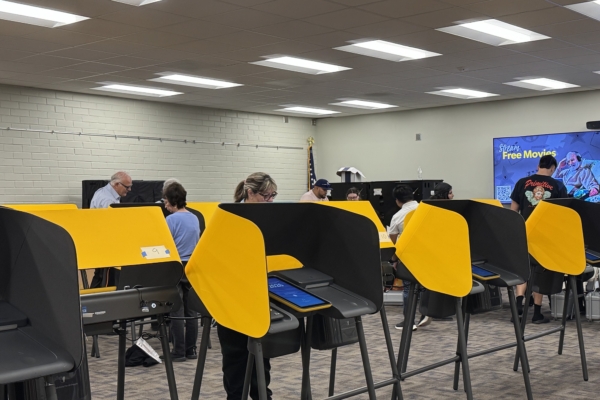
This week on Monday (13th), Ruth Weiss, Vice Chairman of the Election Integrity Project®California (EIPCa), spoke at a community event in Orange County. After more than 15 years of research and documentation, EIPCa believes that “voting in person” is the safest way to vote. But what exactly constitutes “voting in person”?
In California, voters can decide how they want to cast their votes, whether it’s by voting in person at the polling place or by using mail-in ballots. Each voting method has its own advantages and disadvantages. EIPCa encourages voters to weigh their options and choose the method that makes them feel most comfortable and satisfied when voting.
EIPCa is a non-partisan non-profit organization made up of volunteers in California, aimed at upholding the integrity and fairness of the process when citizens exercise their most basic rights, which is the right to select representatives through fair and honest elections.
Some people may have misunderstandings about what “voting in person” entails. While you are physically handling the ballot, the following actions do not qualify as “voting in person”: sealing the ballot in a return envelope and then 1) mailing it; 2) dropping it into a community ballot box; 3) handing it to family, friends, or ballot harvesters; 4) delivering it to the county election office; 5) submitting it directly to the County Clerk or Registrar of Voters.
So, what does “voting in person” actually mean? It’s simple – it means submitting a ballot that is not enclosed in an envelope.
“Voting in person” typically achieves the following goals: 1) Expedite the counting process – after voting in person, the ballot will be counted on the same day or the next day (if voting is done before election day); 2) Maintain the voter’s personal privacy and ballot confidentiality; 3) Avoid potential delays, mishandlings, or tampering that can occur with ballots sealed in envelopes; 4) Preserve the integrity of the chain of custody. State regulations stipulate that after the polls close, ballots are moved by at least two people to a transport container and sealed; during transportation, two individuals are responsible, and both must sign off during the handoff; once ballots reach the counting center, the seals are removed, and the ballots are counted “before the eyes of the public,” ensuring uninterrupted oversight throughout the entire process.
On the other hand, “non-personal voting” fails to achieve the aforementioned goals due to the following reasons: 1) Delay in the counting process – ballots sealed in envelopes require sorting, scanning, and signature verification, which is a highly subjective process by the staff; the verification process is time-consuming and labor-intensive with lenient inspection standards resulting in delays ranging from 24 hours to several weeks depending on the time of submission; 2) Not completely anonymous voting – voter’s name, address, and signature are prominently displayed on the envelope. In most counties, this information is visible on the outside of the envelope, making ballots susceptible to improper alterations or malicious exploitation after being handled by postal workers or ballot collectors. During signature verification, staff have access to the voter’s complete file, including party affiliation; although inspectors are supposed to remain unbiased in their assessment, human error can be influenced by this information.
3) Ballots are easily damaged and may require duplication – apart from the inherent risks and inaccuracies in signature verification, ballots could easily incur damage during the mechanical process of opening envelopes and retrieving them, requiring patching and duplication; ballots with stains, smudges, tears, irrelevant marks, water damage, among other issues, are sent for reproduction.
4) Lack of complete oversight – once mailed ballots enter the United States Postal Service (USPS) system, the chain of custody is severed. Ballots could pass through several unsupervised channels, with extended delivery times. Various incidents have been reported in the media, such as ballots being discarded in gutters or bushes, or ballot boxes catching fire.
There is an exception for conditional voter registration (same-day registration) ballots, which must be submitted in sealed envelopes and new voter information logged into county and state-level databases.
In California, if you miss the voter registration deadline by 15 days before the election, you can use conditional voter registration to vote: you can register online or go in person to a voting center within 14 days before election day, or you can register conditionally and vote on election day itself.