
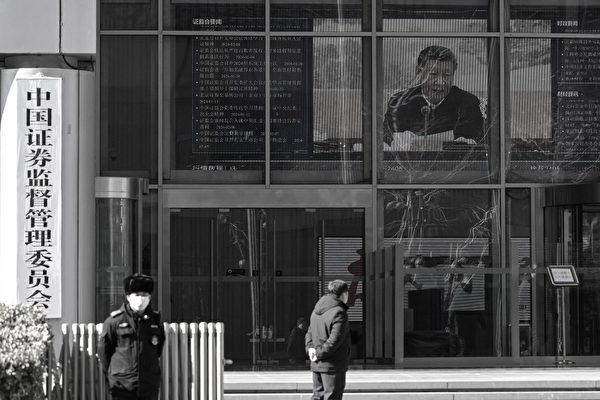
The China Securities Regulatory Commission, together with eight departments, has launched an investigation into Futu, Tiger Securities, and Changqiao Securities. They have issued advance notices of administrative penalties, with the three cross-border securities firms facing a total penalty of no more than 2.2 billion yuan. However, the announcement did not specify the exact amount of confiscation of the “entire illegal gains” of the securities firms, with estimates from analysts suggesting that the three companies may have accumulated revenues totaling between 28 billion to 37 billion yuan.
Several analysts pointed out that this move is not just a routine financial regulation, but a systematic action by the Chinese Communist Party to comprehensively block capital outflows from the private sector and strengthen a “wartime system” amidst economic challenges, with bigger impacts anticipated in the background.
According to various media reports, the China Securities Regulatory Commission has launched investigations into Tiger Brokers (NZ) Limited (Tiger), Futu Securities International (Hong Kong) Limited (Futu), and Changqiao Securities (Hong Kong) Limited (Changqiao) and their related entities for illegal securities business activities conducted in the country and abroad. The commission has also issued advance notices of administrative penalties.
The commission stated that the three institutions conducted securities trading marketing promotions and processing of transaction instructions in the country without approval, and earned related profits. Additionally, their related entities engaged in illegal activities such as public fund sales and futures brokerage services in the country and abroad. The commission intends to confiscate all illegal gains of Tiger, Futu, and Changqiao’s related entities, and impose severe penalties.
On the evening of May 22nd, Futu Holdings and Tiger Securities disclosed the penalties. Futu Holdings revealed that the commission intends to impose a total penalty of approximately 1.85 billion yuan (about 271 million US dollars) on the related companies and proposed a personal fine of 1.25 million yuan (about 183,580 US dollars) on the founder and CEO Li Hua.
Tiger Securities announced that several of its subsidiaries received notifications from the Beijing Regulatory Bureau of the commission, imposing a total administrative penalty of about 308.1 million yuan and confiscating illegal gains totaling around 103.1 million yuan. The company’s director, CEO, and controlling shareholder Wu Tianhua also received a warning and was fined 1.25 million yuan.
On the morning of May 23rd, Tiger International based in Singapore issued a statement regarding the investigations and penalties by the China Securities Regulatory Commission, refuting claims of non-cooperation with regulations or defiance. They clarified their position firmly.
Following the news of the penalties, the US stocks of Futu Holdings and UP Fintech (Tiger Securities) plummeted over 25%.
The China Securities Regulatory Commission did not specify the exact amount of confiscation of the three securities firms’ “illegal gains” in the announcement. Tang Jingyuan, a current affairs commentator living in the US, pointed out in a self-media program that current estimates suggest the total “illegal gains” of the three companies could reach as high as 28 billion to 37 billion yuan.
He mentioned that this action is not just led by the commission but involves cooperation from eight departments, including the Public Security Bureau and the Central Bank, as a coordinated national-level operation rather than ordinary regulation.
Tang Jingyuan emphasized that the sudden heavy penalties on cross-border securities firms by the Chinese authorities are, on the surface, regulatory actions but essentially a systematic financial harvesting operation to cut off channels for Chinese people to invest in overseas markets and prevent continuous outflows of capital.
Independently, commentator Jiang Feng also holds a similar view, stating in a self-media program that “capital has the most sensitive perception.” Mainland Chinese funds are moving away from domestic-backed brokerage platforms towards overseas platforms.
He believes that the authorities had tacitly allowed cross-border stock trading for several years, but suddenly tightening regulations now because it’s “time to kill the pig.” He warned that many investors might face penalties for “evading foreign exchange” in the future.
Commentator Qin Peng mentioned in the program “Good Morning China” that in 2025, China saw a net outflow of capital of around $760 billion, with estimates suggesting the real figure could exceed $1 trillion.
He said, “China’s current problem isn’t earning dollars but retaining them.” He thinks the Chinese authorities are concerned not only about US stocks but also about the middle class shifting their assets out through various means.
Veteran media figure Shi Shan bluntly stated, “This is a case of ‘shutting the door to catch the dog.’ First, close the gate to prevent money from going out, and then force you to buy A-shares.” He mentioned that with record central government deficits and local finances heavily relying on central subsidies, continuous capital outflows are alarming for the Chinese authorities.
According to Xinhua News Agency, with the approval of the State Council of the CPC, the China Securities Regulatory Commission and eight departments jointly issued the “Implementation Plan for Comprehensive Rectification of Illegal Cross-Border Securities, Futures, and Fund Operations,” which entails a two-year concentrated effort to eradicate illegal cross-border operations of overseas securities, futures, and fund institutions.
Under the plan, the two-year focus is on clearing illegal legacy businesses, with a ban during this period on foreign institutions providing buy-in transactions, fund transfers, and other services illegally to investors within the country. After the concentration period, foreign institutions must completely shut down domestic websites, trading software, and supporting servers, prohibiting the illegal provision of transaction services to existing investors within the country.
Tang Jingyuan noted that the authorities’ requirement for cross-border platforms to allow users only sell-offs but not buy-ins mirrors the administrative intervention logic seen during the A-share crisis; ‘at the time of the A-share collapse, buying was allowed but not selling.’ He indicated that when the authorities want investors to stay in the A-share market for party harvesting, they will only allow buying; when they want investors to divest overseas assets, only selling is permitted.
He emphasized that the crucial signal of this move is the authorities beginning a comprehensive crackdown on Chinese residents’ overseas investments. “This is not just shearing the sheep but uprooting it completely,” he pointed out, indicating that the revealed penalties are just the appetizer before the main course of investigations and even more significant actions to follow.
Qin Peng expressed concerns that investors might face further punitive measures in the future beyond the penalties imposed on the securities firms. “Currently, it’s the firms being penalized, but will these individual investors be next? Many are afraid,” he added.
While the Chinese authorities are tightening regulations on cross-border securities trading, the Hong Kong authorities are also taking action. According to Hong Kong Economic Times, the Securities and Futures Commission has sent a circular to the industry, pointing out cases discovered during recent specialized examinations of 12 licensed securities firms involving suspected use of dubious or falsified documents for account openings, with the majority related to “Mainland investors’ accounts.” All licensed corporations in Hong Kong will be required to immediately implement three mandatory additional review measures on Mainland customers.
The Securities and Futures Commission of Hong Kong stated that licensed firms, whether directly providing services to foreign (especially Mainland China) investors or channeling through affiliates, third-party service providers, or intermediaries outside Hong Kong, must comply with all relevant laws and regulatory requirements in Hong Kong and the respective jurisdiction.
Shi Shan mentioned in the program “Good Morning China” that this is the Hong Kong Securities and Futures Commission aligning with Beijing’s actions, signifying a further erosion of Hong Kong’s remaining status as an “international financial center.”
He noted that Beijing needs Hong Kong primarily because it can still accommodate certain “grey financial functions.” “Now, Hong Kong’s other centers are almost gone, only the financial center remains. But even this financial center fundamentally relies on Chinese funds,” he added.
Tang Jingyuan indicated, “Hong Kong is no longer a lawless land; the new version of the National Security Law can ‘control the air from above, the ground from below, and the empty space in between.’ If the CCP is determined to take your money, you won’t be able to escape.”
Regarding the sudden change in the Chinese authorities’ stance, Tang Jingyuan believes it reflects two dangerous signals. First, “any private property is not genuinely protected within the CCP system.” Second, it indicates that the Chinese economic crisis may have worsened significantly. He described this action as akin to “household-style supervision.”
Tang Jingyuan highlighted that signs of this crackdown emerged earlier. He referred to the so-called “Comprehensive Action Meeting for Preventing and Combating Illegal Financial Activities” held by Beijing on April 22nd, initiating a three-year “Prevent-Non-Combat-Non” action from 2026 to 2028.
He mentioned that the so-called “illegal financial activities” defined by the CCP are entirely based on official definitions. Using the P2P lending industry as an example, he emphasized how the definition shifts from innovation during lenient times to illegality during crackdowns.
In fact, before the China Securities Regulatory Commission issued extensive penalties, the official People’s Daily website published an article in 2021 titled “Implementation of the Personal Information Protection Law Imminent, What’s Next for Cross-border Internet Securities Firms?” raising concerns about the mobile applications of Tiger Securities and Futu Securities providing securities trading services to mainland Chinese investors in violation of regulations. A year later, the commission announced Futu and Tiger Securities were engaged in illegal cross-border securities business activities with mainland Chinese investors and demanded corrective actions.
Analyzing from a deeper perspective, commentator Jiang Feng outlined that the current series of policy logics by the CCP ultimately aim at “pooling resources to maintain control.” He warned that the CCP might utilize the guise of “unifying Taiwan” to further militarize national resources.
“They will utilize war mechanisms to consolidate all remaining resources in society,” Jiang Feng explained. “The CCP’s goal is not to improve people’s lives but to sustain the existing power structure.”
Through these developments, it is evident that the Chinese authorities are tightening regulations on cross-border securities trading, aiming to prevent capital outflows and maintain control over financial activities within the country, signaling broader moves to safeguard national interests and retain economic stability amidst challenging circumstances.