
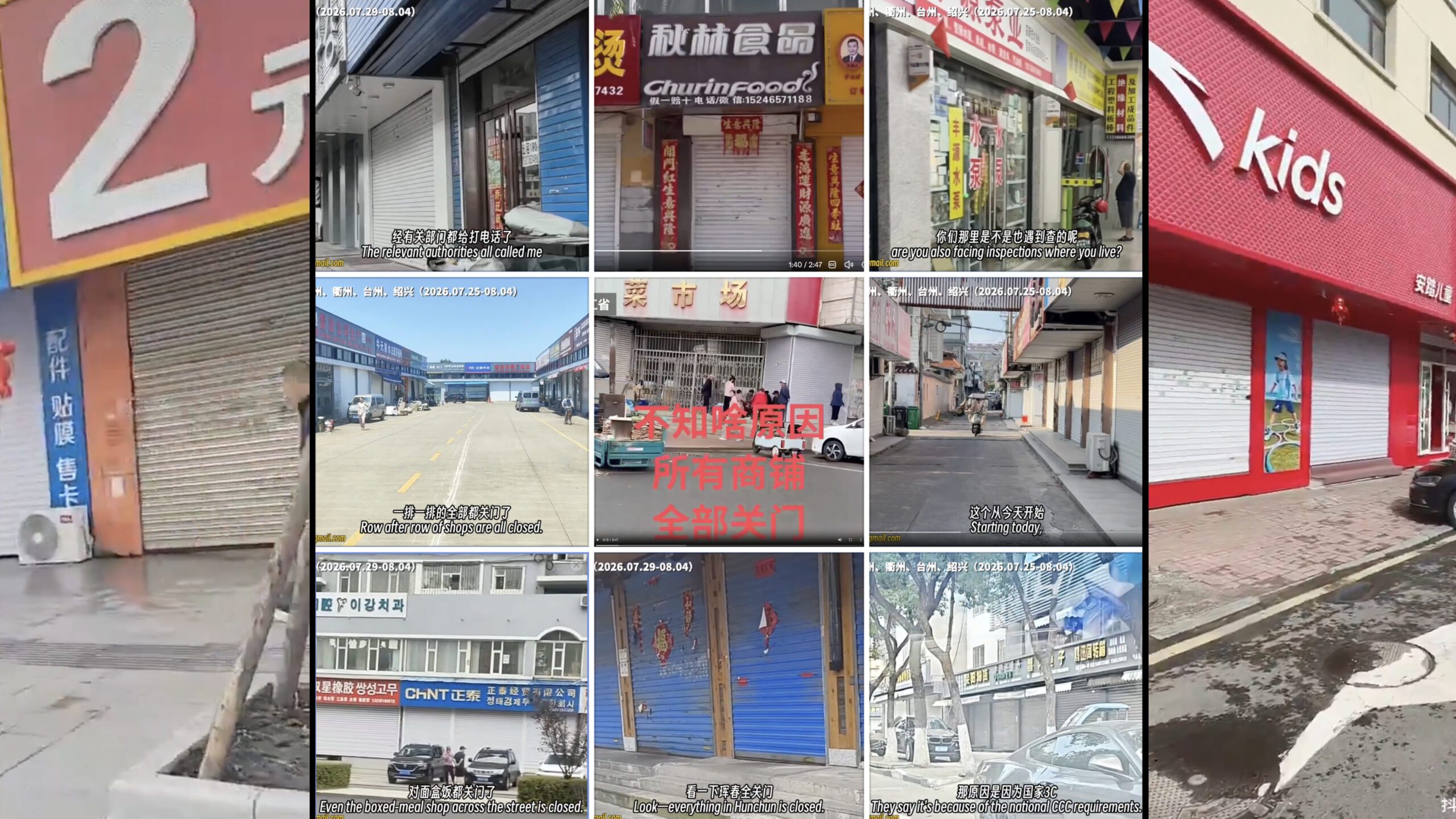
As the inspection teams of the Central Committee of the Communist Party of China successively entered various provinces, a large official inspection under the name of 3C safety certification has been carried out across China. Violators face fines ranging from 50,000 to 200,000 yuan, causing anxiety among businesses. Merchants in various regions are closing their doors, leading to a prevailing sense of pessimism in the market.
Many interviewed merchants told the media that the official inspection directly shifts pressure onto distributors, and there is a lack of sufficient advance publicity and guidance on standard changes and certification requirements from the regulatory authorities. Faced with an already sluggish market, sudden inspections and fines have added further pressure on operations, leading to widespread closures in some areas.
In recent times, multiple regions in China have been conducting ongoing 3C certification and product quality inspections, affecting industries such as building materials, hardware, lighting fixtures, kitchenware, and general merchandise. Several merchants have stated that the inspection scope is wide, and the penalties vary greatly, causing concern among distributors about potential penalties for their stocked goods.
3C certification (CCC certification) is a mandatory certification system in China for products related to electromechanics, automobiles and components, children’s toys, and more. Products subject to certification must pass before they can be imported, exported, manufactured, sold, and used. On June 10th this year, the Emergency Management Department of the CPC issued the work arrangements for the 2026 Central Safety Production Inspection. Since June, 24 Central Safety Production Inspection teams have successively entered 31 provinces, municipalities, and autonomous regions to conduct inspections during the second and third quarters.
A hardware store owner surnamed Wu in Yanling County, Zhuzhou City, Hunan Province, when interviewed by the media, mentioned that during the inspection she underwent in June, the main focus was on PE pipes (polyethylene pipes). She explained that a friend of hers in the county was recently inspected for similar products, and she describes it as “very hard to pass.”
Wu mentioned that she narrowly avoided being fined because the product’s “thickness was slightly off,” but the regulatory personnel contacted the manufacturer, so she ultimately did not face further penalties. Regarding the fine amount, she said: “The amount of the fine depends on whether you have a high or low sales volume. If you have a high volume, the fine can be substantial.”
Her biggest takeaway from the inspection was the continuously increasing business pressure. In her opinion, if there are issues with the products themselves, they should be traced back to the source of production rather than putting the main pressure on the sales sector. She added, “Inspecting distributors is probably just a way to impose heavier fines.”
A kitchenware and general merchandise sales owner surnamed Lin from Guangdong shared a practical issue with reporters: defective products in the possession of distributors are not necessarily recently acquired.
She explained that after the standard upgrade by production companies, their previously manufactured products may still gradually enter the market through the distribution system. This means that for small merchants at the sales end, they not only face the new standards but also have old stock products already in circulation to deal with.
In situations where there is a lack of clear and sufficient transition periods and notification mechanisms after standard adjustments, merchants may unknowingly continue selling old inventory, thereby risking inspection and penalties.
A man in the decoration industry from Ningbo, Zhejiang Province, when approached by reporters, mentioned that he recently went to the market to buy lighting fixtures and discovered that all the shops had “closed.” He acknowledged that 3C certification is a mandatory quality inspection in the country but believed that the operating environment for many industries has become exceedingly difficult.
According to his observations, the inspections are not just targeting small brands, as “domestic first-line brands are also being inspected.” Upon discovering issues, the fine amount can reach tens of thousands of yuan. He said, “Fines ranging from 50,000 to 200,000 yuan have already been imposed.”
For businesses relying on physical stores, in the midst of insufficient consumer demand and intense market competition, further high penalties would only amplify the business pressure.
The boss, Lin from Guangdong, recounted her own inspection experience to the reporters. According to the relevant regulations, the amount of the penalty is related to the value of the goods, “it’s three times the value of the product, and my goods are not worth that much, how can they impose such a hefty fine?”
Ultimately, she was fined 495 yuan for selling a gas stove without 3C certification and a few gas hoses. She mentioned that the reason for her lighter penalty this time was that the relevant standards were only enforced from October 2025, which wasn’t too long ago, and she was considered a first-time violator.
More than the fine itself, Lin was concerned about whether the information could be conveyed promptly to the operators. She mentioned that when she questioned the penalty with the officials, she directly asked them, “Before you conduct the inspection, you should inform us, the merchants, and provide a standardized list.” She believed that if the standards change, the regulatory authorities should inform the operators in advance to give them a chance to handle their inventory promptly.
When challenged by the officials that “the internet is so advanced now, you can search it online by yourself,” she quickly retorted, “What if someone didn’t go to school and can’t read? How would they learn?”
Apart from inspections and penalties, several interviewees repeatedly mentioned another common sentiment, the current struggle in the physical retail business.
Lin expressed, “Business is tough now, I’ve been doing it for over a decade, and this year is the worst, especially the past two months, it’s never been this bad.” She shared that she’s still persevering in her business, but with inadequate demand, strict inspections, and changing product standards, the operating space for small businesses is diminishing.
A business owner surnamed Sun engaged in the building materials trade in Jiangdong District, Ningbo City, Zhejiang Province, told the media that a central inspection team recently conducted inspections on 3C certification for several days. He mentioned, “The central inspection team came down to inspect and supervise 3C; Zhejiang has been inspected for quite a few days. If they find products without proper certification, the businesses are ordered to shut down and fined.”
According to his observations, this wave of inspections has affected various industries. “Now all businesses dealing with building materials, hardware, adhesive materials, auxiliary materials, paint, and logistics have closed down.” He stated that many businesses have chosen to temporarily cease operations to avoid risks until the inspections conclude, and then resume business.
A shop owner surnamed Zhou from Shibing County, Guizhou Province, running a mobile phone and computer repair shop, noted that there have been 3C inspections in the area for many years, but this year’s inspections are notably stricter. He mentioned, “We’ve been inspected many times; they are checking more rigorously this year. They took the products for testing and said they would have the results after a month.”
He described that his store was recently inspected with mobile phone chargers and power banks being targeted for examination. Law enforcement officers would sample products related to 3C certification and send them for testing by professional institutions.
“Anything electronic is inspected, light bulbs, sockets, gas stoves, they examine everything. The Industrial and Commercial Bureau does not have the experience of inspecting the equipment’s compliance. They send a sample to a professional institution, and if it fails, they have to pay a fine, the amount of which is unknown.”
Zhou mentioned that rural markets were already very quiet, making it increasingly challenging for small businesses to operate. He commented, “We are a small store on the village roadside; what business can we have? If we don’t go out of business, that’s good.”
In response to ongoing inspections, he has taken measures to mitigate risks. “First, I obtained the distributor’s business license and then requested the manufacturer’s 3C certificate for the products. Even if something comes up, it won’t have much impact on you.” Regarding enforcement, he mentioned that inspections are usually not forewarned. “These checks will not be informed beforehand; officials from the commercial and industrial bureau come for inspections, checking all electronics.”
He highlighted that there had been ongoing 3C inspections in their area, but the enforcement measures were now visibly intensified this year.
Official reports indicate that this round of inspections is not a local individual action but rather a unified special inspection conducted nationwide by the Chinese authorities.
According to state media reports, in July this year, the Central Inspection Team conducted safety production inspections in Hunan, Guangdong, Zhejiang, Guizhou, among other provinces, and provided feedback to the local provincial committees and governments. However, the authorities have not publicly disclosed the accountable parties or a specific list of hidden dangers.
Factual reporting from interviewed merchants, along with numerous circulated videos on social media, further illustrate the chain reactions and panic triggered across various regions nationwide by this round of inspections.
Landowner Mei from Dongyang City, Zhejiang Province, who operates household appliances from Bosch and Southern Lighting, recently posted a video mentioning that on August 1st, two plainclothes men visited her store, seeking to buy “waterproof lights,” demanding the “cheapest ones.” On August 2nd, the same individuals appeared again in vests, questioning the 3C certification for a batch of products not labeled on the packaging, instructing the shop to “sell them quickly,” or else they would “return for checks.”
Mei revealed that a local colleague was fined 50,000 yuan for a non-3C certified switch panel and 300,000 yuan for a lamp. She lamented that whether or not fines are imposed depends on whether the local leadership is “genuinely considerate for the people or looking to generate income.”
In northeastern provinces of Jilin and Heilongjiang, a similar wave of closures spread to livelihood industries such as restaurants, pharmacies, repair shops, and hair salons.
A video shared by a resident in Longjing City showcased numerous closed shops on the street; another in Yanji City expressed frustration over the consecutive disasters in the region, stating, “After the flood, now more penalties”; while a resident in Hun Chun City described the streets as akin to a “foreign invasion,” with almost all shops tightly locked, making life increasingly difficult for ordinary citizens.
It’s worth noting that a man who previously published a video of closed shops in Hun Chun received a call from a relevant department after the video went viral, and they claimed that the content was considered as “rumors.”
Political commentator Li Lin told the media that with the continuous slump in China’s real estate market and the unsustainable land finance model, local governments facing drastically reduced land sale revenues are experiencing exacerbated fiscal challenges. In this light, all levels of government have stronger incentives to seek new income sources.
He elaborated that the recent authorities frequently inspect businesses and companies under the guise of updating national standards to increase income through fines and penalties. One significant factor behind this strategy is intensified local fiscal pressures. For small and medium-sized enterprises and individual merchants already struggling, intensified inspections and high fines undoubtedly inflate operating costs and potentially force some businesses to shut down.
Li Lin believes that this practice of “being financially strained results in heightened inspections and fines; the more inspections and fines, the harder it is for businesses to survive,” could lead to a vicious cycle. The deteriorating business environment might cause companies and merchants to reduce investments, lay off employees, or even exit the market, subsequently causing reductions in tax revenues and other fiscal income. Ultimately, it may not only fail to alleviate local fiscal pressures but worsen the financial predicament.
“Plague God Returns II: Tens of Thousands of Merchants Close to Avoid Penalties, `Avoiding the Plague God` Movement Spreads to Four Provinces and Nine Cities (2026.07.22-08.04)” — In late July to early August, following the significant impact in various regions of Heilongjiang, the “Avoiding the Plague God” movement, after a month of silence, began spreading southwards to other provinces. Over ten days from July 22 to August 4, the “Yesterday” project recorded large-scale closures of businesses in nine cities across four provinces…
*[Image link posted]*