
California and Los Angeles County fire investigators in a report released on Monday determined that a equipment failure by Southern California Edison (SCE) was the main cause of the Eaton Fire in Los Angeles County in January last year. The company has compensated some of the affected households. Despite this, the CEO of SCE’s parent company recently stated in an interview on the radio program “AirTalk” that the company cannot determine the exact cause of the spark generated, and is uncertain if the investigation can be fully clarified.
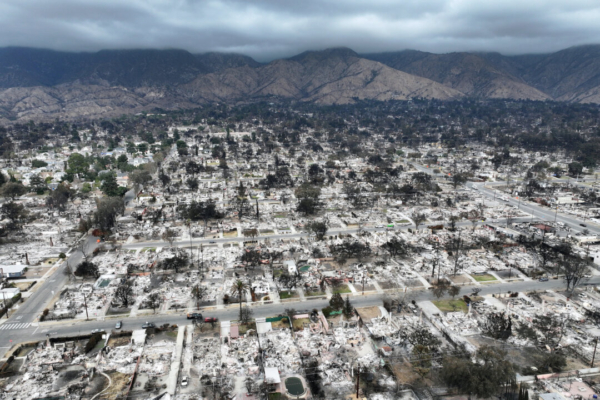
On January 7 of last year, the National Weather Service issued a “Red Flag Warning” for extreme weather and strong winds in Los Angeles County. The Eaton Fire ignited around 6:11 pm on that day, consuming over 14,000 acres of land in the following days and destroying more than 9,000 residences and commercial facilities in cities such as Altadena, Pasadena, Sierra Madre, and La Cañada Flintridge, resulting in at least 19 deaths. The fire lasted for 24 days until it was completely extinguished on January 31.
A joint investigation report by Cal Fire and the Los Angeles County Fire Department indicated that based on surveillance footage obtained, there were two electrical discharges on SCE’s transmission tower, causing unknown burning material to fall onto dry combustibles below, igniting the fuel layer 12 seconds later, leading to the Eaton Fire. After the fire, the related equipment was dismantled and sent to the laboratory for analysis, ultimately confirming that the transmission tower discharge ignited the fire.
The Eaton Fire was one of the most destructive wildfires in California. Besides equipment issues, key factors contributing to widespread building damage and casualties included extreme weather, strong winds, prolonged burning, and delayed evacuation orders.
SCE plans to compensate approximately $650 million through its Wildfire Recovery Compensation Plan; as of August, over $375 million has been paid to victims, and the total compensation amount may reach billions in the future. Over 4,000 claims have been received, with more than half already compensated. Tenants affected by smoke or ash damage in the disaster area may receive compensation ranging from $15,000 to $44,000; homeowners whose houses were completely destroyed receive an average of $754,000 in compensation, with the most severely affected receiving comprehensive compensation of around $6 million (including insurance and program benefits).
Pedro Pizarro, CEO of SCE’s parent company Edison International, emphasized that although the investigation report has reached a conclusion, the company may never fully understand the exact mechanism that caused the fire.
He stressed that while sparks were generated from the equipment, it remains unclear why a dormant and grounded line would become electrified at a specific moment. Pizarro stated, “The reality is we don’t fully understand the specific mechanism that caused the spark, and I’m not sure if we can ever fully clarify that.”
Furthermore, the official report contains a significant amount of redacted content, with at least 20 attachments remaining undisclosed, making it difficult for the public to fully comprehend the root cause of the malfunction. Pizarro mentioned, “We hope to have the opportunity to analyze this data; if the data is allowed to be released, it may contain more valuable information.”
Pizarro also pointed out that strong winds and natural gas pipeline issues were factors that contributed to the rapid spread of the fire. In January this year, SCE filed a lawsuit against Southern California Gas, accusing the company of only initiating widespread gas shutdowns several days after the fire, exacerbating the situation; SoCalGas countered SCE’s accusations, claiming they were trying to shift blame.
Pizarro concluded by stating that preventing wildfires is not solely the responsibility of a single electric utility company: “In order to reduce the risk of disasters caused by public utility facilities, we have done a lot of work with other public utility companies across the state, but unfortunately, we can never eliminate the risks entirely.”