
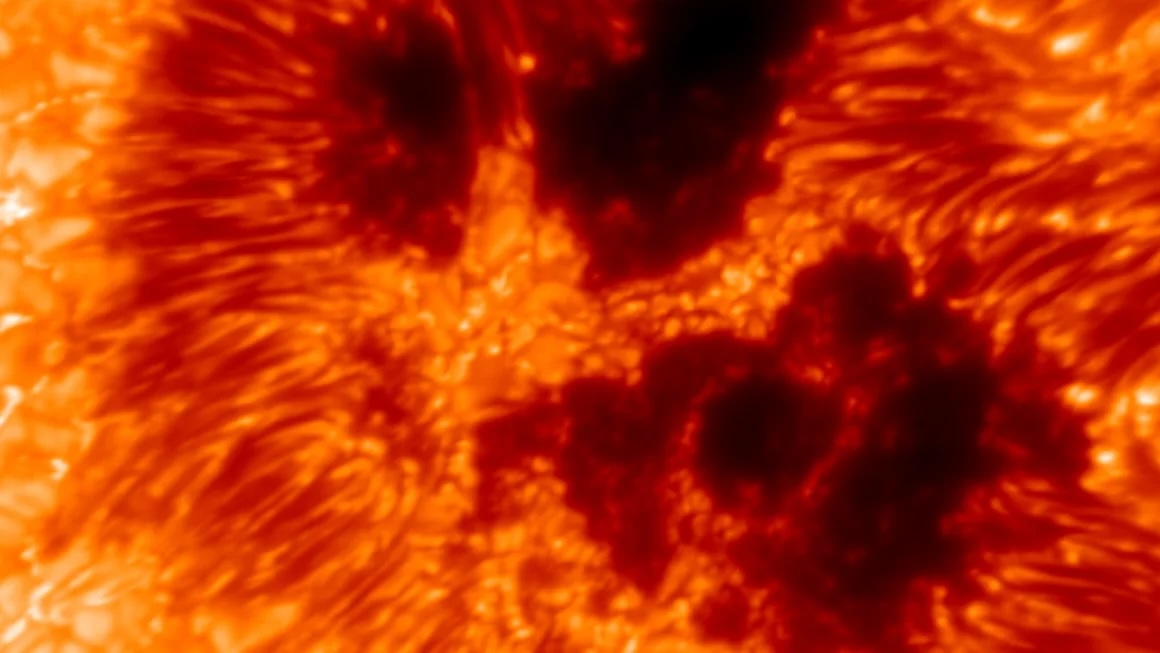
Scientists have captured the most detailed and clear image of the sun’s surface to date, revealing a peculiar and dynamic appearance.
According to the Associated Press, it is dangerous to directly stare at the sun without proper eye protection, but researchers were able to glimpse the sun’s scorching surface through the Daniel K. Inouye Solar Telescope located on Maui, Hawaii, under the National Science Foundation.
Initially, scientists captured these images not to observe the sun itself but to debug the telescope and test its performance limits. However, upon seeing the results, they realized they had captured unprecedented high-resolution images of the bright outer layers of the sun.
Moreover, they observed a peculiar feather-like texture on the sun’s surface, reminiscent of rippling layers.
Researchers observed unstable ripples on the sun’s surface generated by plasma clumps moving at different speeds due to magnetization, similar to the waves stirred up when a gust blows over a water surface, a well-known phenomenon that governs the movement of fluids.
Although this phenomenon has been observed on Earth, as well as other planets such as Jupiter and Saturn, “this kind of phenomenon has never been observed at this level on the sun’s surface before,” said Friedrich Wöger, a co-author of the study from the National Solar Observatory.
The research findings were published in the journal “Nature” on Wednesday, August 5th.
Scientists are dedicated to exploring the internal mechanisms of the sun to better track massive energy outbursts that could potentially impact Earth, known as “solar coronal mass ejections.” When these materials collide with Earth, they can trigger solar storms, disrupting GPS communications and creating beautiful auroras.