
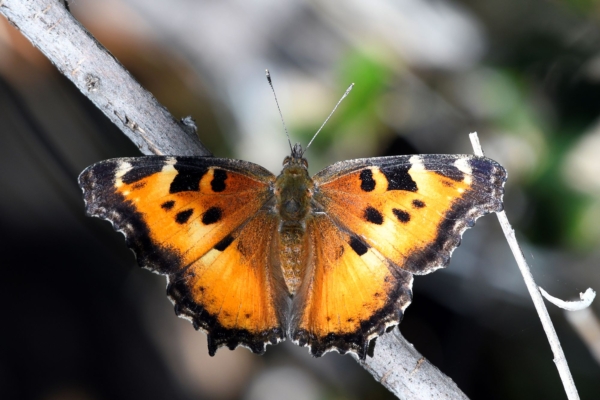
During this summer in Northern California, the vibrant California tortoiseshell butterflies have shown a significant increase in numbers. Many hikers in regions such as the Sierra Nevada, Lassen Volcanic National Park, and Lake Tahoe have spotted numerous orange butterflies with brown-black patterns.
In the spring, a large number of California tortoiseshell butterflies (scientifically known as Nymphalis californica) were also discovered in the Santa Cruz Mountains and Marin County. When these butterflies rest and fold their wings, they resemble dried leaves, providing them with excellent camouflage while at rest.
According to the Tahoe Daily News, observers can see adult butterflies collecting pollen and nectar among various shrubs and flowers. They also gather by waterside mud or nutrient-rich soil in a behavior known as “mud-puddling.” Throughout their lifecycle, they migrate with altitude variations and seek out California lilac shrubs for egg-laying.
After the eggs hatch, the caterpillars feed on host plants and grow rapidly until they form a chrysalis. These chrysalises will transform into winged insects flying to mountain peaks for “hibernation,” relying on stored fats to sustain life.
In the Lake Tahoe region, California tortoiseshell butterflies have three generations in a year, including two migratory activities. The first generation hatches in late summer of the previous year at high altitudes and overwinters as adults in low-lying areas. The second generation has the shortest lifecycle, hatching in lowland areas and flying to high altitudes for egg-laying to complete their lifecycle in summer. The current abundant butterflies are the third generation of the year, which will overwinter in low-lying areas in a few months and awaken in the following spring.
The surge in California tortoiseshell butterfly numbers this year may be attributed to abundant food sources. After several large wildfires in California, vast burnt lands have been left behind, providing ample growth space for shrubs and a rich food source for the butterflies.
Although butterfly caterpillars may consume many leaves or cause substantial leaf loss, this should be seen as a natural occurrence in the forest ecosystem that does not lead to the death of healthy shrubs. On the contrary, it promotes nutrient cycling and competition among plants.
In the upcoming weeks, if you venture out for a hike, you may enjoy the spectacle of butterflies fluttering in abundance. A resident who witnessed a swarm of butterflies remarked, “Seeing tens of thousands of butterflies flying overhead is truly astounding and brings joy.”