
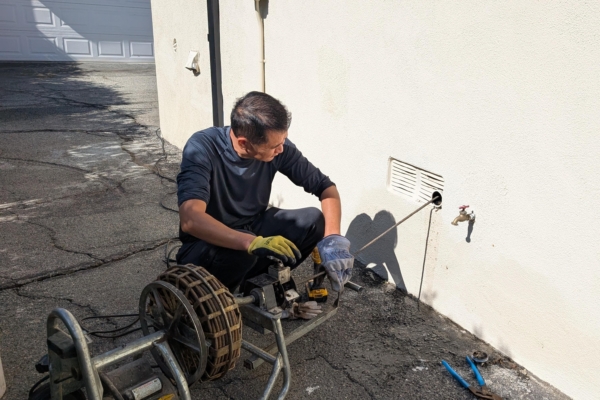
With the rapid development of artificial intelligence (AI), white-collar jobs such as clerical work, customer service, and administration are facing an automation wave. Many people are concerned about being replaced by AI. In contrast, plumbers who need to provide on-site maintenance, rely on practical experience, and make on-the-spot judgments have become a popular technical profession that is difficult to be replaced by AI. The United States continues to face a talent shortage in this field, attracting more and more people to enter the industry.
Peter Yuan, who has been working as a plumber in Southern California for over eight years, mentions that he can handle six to seven jobs on average in a day. From unclogging toilets, clearing pipelines to fixing leaks, his work schedule is almost always full. He emphasizes that the key feature of this profession is the accumulation of skills through experience. Typically, after learning from a master for two to three years and gaining sufficient practical experience, one has the opportunity to take on independent projects and establish their own company.
“The salary is actually very good, and the working hours are flexible. I can manage my own schedule,” Peter Yuan remarks. As long as there is a steady stream of clients, earning between $10,000 to $20,000 per month is not difficult. Therefore, many plumbers eventually choose to start their own businesses, increasing their income compared to being employed by others.
However, behind the high income lies hard work and responsibility. He admits that plumbers often have to deal with tasks like unclogging toilets and handling sewage overflow, which not only create a dirty and smelly environment but also require emergency responses. “Sometimes, I’m still helping customers fix toilets or unclog pipes at 8 or 9 o’clock at night. I have to rush over if someone’s house is flooded or they have nowhere to go to the bathroom,” he says.
Peter Yuan points out that due to the challenging nature of the job and the unpleasant working environment, many young people are reluctant to enter the field. This has led to a long-standing labor shortage in the market. He notes, “When people hear that they have to deal with sewage, they often back off, so there aren’t many who are willing to learn.”
He immigrated to the United States from Henan, China with his family in 2012. Upon his arrival, he began learning plumbing skills from fellow countrymen, hoping to quickly acquire a trade. Reflecting on his journey, he recalls that although he quickly learned the basics, he often struggled with complex issues due to lack of experience. Over time, through hands-on repairs, he gradually developed his judgment abilities.
“This industry has no shortcuts. You have to keep working and learning. Each household situation may be different,” he emphasizes. True skills often come from years of on-site experience rather than classroom theory.
When it comes to other technical trades, Peter Yuan believes that electricians have a relatively lighter work environment but require reading regulations and communicating with clients, making a higher proficiency in English necessary. In comparison, plumbing is easier to get into; as long as one is willing to work hard and learn, there is room for development.
He encourages young people interested in technical trades not to be afraid to start from scratch. “As long as you’re willing to learn, I’m willing to teach,” he says. He believes that networking is equally important when working in technical fields in the United States. “Networking with friends and acquaintances opens doors to opportunities.” He advises new immigrants to establish themselves in the U.S. by actively participating in social activities rather than confining themselves to air-conditioned rooms and computers.
As AI continues to transform the job market, technical professions that require labor-intensive work and on-the-spot adaptability are gaining renewed attention. Blue-collar technical jobs such as plumbing, electrical work, and heating, ventilation, and air conditioning (HVAC) are not only difficult to be fully replaced by AI or robots in the short term but also have become sought-after careers for new immigrants and graduates due to stable market demand and insufficient supply.