
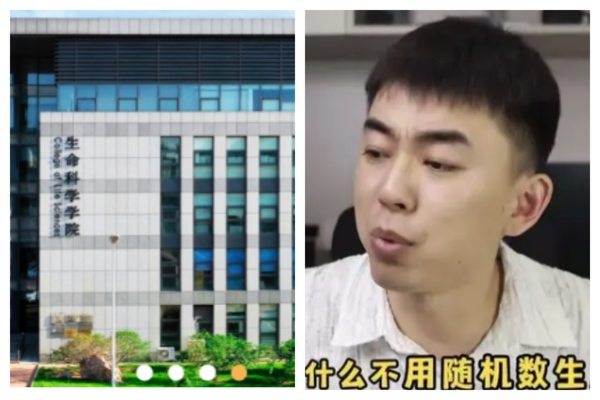
Recently, a Chinese dropout Ph.D. student named “Geng” has exposed multiple scholars online for academic misconduct in the field of life sciences. As a result, on May 6, a dean from Tongji University was dismissed, while a dean from Nankai University, a vice director, and an associate dean from Sun Yat-sen University in Guangzhou were also dismissed on May 30. “Geng” announced the suspension of his anti-fraud activities due to immense pressure, and his Douyin account has been permanently restricted. Overseas netizens expressed that “eliminating those who discover problems has always been the traditional way of the CCP.”
Tianjin Nankai University released a statement on May 30, revealing that the dean of their School of Life Sciences, Chen, had engaged in academic misconduct such as data duplication, errors, and inaccurate quantification in a paper published in the journal Nature Cancer in 2024. Chen was relieved of his position as dean, downgraded in professional grade, and stripped of various qualifications for 24 months. Another corresponding author of the problematic paper, Professor Hu from the School of Statistics and Data Science, was given a warning.
On the same day, Sun Yat-sen University in Guangzhou reported that two problematic papers were identified and ordered to be corrected or retracted. Kang was relieved of his positions as vice director of the National Key Laboratory of South China for Malignant Tumor Control and as deputy director of the Experimental Research Department of the Tumor Prevention and Control Center. The first author of the related paper, Liao, had his professional grade reduced. Kuang, an associate dean of the School of Life Sciences, was also dismissed, leading to a one-year delay in conferring a degree upon another first author, Wan.
The three scholars from Nankai University and Sun Yat-sen University involved in the investigation were Dean Chen from Nankai University’s School of Life Sciences, Vice Director Kang Tiebang from Sun Yat-sen University’s Tumor Prevention and Control Center, and Associate Dean Kuang Dongming from Sun Yat-sen University’s School of Life Sciences.
Both Sun Yat-sen University and Nankai University released the outcomes of their investigations last Saturday. Mainland scholar Rao Yi commented on a public WeChat account, saying, “Making announcements as late as possible and on weekends is better.” Some netizens speculated that the authorities intentionally chose to release the information when people were away on holiday to minimize public attention.
On May 6, Shanghai Tongji University also announced the dismissal of the corresponding author of the problematic paper, Wang, as the dean of the School of Life Science and Technology, citing similar reasons. The first author of the paper, Jin, a researcher at the Tongji University Advanced Research Institute, had their employment terminated. The dismissed Wang was named Wang Ping.
Since April, Geng Jiangtao, a dropout Ph.D. student from Beihang University in Beijing who operates the “Geng Student Storytelling” account on multiple platforms, has publicly accused nine top scholars from five universities of falsifying research papers published in “Nature” or its subsidiary journals. He stated that the information for his reports came from netizens, especially university students and graduates, and he mainly utilized computer data comparison as a tool for exposing falsification.
The scholars reported and subsequently dealt with include Wang Ping, the dean of the School of Life Science and Technology at Tongji University; Dean Chen from Nankai University’s School of Life Sciences; Vice Director Kang Tiebang from Sun Yat-sen University’s Tumor Prevention and Control Center; and Associate Dean Kuang Dongming from Sun Yat-sen University’s School of Life Sciences. Su Jiacan, the dean of the School of Translational Medicine at Shanghai University and a Yangtze River Scholar, was implicated in data falsification allegations but has not faced consequences yet.
However, on May 23, Geng suddenly announced that he would no longer be exposing academic fraud due to overwhelming pressure and concerns for his family’s safety. On May 28, he declared a complete halt to his efforts, citing the principles of not holding the masses accountable under the law and becoming desensitized to the abundance of fraudulent activities. On May 29, he further revealed that his Douyin account had been permanently restricted, indicating a significant decrease in platform recommendations for all his videos.
Legal blogger “Zhang San Student” expressed on Weibo that Geng’s exposés have tarnished the reputation of prestigious universities and criticized his reports as being arbitrary, a practice not generally accepted in reality.
Discussions on X platform have sparked, with many netizens commenting on the situation. Some remarked cynically, “Will they come after Tsinghua’s (Xi’s) Law Ph.D. next? Why are they in such a rush?” Others even humorously mentioned, “Doctor Xi Jinping’s thesis is coldly reigning from above.” The sentiment continued with critics pointing out that silencing individuals who identify problems has been a long-standing tradition of the CCP.
One netizen argued, “The CCP is the biggest fabricator. With so much going on, it’s surprising he is targeting academic fraud. If he’s not allowed to speak out, then who is? Many domestic internet personalities are acutely aware and actively avoiding sensitive topics, but the sensitivities of the Chinese government (CCP) are escalating, making evasion increasingly challenging.”
Another netizen shared, “I saw an article about Geng’s academic exposés on People’s Daily, but when I checked again today, the article had been deleted. The privileged class’s resistance to change is challenging.”
A search by Epoch Times discovered that the People’s Daily published an article on May 27 titled “Geng’s Storytelling Reveals the Shortcomings of Academic Supervision Systems,” which was later removed.