
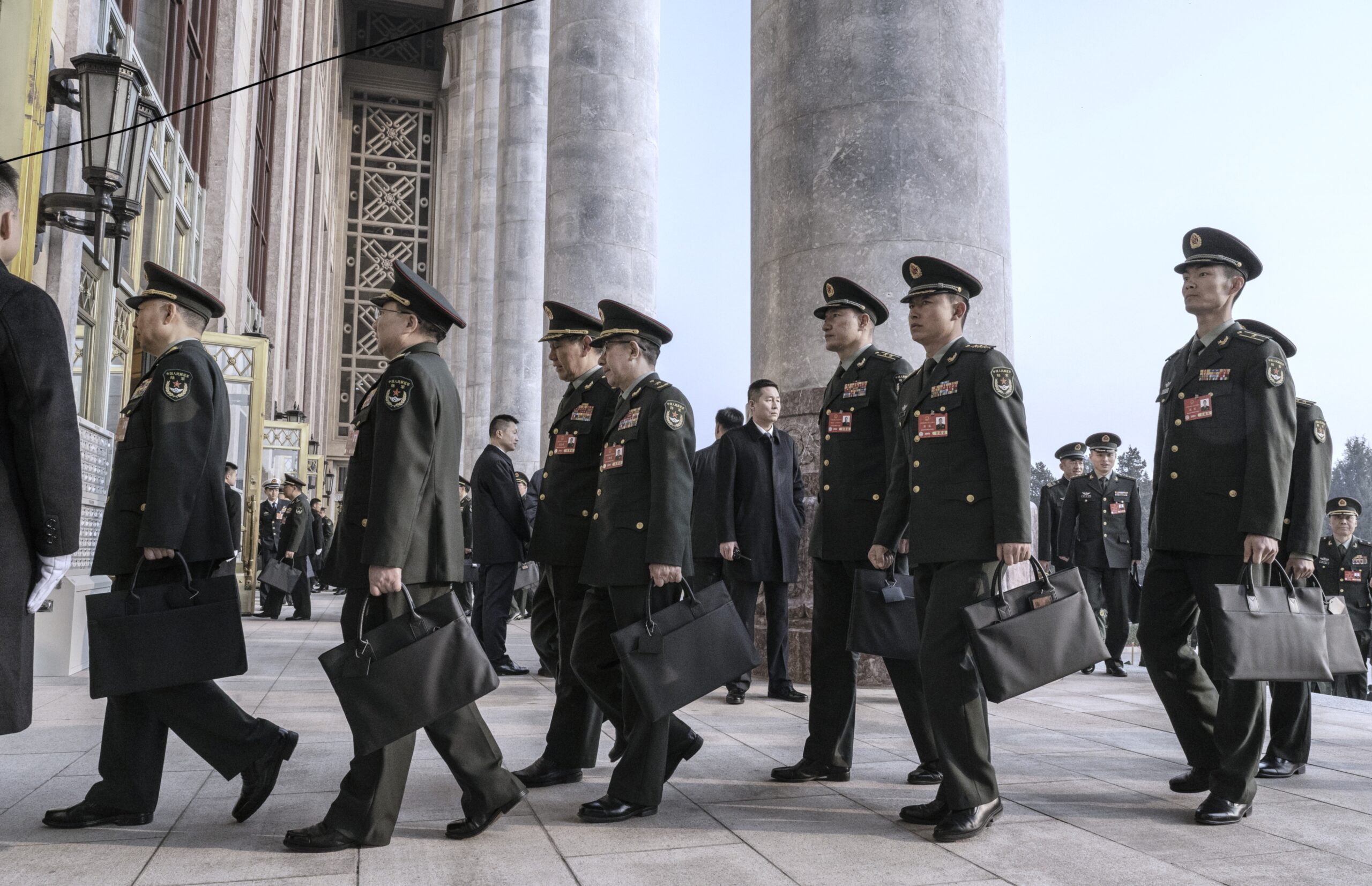
The Chinese authorities have confirmed the convening of the 20th Fifth Plenum in October this year. With a significant number of vacancies at the top due to recent purges, there is speculation on whether the Plenum will address the appointment of Political Bureau members, especially the absence of 5 members in the Military Commission. Analysts believe that while the Plenum may not address personnel issues this time, considering the upcoming centenary of the founding of the army next year, there is urgency in filling key military positions. With a shortage of high-ranking military officers, the new Military Commission of the Chinese Communist Party may face difficulties even leading up to the 21st National Congress next year.
Following nearly three years of intense power struggles and the downfall of several prominent figures including He Weidong, Zhang Youxia, and Ma Xingrui, the current Political Bureau lacks three members. The Central Military Commission is also missing five Commission members, including fallen figures such as Zhang Youxia, He Weidong, Miao Hua, Li Shangfu, and Liu Zhenli.
Zhang Shengmin was promoted to Vice Chairman of the Military Commission at the Fourth Plenum in October last year, but did not enter the Political Bureau; while Dong Jun has been serving as Minister of National Defense since December 2023, he has yet to be promoted to State Councilor and member of the Central Military Commission, as is customary.
This year’s Fifth Plenum has attracted attention due to the possibility of personnel adjustments, such as whether Zhang Shengmin will be appointed as a Political Bureau member or if a Vice Chairman will be added to the Central Military Commission, as well as the potential appointment of new members to the Central Military Commission.
Taiwanese veteran political scholar Sun Guoxiang told Dajiyuan that theoretically, the Political Bureau members could be adjusted at the Central Committee meeting, but in recent years, the CCP has tended to leave vacancies until the Party Congress to address collectively. Increasing Political Bureau members would mean revealing the layout of the 21st National Congress in advance. If the Fifth Plenum indeed appoints several Political Bureau members, it would indicate a significant signal that the top-level vacancies have affected operations, and Xi Jinping needs to install reliable candidates before the 21st National Congress.
Sun Guoxiang believes that the Military Commission is more likely to appoint new members than the Political Bureau. With only Xi Jinping and Zhang Shengmin left in the current Military Commission structure, it is considered too weak, creating an abnormal external perception.
Independent commentator Cai Shunkun also suggested that both Political Bureau and Military Commission members are likely to be appointed or replaced together at the upcoming 21st National Congress. However, he doubts that Zhang Shengmin will be able to enter the Political Bureau. “Xi Jinping has managed to eliminate the bigwigs in the military that needed to be purged, much like Wang Qishan before. His political mission has basically ended. If Zhang Shengmin can stay on until the 21st National Congress, that would still be considered good.”
According to official Chinese media reports, on July 3, 2026, Zhang Shuguang, Secretary of the Central Military Discipline Commission and Director of the Central Military Commission Supervision Commission, and Air Force Commander Wang Gang were promoted to the rank of general. This news indicates that Zhang Shuguang has taken over as Secretary of the Military Discipline Commission from Zhang Shengmin, who has been promoted to Vice Chairman of the Military Commission, while Wang Gang has succeeded Chang Dingqiu as Air Force Commander.
On December 23, 2025, the newly appointed Commanders of the East and Central Theater Commands, Yang Zhibin and Han Shengyan, were promoted to the rank of general.
Xi Jinping’s promotion of dozens of active generals in the past three years has almost been wiped out amid the recent turmoil within the military. This is the largest personnel shake-up in the Chinese military since the Cultural Revolution.
Public information shows that following the reform of the Chinese Communist Party’s military, there are typically 25 to 32 leadership positions equivalent to general or above in the military and armed police forces. Currently, only 6 active generals hold these positions, including Military Commission Vice Chairman Zhang Shengmin, Minister of National Defense Dong Jun, East Theater Command Commander Yang Zhibin, Central Theater Command Commander Han Shengyan, as well as Zhang Shuguang, Secretary of the Military Discipline Commission, and Air Force Commander Wang Gang, who were promoted in July.
After the removal of leading figures such as the Chief of the Joint Staff of the Military Commission, the Director of the Political Work Department, and many leaders of the theater commands and branches, most key military positions that were previously held by generals are now filled by acting lieutenant generals.
Christopher Nye, a resident researcher at the Jamestown Foundation, wrote in Nikkei newspaper on August 6 that Xi Jinping is facing his self-imposed deadline to rebuild the army. August 1, 2027, marks the centenary of the founding of the CCP’s army, and the date he set for the “centenary military goal,” which will include a military parade showcasing a unified and complete senior command team. However, if the military is still being led by acting officers during the centenary celebration, it would openly admit to the massive damage caused by the purge campaign.
The article highlights that with numerous vacancies and a shortage of generals, time is running out. The most challenging gaps exist within the Central Military Commission itself. Members of the Central Military Commission are usually selected from active generals, but the talent pool is almost empty. It is believed that the new Discipline Commission Secretary Zhang Shuguang is almost certain to be selected, Commanders of the theater commands Yang Zhibin and Han Shengyan may still face vacancies even if they are appointed, and it remains uncertain if Minister of National Defense Dong Jun can take on this role.
Sun Guoxiang told Dajiyuan that Dong Jun has been in office for over two years but has not yet joined the Military Commission, indicating Xi’s continued lack of trust in him.
Before the Army Day this year, Xi Jinping emphasized at a Political Bureau study meeting to ensure that “the barrel of the gun always listens to the Party’s command” and to continue the “anti-corruption struggle.”
Shen Mingshi, a researcher at the Taiwan Institute for National Defense and Security Studies, analyzed for Dajiyuan that Xi Jinping’s efforts to streamline the Party and the military may continue with further purging of military leaders close to Zhang Youxia and Liu Zhenli, possibly to rid of remaining “poisons.”
China expert Li Linyi stated that currently, military personnel issues are mainly controlled by Xi Jinping through the Military Commission Vice Chairman Zhang Shengmin. The delayed formal appointment of the Director of the Political Work Department indicates Xi’s concerns about the loyalty of military personnel in charge of personnel affairs because the previous two, Zhang Yang and Miao Hua, have encountered issues. Therefore, the replenishment of other key military positions is proceeding cautiously. At this pace, even the new Military Commission may face challenges by next autumn.
Li Linyi added that with the centenary of the founding of the army as a milestone, the time to fill vacancies in the CCP Military Commission is indeed urgent. However, due to Xi prioritizing the integrity of the military command system over the security of his own power, he may have to accept a command structure led by acting senior officials with a fragmented leadership team during the centenary celebration. Faced with a crisis of rule, he may no longer be concerned about external perceptions.