
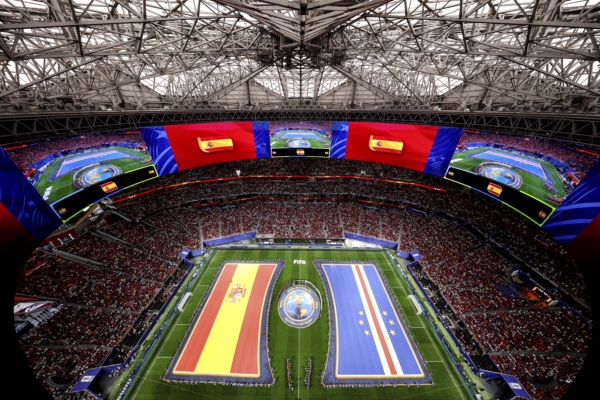
In 2026, the FIFA World Cup has kicked off in the United States, Canada, and Mexico this month, but once again, the Chinese national football team failed to qualify for the tournament. Despite this, there is a notable presence of “Made in China” on the playing field, with Chinese-made soccer balls, apparel, Chinese referees, and electric buses shuttling fans around. A trending topic on social media revolves around the irony of having Chinese elements everywhere except for a Chinese team on the field.
The 2026 World Cup is the first to expand to include 48 teams. The number of slots allocated to Asian teams has doubled from 4.5 to 8.5, and several Asian teams have already completed the initial group stage matches. However, the Chinese team’s poor performance in the preliminary 18 matches ultimately led to their failure to advance.
The Chinese men’s national team has now missed the final rounds for the sixth consecutive tournament, sparking discussions and ridicule online about why the national team is absent despite the expansion, the influx of Chinese elements at the tournament, and the seeming exodus of everything but the football team.
On Weibo, a user named “Technology Novelty” humorously questioned: “I’m just curious—how many teams would the World Cup have to expand to for the Chinese team to finally qualify?”
In response, another user quipped: “The national team is currently ranked 91st, so maybe expanding to 96 teams would do the trick.” Others suggested whimsical solutions like applying for spots in Antarctica or expanding up to 192 teams.
A user named “Niu Huluru” sarcastically suggested that some believe the reason for China’s absence from the World Cup is that they are too strong and have been banned from competing.
Amidst the absence of Chinese players on the field, Chinese state media outlets such as CCTV and People’s Daily have been highlighting the “Chinese elements” at the current World Cup, including Chinese toy brand Labubu showcasing themed apparel at the opening ceremony, Chinese referee Ma Ning being selected as a main official, and the official match balls being manufactured by a Chinese company.
However, despite these non-competitive aspects, the Chinese men’s national team continues its prolonged absence from the tournament, presenting one of the most contrasting narratives at the beginning of this edition of the World Cup.
This stark contrast has fueled dissatisfaction among many mainland Chinese football fans, who find the absence of the national team increasingly embarrassing and akin to a joke in comparison.
An article published by the Hunan media outlet “Rednet” on June 12 commented that while China excels in areas like cultural creativity, business, and event collaborations that align with international trends, the country has struggled to establish a stable and mature domestic football development system.
The piece pointed out that the Chinese football industry has faced periods of excessive investment and blind expansion, as well as challenges such as fragmented youth training systems, talent drain, significantly lower numbers of registered youth players compared to football powerhouses, and weak grassroots development programs. These factors have led to a consistent lack of talent pool for the national team, even with the lowered barriers to entry due to the considerable expansion of the World Cup.
Looking back at history, the only time the Chinese men’s national team entered the World Cup finals was during the 2002 tournament co-hosted by South Korea and Japan, but since then, they have failed to qualify for over twenty years. Over this period, as Chinese fans watch the World Cup, their attention inevitably dwells on the absence of the Chinese national team, leaving them in a perpetual state of regret and criticism.
In the past decade, Chinese professional football witnessed a phase of rapid capital infusion, with numerous Chinese Super League clubs backed by real estate companies, introducing a plethora of high-priced foreign players and boosting league popularity. However, as the real estate sector faced adjustments and funding withdrawals, over forty football clubs primarily supported by real estate developers began dissolving, leading to a contraction in the league structure.
The massive investments made in previous years drew criticism from many netizens, who pointed out that the money mostly benefited foreign players while neglecting the development of local talent. The exposure of corruption within the Chinese football management system involving former national coach Li Tie has further shaken the Chinese football hierarchy, plunging the sport into a period of decline.