
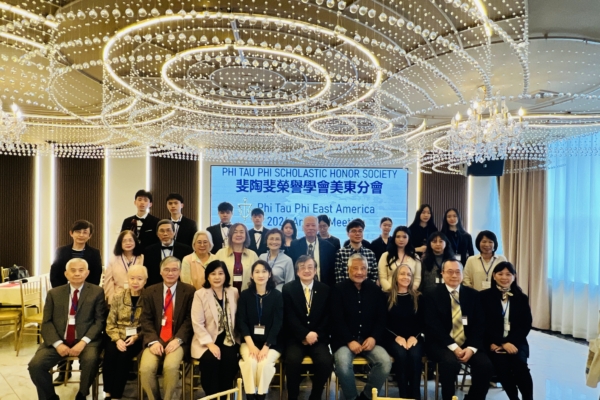
The Phi Tau Phi Scholastic Honor Society East Coast Chapter held its 2026 annual meeting in Flushing on May 31st, awarding annual scholarships to two outstanding Chinese-American college students and encouraging FASCA Youth Ambassadors and young learners to learn from excellence, develop leadership, and cultivate a spirit of serving society.
The event was hosted by Xiao Xinghua, Vice President of Phi Tau Phi East Coast and Data Architect at Langone Medical Center of New York University. She encouraged FASCA overseas youth cultural ambassadors and young learners to strive for development in their areas of interest and to be fearless in innovation. She said, “Learning from the best will bring richness to your life.”
Wang Yiru, Director of the New York Overseas Chinese Cultural and Educational Services Center, introduced the FASCA Youth Cultural Ambassador program, encouraging second and third-generation Taiwanese-Americans to enhance their leadership skills, foster connections with Taiwan, preserve traditional culture, and become a bridge for Taiwan-US exchanges.
Chung Bingcai, President of Phi Tau Phi East Coast, presented annual scholarships to the two outstanding Chinese students, Zeng Jiajun and Chen Xiuqing. Zeng Jiajun, a junior studying computer science with a minor in information engineering at the University of Massachusetts Amherst, is particularly interested in artificial intelligence (AI) and cybersecurity. He emphasized the importance of regulating and controlling AI due to its high energy and resource consumption. He expressed that his parents’ emphasis on education and the pursuit of excellence in Chinese culture had a significant impact on him.
Chen Xiuqing, who grew up in Myanmar, is a senior at the New York City College of Technology with a perfect GPA of 4.0. She will be interning at Newlab BNY as a product realization intern this summer. She credited her values from Chinese culture for teaching her the importance of responsibility, humility, and perseverance in facing challenges. In an interview, she mentioned, “Maintaining humility allows me to go further. When others are more successful than me, I look at it positively, learn from them, try to emulate their strengths, and turn them into my own advantages, which helps me advance further.”
Professor Benjamin Hsiao from Stony Brook University gave a keynote speech on utilizing “zero-waste nitrate oxidation technology” to transform organic waste into high-value agricultural products, promoting circular economy and sustainable agricultural development.
The FASCA Youth Cultural Ambassador presented an indoor music performance. The Phi Tau Phi Scholastic Honor Society was founded in 1921 by American professor Joseph H. Ehlers at Beiyang University in Tianjin. The name “Phi Tau Phi” is the transliteration of the Greek letters Phi, Tau, Phi, representing the three academic disciplines of philosophy, technology, and physiology. The society was reinstated in the United States and Taiwan in 1964. There are three branches in the United States: East Coast, West Coast, and Central, coordinated by the national association in the United States.