
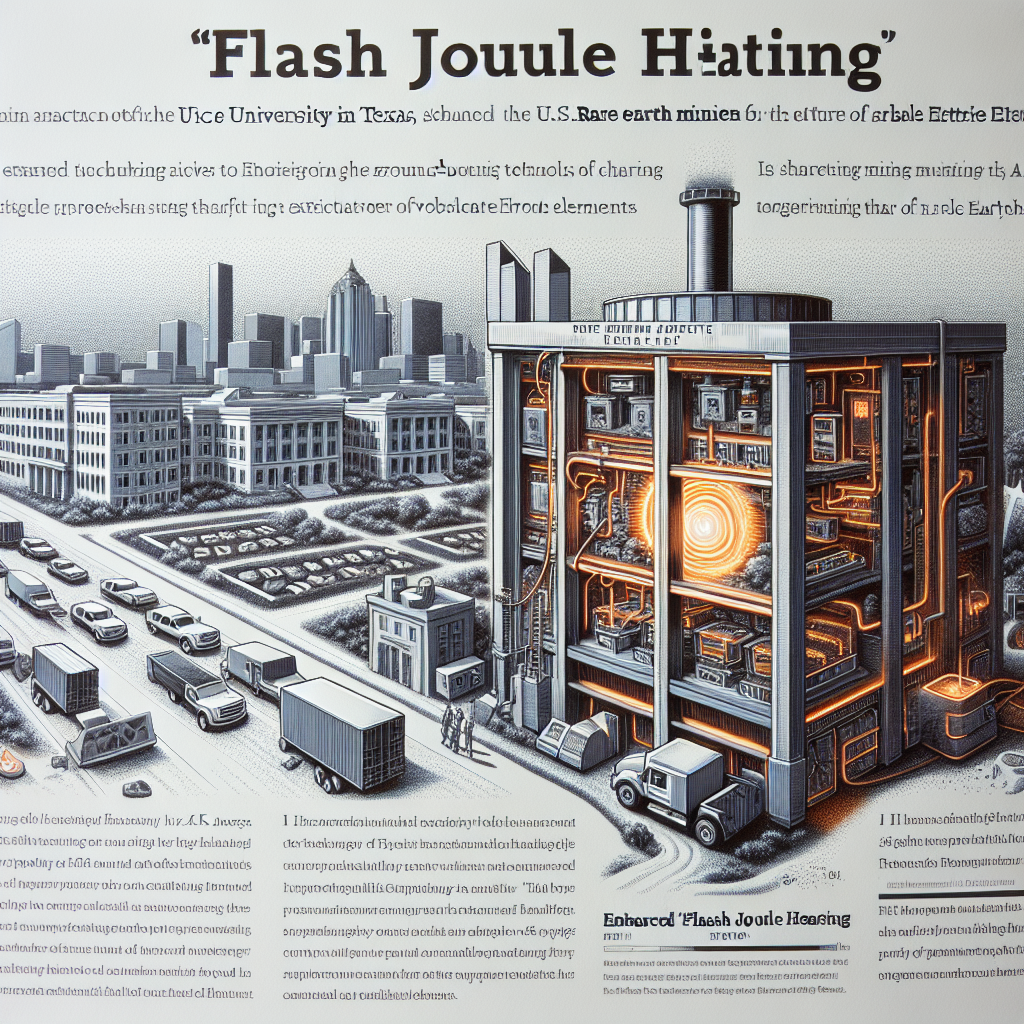
Rice University in Texas has developed a “Flash Joule Heating” technology (FJH) that can recover valuable metals from discarded electronic products. This technology enables “urban mining,” providing a new way to reshape the U.S. rare earth supply chain. It is becoming a new chip for U.S. national security. In September of this year, the Pentagon signed a contract with the Texas startup Flash Metals USA to apply FJH on an industrial scale to extract the crucial mineral gallium from waste streams, essential for national defense security.
For a long time, China has monopolized the global rare earth resources market and has used this industrial advantage to constrain and coerce other countries. The international community has raised strong concerns about the interruption of rare earth supplies.
According to data from the U.S. Geological Survey (USGS), in 2024, up to 77% of rare earth imports to the U.S. came from mainland China. The Ministry of Economy, Trade, and Industry of Japan also stated that Japan relies on mainland China for nearly 60% of its rare earth supply. Additionally, the European Union sources 46% of its rare earth from mainland China.
To break the monopoly of rare earth markets by China, the U.S. is reshaping its domestic rare earth supply chain from two aspects.
One approach is to rebuild a complete domestic rare earth industry chain. For example, MP Materials, supported by billions of dollars from the U.S. government, is integrating a complete supply chain from rare earth mining to magnet production.
MP Materials is the only rare earth producer with a complete production chain in the U.S., focusing on rare earth mining, refining, separation, heavy metal/alloy production, and magnet manufacturing, aiming to reduce the West’s dependence on China, which currently controls over 90% of the global rare earth processing industry.
MP Materials is headquartered in Las Vegas, Nevada, with its key asset being the Mountain Pass mine in California, one of the largest rare earth mines globally, accounting for 11.5% of global production capacity.
A November 25 report by Reuters on an analysis of data from the International Energy Agency showed that global billion-dollar rare earth projects will to some extent enable the U.S. to reduce its reliance on Chinese rare earths by 2030. While China may still supply around 60% of the critical rare earths needed for magnet manufacturing globally, the U.S.’s domestic rare earth supply is expected to achieve a self-sufficiency rate of about 95%.
The rare earth metals used in magnet production mainly consist of four elements: neodymium (Nd), praseodymium (Pr), dysprosium (Dy), and terbium (Tb). However, dysprosium (Dy) and terbium (Te), the two essential high-temperature magnetic rare metal elements, have low contents in the California mine operated by MP Materials, prompting the West to explore broader global partnerships and innovative technologies.
Innovations in recovering rare earth elements from electronic waste are becoming another critical aspect of reshaping the domestic rare earth industry in the U.S.
A team led by James Tour of Rice University in Texas has developed a super-fast method that can directly recover rare earth elements from discarded magnets. Compared to traditional recovery methods, this method offers significant environmental and economic benefits. Their research was published in the Proceedings of the National Academy of Sciences (PNAS) on September 29, 2025.
This innovative technology, called Flash Joule Heating (FJH), was initially used to extract graphene from waste in 2020 and has since expanded to recover rare earth metals, such as extracting rare earth elements from electronic waste. This technology is seen as a critical innovation to address the U.S.’s dependence on China’s monopoly of the rare earth supply chain.
Traditional processes for recovering rare earth metals from electronic waste often involve strong acid leaching, which is energy-intensive, time-consuming, and generates toxic waste. However, the Tour team at Rice University’s laboratory uses high-intensity pulsed electric currents to heat waste powder and other materials (mixed with carbon powder to enhance conductivity) to thousands of degrees Celsius within a second, producing metal vapor. The vaporized metal is then mixed with chlorine gas and converted into chlorides that precipitate at different temperatures, instantly transforming the waste into highly soluble “active rare earth elements.” This breakthrough supports efforts to enhance domestic rare earth mining supply in the U.S.
Tour stated, “We have demonstrated that we can recover rare earth elements from electronic waste within seconds with minimal impact on the environment, which is what we need to ensure the technology leap required to establish a resilient and circular supply chain.”
Tour’s method of electric pulse heating waste powder allows solid powder to instantaneously turn into plasma, making it applicable for industrial production, benefiting from recent advancements in material science.
Currently, Tour’s research team has tested the process with the two most common rare earth magnetic materials – samarium-cobalt and neodymium-iron-boron. Besides applications in the rare earth metal field, this technology also holds broad environmental prospects.
For example, researchers have used this method to remove toxic metals from red mud (a byproduct of aluminum production) to obtain aluminum-rich materials, which can be used in manufacturing tiles or re-entered into conventional aluminum production cycles.
Tour mentioned that jewelry manufacturers have contacted them to extract gold from electronic products, and even plastic components on printed circuit boards are valuable. Under high temperatures, plastics decompose into carbon monoxide and hydrogen, with hydrogen being a fuel and crucial raw material for chemical production.
Australian-listed company Metallium (MTM), focusing on critical mineral recovery, has its Texas subsidiary, Flash Metals USA, responsible for advancing the industrial application of FJH technology in the U.S. In May 2024, Metallium obtained global commercialization licensing for the FJH technology in critical metal recovery fields such as rare earths, gallium, and gold, from Rice University.
In September of this year, the Pentagon awarded Metallium a Phase I contract to extract the critical mineral gallium from waste streams.
Gallium is a vital material for the defense industry, used in gallium nitride semiconductors for electronic warfare, advanced radar jamming systems, anti-aircraft and missile defense radars, satellites, and other communication equipment.
A report published by the Center for Strategic and International Studies (CSIS) on February 18 revealed that since 1987, the U.S. has halted the mining of gallium ores, and a single company in New York only recovers and extracts high-purity gallium from imported low-purity gallium metal and waste materials.
According to the USGS, in 2023, China accounted for approximately 89% of global low-purity gallium production capacity and 98% of global gallium production capacity. Due to China’s monopoly on gallium production, the USGS concluded that gallium poses the largest risk of supply chain disruption in the U.S.
As gallium supply is highly concentrated in China, any export restrictions by China could severely impact the semiconductor, radar/communication equipment, optoelectronics, and other industries in the U.S. and its allies.
The FJH technology used to extract gallium marks an important move for the U.S. defense industry. This contract is Metallium’s first funding support from the U.S. Department of Defense, signifying the formal integration of this technology into the federal innovation system.
The contract falls under the Small Business Innovation Research Phase I, focusing on verifying the feasibility of recovering gallium from waste streams using FJH technology, aiming to establish a domestic supply chain and reduce dependence on China.
The contract is valued at $100,000 and will utilize Metallium’s proprietary Flash Joule Heating process to recover gallium from waste streams including LED waste and gallium-rich waste. These materials also contain germanium and other precious metals, expanding the project’s strategic impact. The project is expected to be completed within six months.
Currently, Metallium’s subsidiary Flash Metals USA, located outside Houston, is progressing with plans to commence operations at its commercial-scale plant in early 2026.
Michael Walshe, Managing Director and CEO of Metallium, said, “Although the contract amount is not large, it holds significance as it represents our first funding from the U.S. Department of Defense.” He added, “By showcasing our gallium recovery technology, we will continue to construct domestic solutions to reduce reliance on foreign supply chains, directly supporting national security priorities.”
The project will be carried out by Flash Metals Texas as the main contractor, with Rice University’s Tour team participating based on resource and cost-sharing agreements. Upon successful completion of the Phase I work, Metallium and Flash Metals plan to immediately apply for up to $1 million in Phase II funding to advance the pilot-scale deployment at Metallium’s existing facility in Chambers County, Texas, aiming to start Phase III commercial implementation to strengthen the U.S. gallium and other critical metal supply chains.
Tour stated that their goal is to handle one ton of printed circuit boards daily by January next year and to increase processing to 20 tons per day by September. Additionally, the company is in the process of building two more plants in Massachusetts and Virginia.
From the reopening of the Mountain Pass mine in California to the forthcoming “urban mining” plant in Chambers County, Texas, to be operational in 2026; the U.S. is walking on two legs: bringing rare earths from underground and reclaiming rare earths from discarded old phones, electric vehicles, and wind turbines each year. When these two legs stand firm, by 2030, the U.S. will confidently say: our electric vehicle motors, our radars, and missiles no longer need to look at any country’s face.
And the turning point for all of this may lie in that brief flash of light in the Rice University lab, ushering a new era of U.S. independence in critical mineral resources.
Essence Focus Production Team