
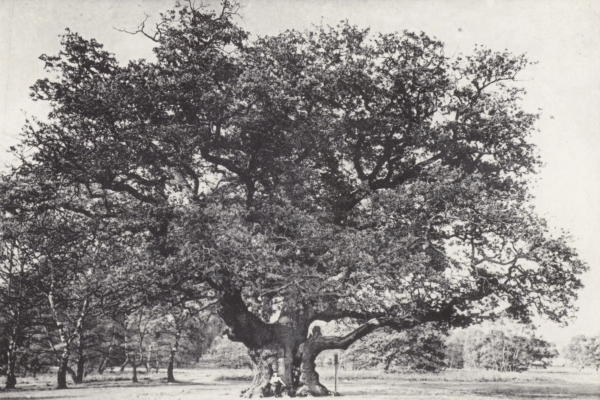
In a vast open space, it stood silently. As the giant among giants, both in height and width, there was no other tree around that could compare – this is the famous Major Oak in the UK.
The journalist from USA TODAY, Karina Zaiets, vividly remembers her first encounter with the Major Oak in Sherwood Forest: the forest king with a 1,200-year-old history, its robust trunk rising up, curved branches stretching in all directions. When the gentle breeze blew, the lush leaves rustled, as if whispering to those approaching it.
Looking at the old branches of the Major Oak that relied heavily on multiple supports to maintain balance, people instantly felt the weight of the long years. However, this tree that witnessed countless legends has failed to produce new leaves this year, leading the management organization to sadly declare its death.
The worldwide fame of this ancient tree is closely tied to the legendary figure in English folklore – Robin Hood. Robin Hood, a skilled and noble outlaw in 13th-century British folklore, led a band of “Merry Men” in fighting against injustice and tyranny.
Legend has it that Sherwood Forest was Robin Hood’s base. After a successful raid, they would gather under the Major Oak to celebrate with songs and wine. When the Sheriff of Nottingham sent soldiers to hunt them down, the massive hollow trunk of the Major Oak became the perfect hiding place, sheltering Robin Hood and his companions.
With the passage of time, this once vast ancient forest has now been reduced to a mere 1,000-acre nature reserve. The Major Oak that witnessed countless legends has now died this year due to the inability to produce new leaves.
“The Major Oak’s failure to sprout new leaves this year is heartbreaking for everyone,” said Hollie Drake, Senior Manager of RSPB Sherwood Forest. However, she emphasized that the legacy left by the Major Oak to future generations will be eternal. Not only is it forever intertwined with the legend of Robin Hood, but even after its death, its remains will continue to serve as an important habitat for wildlife, reminding humans of the significance of protecting ancient trees and the natural environment.
According to a survey by the Royal Society for the Protection of Birds (RSPB), long-term soil compaction caused by visitors, improper human intervention, and weakening root systems over the years were the main reasons leading to the withering of the Major Oak. The extreme heatwaves and consecutive droughts in recent years were the final straws that broke the “forest king”.
Although the Major Oak has passed away, there are still several ancient giant trees on Earth that are considered priceless and are standing against the flow of time alone:
Highlights:
-The largest single living tree in the world.
Overview:
-Approximately 2,200 years old, towering at 275 feet, weighing up to 2.8 million pounds, equivalent to nearly 10 adult blue whales combined.
Highlights:
-One of the most famous and scientifically confirmed ancient non-clonal surviving trees in the world.
Overview:
-This Pinus longaeva is 4,850 years old. Growing extremely slowly in highly cold and dry extreme environments, its dense wood is almost immune to decay, fungi, and pests.
Highlights:
-A “longevity rival” of the Methuselah tree, possibly surpassing 5,000 years of life.
Overview:
-The estimated age of this Fitzroya cupressoides ranges from 2,400 to 5,400 years. Due to its extremely thick trunk and partial decay in the center, scientists cannot determine the exact age by extracting complete tree rings. However, the latest computer modeling estimates it is likely the oldest living tree on Earth.
Highlights:
-One of the oldest living tree representatives in the UK and Europe.
Overview:
-Modern botanists estimate its age to be between 2,000 to 3,000 years (folklore once claimed up to 5,000 years). As the years passed, its main trunk split into several hollow independent trunks, resembling a mysterious small forest at first glance.