
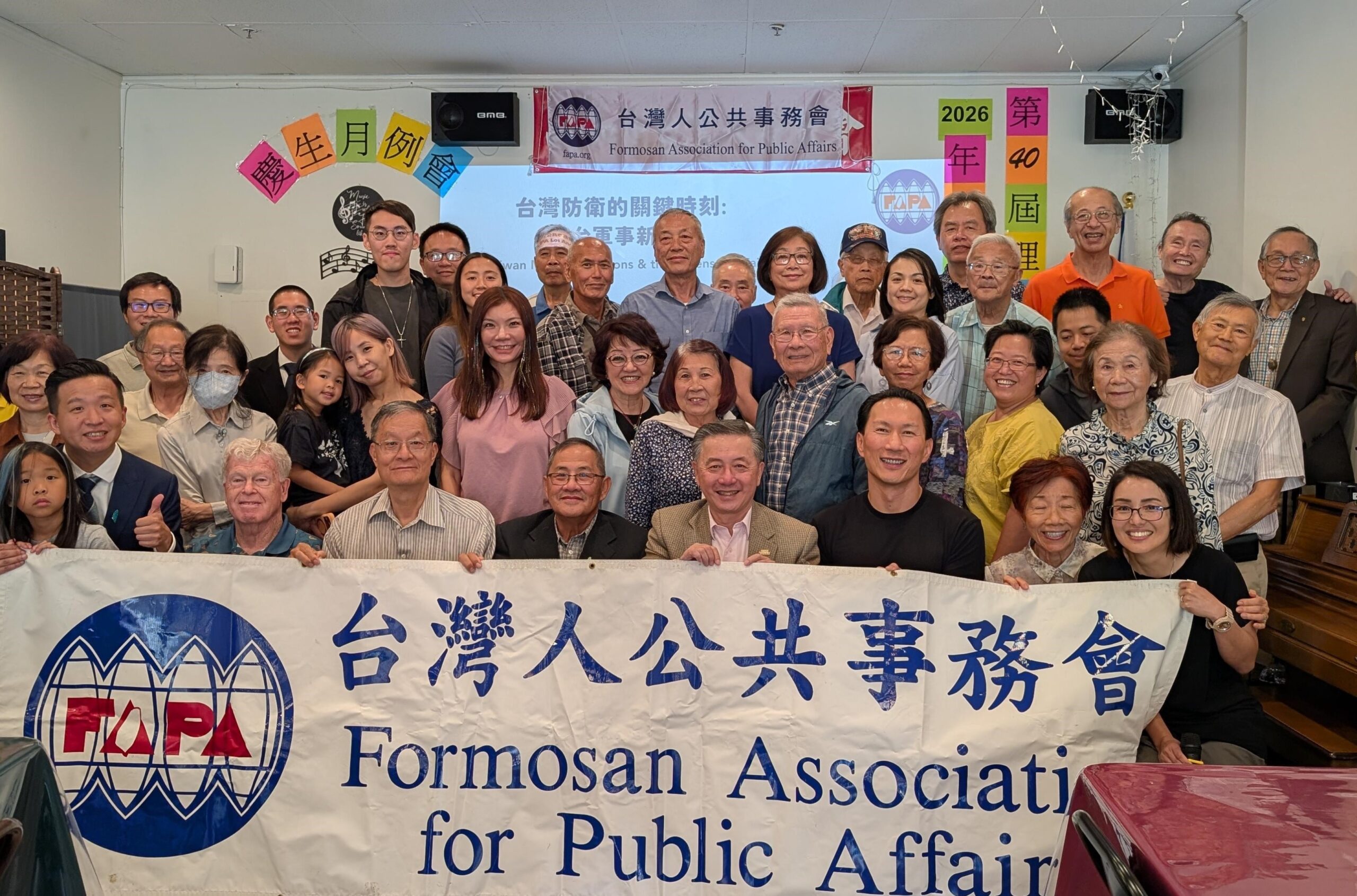
Facing the uncertainties of geopolitical risks and geohazard disasters, how can overseas Taiwanese become the strongest backing for Taiwan in times of crisis? The Los Angeles chapter of the Formosan Association for Public Affairs (FAPA-LA) held a seminar on Thursday, inviting military expert Tony Hu to deliver a speech.
Hu, a retired U.S. Air Force Colonel, former Pentagon official, and Deputy Director of Security Cooperation at the American Institute in Taiwan (AIT), emphasized that whether facing war or natural disasters, the key is not the “post-event response”, but establishing a complete network and contingency mechanism during peacetime. He called on overseas compatriots, saying, “We should not be a burden but rather a source of assistance.”
Recalling his time in the U.S. military, Hu mentioned that previously, operational and contingency plans were typically planned on a single-nation basis. However, in recent years, the U.S. has increasingly emphasized cross-domain, cross-sector, and international cooperation to enhance overall resilience. He believed that this concept is also applicable to the overseas Taiwanese community.
Hu pointed out that in the event of a major crisis in Taiwan, overseas compatriots may not necessarily be suitable for personally returning to the front lines. Instead, overseas Taiwanese can play a wide range of roles, including advocating for international support and public opinion, fundraising, providing essential medical supplies, evacuation equipment, clothing, and bedding for emergency relief.
“Everyone has different expertise, some are skilled in media, some excel in website development, some specialize in logistics, or community mobilization,” Hu said. He emphasized that major events often occur very suddenly, and without prior planning, valuable response time may be lost. He suggested that overseas communities should establish contact directories, assign responsibilities, and develop response procedures in advance, and assess their capabilities and resources during peacetime so they can swiftly mobilize in times of crisis.
To make support mechanisms more efficient, Hu also recommended that Taiwanese community organizations across the United States maintain regular contact with the Taipei Economic and Cultural Office in Los Angeles (TECO Los Angeles) and its offices throughout the country. For example, in Southern California, coordination could be overseen by TECO Los Angeles to plan donation platforms, procurement channels, and logistics systems for transporting supplies.
Hu proposed specific measures, such as establishing dedicated websites and donation accounts and identifying medical and emergency relief suppliers within the U.S., while also planning logistics for transporting supplies to Taiwan. With established systems in place, the public can immediately contribute support when a crisis occurs without the need for last-minute channel searching.
Hu revealed that he has already presented his ideas to the Taiwanese Ministry of Foreign Affairs, hoping the government will further strengthen the institutionalized construction of overseas support networks. He believed that with adequate preparation from both the government and the private sector, the global Taiwanese community can exert significant influence in critical moments.
Regarding the security situation in the Taiwan Strait, Hu pointed out that Taiwan has significant potential in the field of drones and related supply chains in recent years, positioning itself to play a more prominent role in the global defense technology industry in the future.
He particularly mentioned that the development of drones is not solely dependent on the flying platform but also crucially on battery technology. Some Taiwanese companies have developed special batteries with high durability, capable of maintaining operation for a certain period even after external damage, showcasing Taiwan’s technological prowess in critical component areas. These dual-use technologies hold great potential for both defense and industrial applications in the future.
However, regardless of technological advancements, the fundamental issue Taiwan faces stems from the military aggression threat from the Chinese Communist Party (CCP).
“Many people ask me, what is the most dangerous aspect of China (CCP)? Is it the new aircraft carrier? Is it the stealth fighter? My answer is neither,” Hu stated bluntly. He believed that the biggest risk actually comes from the decision-making will of the top CCP leadership. Under a highly centralized system, Xi Jinping has demanded the People’s Liberation Army to possess more comprehensive combat capabilities by 2027. In such a system, the strategic judgments and political intentions of leaders play a key role in influencing regional security.
Hu analyzed that evaluating security threats requires simultaneously observing the elements of “intent,” “capability,” and “opportunity.” Among them, the “intent” of the CCP to militarily invade Taiwan belongs to the subjective will of the top leaders, which is challenging for external parties to directly alter. On the other hand, Taiwan needs to strengthen its defense and technological capabilities to counter the continuous expansion and military buildup of the PLA. Nevertheless, among these factors, the timing and chance of launching an attack – the “opportunity” – are the most substantial variables that can be influenced by Taiwan and the international community.
“Do not give the other party the opportunity to misjudge, nor should you tempt them,” Hu emphasized. Maintaining sufficient defense capability and deterrent power, making potential aggressors believe that the cost of launching military action is too high and the likelihood of success is too low, is the most effective way to maintain peace.
In conclusion, the essence of deterrence lies not in provoking conflicts but in preventing them. Peace is never a given but is built on strength and determination; Taiwan’s continuous enhancement of national defense, improvement of societal resilience, and demonstrating the will of the entire population to safeguard freedom and democracy are key to reducing the risk of war and maintaining regional stability.