
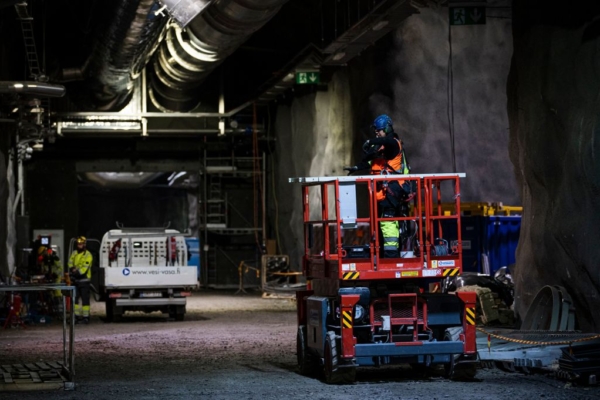
22 years ago, Finland invested 1 billion euros (approximately 11.6 billion US dollars) to construct the “Onkalo Spent Nuclear Fuel Repository”, and it is now nearing its operational phase. This facility, located 433 meters underground, will seal nuclear waste deep within the bedrock, with an expected safe isolation period of up to 100,000 years.
The nuclear waste repository is situated in the southwestern Finnish town of Eurajoki. The country’s Radiation and Nuclear Safety Authority (STUK) is expected to complete the final assessment and approve the facility in June this year, after which an operating permit will be issued.
Philippe Bordarier, CEO of the nuclear power operator Teollisuuden Voima Oyj, stated, “We hope to start operations officially by the end of this year, but it is more likely to be early next year.” He mentioned that the first batch of nuclear waste to be sent to the underground storage will be from the temporary storage site at the Olkiluoto Nuclear Power Plant on the coast of the Baltic Sea.
“Onkalo” means “cave” in Finnish. According to the design blueprint, the Onkalo storage will seal nuclear waste within the bedrock formed 1.9 billion years ago and is expected to accommodate around 6,500 tons of uranium, the waste generated by five nuclear reactors in the country.
The nuclear waste management company Posiva began constructing the underground storage in 2004, and the total cost has now reached 1 billion euros. Upon activation, the company plans to gradually deposit nuclear waste into the repository over a period of 100 years before permanent sealing. If there are future increases in waste due to new nuclear power plants, the overall operation time may be further extended.
Posiva chemist Lauri Parviainen emphasized that the underground repository “must remain safe forever” as the nuclear waste will remain highly radioactive for “tens of thousands of years,” with its radioactivity only reaching levels similar to uranium ore after 100,000 years.
Initially, experts will encapsulate the nuclear waste in highly corrosion-resistant copper containers, placing them into vertical holes drilled in the tunnel walls, filled with bentonite (a type of clay) for sealing. Safety is ensured as long as the bentonite remains undisturbed. Once every 300 meters of tunnel is filled, they will be sealed with reinforced concrete.
Jarkko Kyllonen, a nuclear safety expert at STUK, has conducted risk assessments on the underground storage, evaluating risks up to a million years into the future. Considering the hazards of nuclear waste, the first 10,000 years are critical for ensuring the integrity of the containers. Long-term risks include possible corrosion of the copper containers or damage during future ice ages earthquakes, leading to radioactive fuel leakage.
However, results from numerous risk assessments over the years have been consistently positive.
Finland’s Minister of Climate and the Environment, Sari Multala, stated that according to Finnish law, nuclear waste generated in Finland must be disposed of domestically.
Since the construction of the first nuclear power plants in the 1950s, most nuclear waste has been stored temporarily, with governments worldwide continuing to explore disposal solutions. Currently, countries like Sweden and France are also constructing permanent disposal repositories.
(this article was based on reports from Agence France-Presse)