
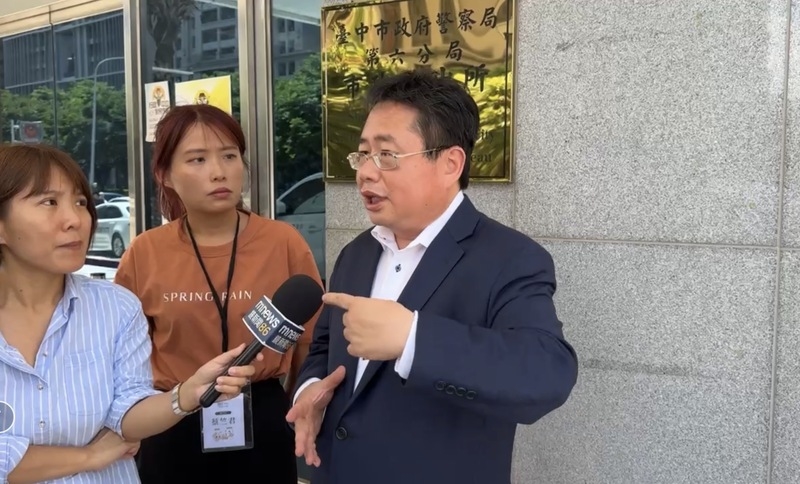
The assault case involving the chief executive of an Indo-Pacific think tank, Mr. Yagita Akio, in Taichung has seen significant developments. Recent reports have revealed that the mastermind behind the attack is a senior member of Hong Kong’s largest triad, “Wo Sheng Wo,” allegedly hiring someone across the sea for 50,000 Hong Kong dollars to carry out the assault. In response, Yagita Akio stated that the elaborate mobilization of numerous individuals by the triad just to “land a punch at him” was surprising, questioning that this was not merely a personal feud but evidently backed by more powerful authoritarian forces.
According to a report by “Mirror Weekly,” the mastermind behind the operation is the triad’s senior member in Hong Kong, Chen Wai Ho. Chen himself did not come to Taiwan, mainly responsible for issuing instructions overseas, arranging personnel, and coordinating funds. For this particular incident, they spent HK$50,000 to hire Liao Gangfa to attack Yagita Akio across borders, with five other associates mobilized to assist.
The report noted that aside from the leader Chen Wai Ho, Liao Gangfa was the attacker in this operation, and the other five served as logistical support. The group had meticulously planned in Taichung before the crime, including arrangements for accommodation, transportation, scouting, surveillance, scenario rehearsals, and more. On the day before the mission, four of the supporting associates left Taiwan, leaving one behind to watch over Liao Gangfa.
Yagita Akio admitted during an interview on the 14th that he was “shocked” to see the reports, never expecting the other party to go to such lengths, mobilizing so many people and spending so much effort and funds just to come to Taichung and punch him.
He revealed that after the incident, when he reported the case and reviewed surveillance footage with the organizers, they noticed a suspicious man in the hotel lobby constantly watching their movements. He then informed the police about this situation, speculating that the man was responsible for “cleaning up.” After the police received the report, the cleanup man quickly notified Liao to escape.
Yagita Akio emphasized that this was not a personal attack but an organized and planned act of violence. He pointed out that the intent of this punch was not about personal grudges but to instill fear in all Taiwanese citizens. The initial plan of the Hong Kong triad was to allow the perpetrator to easily remove all evidence and escape, planting seeds of terror in the hearts of every Taiwanese.
Regarding this case, a spokesperson for the Office of the President of the Republic of China (Taiwan), Guo Yahui, stated on the 14th that the government has raised the national security level and classified this case as “transnational oppression initiated by an authoritarian group.” She emphasized that the government is closely cooperating with countries that share similar values internationally to combat these new forms of transnational crimes.
Guo Yahui mentioned that Taiwan will not tolerate foreign forces resorting to violence, and whether it is the mastermind, assailant, or local accomplices, all will be thoroughly investigated and dealt with.
Meanwhile, Japan’s “Sankei Shimbun” published an editorial on July 12, strongly condemning the violent attack on its former Taipei bureau chief. The editorial asserted that as a seasoned media commentator, Yagita’s experience of violence should not be tolerated, urging Taiwanese authorities to thoroughly investigate the background of the suspects, their financial links, the connection to China’s newly implemented “National Unity and Progress Promotion Law,” and disclose the truth to the public.
The editorial also questioned the Chinese Taiwan Affairs Office spokesperson openly absolving the suspect, claiming his actions were “an act of righteousness,” and even accusing the ruling Democratic Progressive Party of Taiwan of “politically manipulating and inciting cross-strait confrontations,” a stance that is perplexing.
In addition, the “Japan Taiwan Straits Peace and Stability Parliamentary Thought Council,” composed of bipartisan members of the Japanese parliament, held its inaugural meeting in Tokyo on July 13. During the meeting, all parliament members issued a joint statement condemning the violent suppression of freedom of speech and cross-border oppression in the case of Yagita Akio, expressing steadfast support for freedom of speech.