
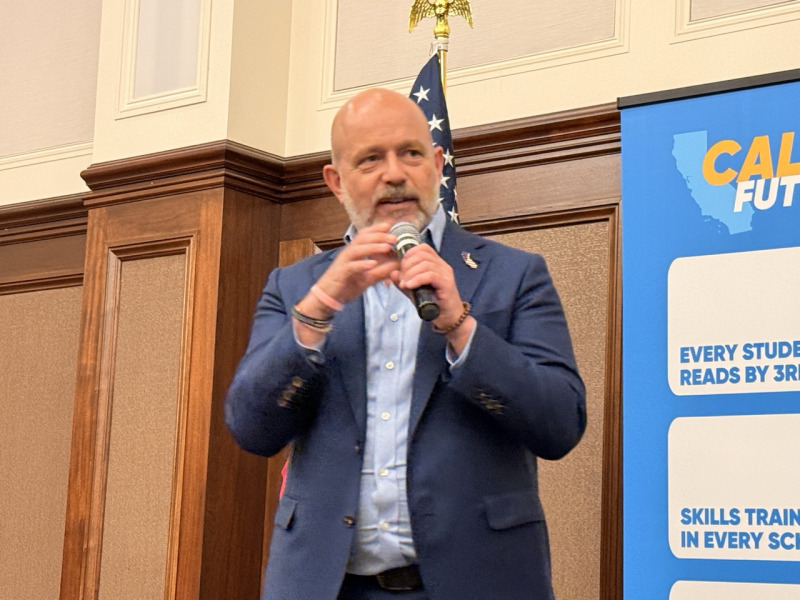
California Republican gubernatorial candidate Steve Hilton held a “Califordable” town hall meeting on the evening of July 10th in San Francisco, attracting nearly 200 people to discuss issues such as lowering the cost of living, education, housing, small businesses, and government reform, engaging with the public and media.
The event took place at the San Francisco Italian Athletic Club. Hilton stated that the town hall was one of the most important activities in his campaign, aiming to directly understand the most concerning issues for California residents through face-to-face interactions.
During his speech, Hilton highlighted the 16 years of single-party rule in California, where the costs of living have continued to rise, putting significant pressure on working families, small businesses, and young people. “Enough is enough,” he said, emphasizing the need for real change in California, rather than maintaining the status quo.
Using “Califordable” as the cornerstone of his campaign, Hilton proposed four main policies, including reducing gasoline prices to $3 per gallon, halving utility costs, exempting the first $150,000 of personal income from state income tax, and increasing the supply of starter homes for young families, aiming to lower the cost of living for residents, encouraging more families to stay and thrive in California.
Apart from addressing the cost of living, Hilton also presented the “Califuture” vision, advocating for government investment in the next generation rather than expanding bureaucracy. He outlined four key points, including ensuring every student can read by third grade, reintroducing skill education and vocational training in all schools, assisting young families in achieving homeownership, and creating a more conducive economic environment for innovation, entrepreneurship, and employment to retain more young people in California.
During the subsequent Q&A session, multiple attendees raised questions on education, housing, and government finances.
On the topic of education funding, some questioned why, despite increasing California’s education spending and lottery revenue annually, parents still need to bear the burden of basic student supplies. Hilton pointed out that approximately 38% of the state budget goes towards K-12 education, but due to retirement fund allocations and systemic issues, not all funds are truly allocated to educational purposes. He advocated for enhancing the efficiency of education spending to ensure taxpayers’ money is used effectively for students’ benefit.
Regarding government finances, Hilton stressed that tax cuts should be built on improving government efficiency. He highlighted long-standing issues in California, such as fraud, waste, and low administrative efficiency, emphasizing the need for strengthened auditing oversight to enhance the efficiency of public fund utilization, ultimately redirecting more resources into education, infrastructure, and public welfare.
Addressing housing concerns, Hilton mentioned that aside from the shortage of land supply, California’s housing crisis is exacerbated by intricate regulations, administrative procedures, and escalating construction costs. He believed that streamlining approval processes, reducing construction costs, and boosting housing supply are vital steps to alleviate the housing burden and aid young families in staying in California.
Following the event, Hilton participated in a joint interview with several media outlets, addressing issues like abortion, artificial intelligence (AI), energy policies, and bipartisan support.
Regarding the abortion issue, he acknowledged that abortion rights are enshrined in the California Constitution, making it beyond a governor’s power to alter the current system. However, he suggested that the government could offer more choices, such as encouraging adoption, to minimize the occurrence of abortions.
Discussing AI development, Hilton emphasized the need for California to maintain its global AI leadership position. While the impact of AI on the job market remains unclear, he cautioned against hasty new administrative regulations, recommending a focus on enhancing education and skills training to equip more young people with the necessary skills for future industries.
On energy policy, he noted that California’s high oil prices are not solely influenced by international factors but are also shaped by state energy policies and related regulations. Lowering energy costs, Hilton argued, would not only help reduce oil prices but also decrease costs in food transportation, dining, and small business operations.
When asked about garnering support from Democratic and non-partisan voters, Hilton mentioned a rising number of voters from different parties participating in his activities. He believed that the key to this election lies not in party affiliations but in the choice between “change or continuity.”
In an interview with “Dajiyuan,” Hilton expressed that his core principles, focusing on lowering the cost of living, remained consistent compared to the primary elections, aiming to spread this message to more California voters.
Addressing concerns prevalent in the Chinese community regarding education, public safety, and small business development, Hilton reiterated that small businesses and working families are always at the forefront of his governance priorities. Having previously founded and operated a restaurant, Hilton understood the challenges of running a business and pledged to reduce the burden on enterprises if elected governor, fostering a more business-friendly environment. He emphasized that having immigrated legally himself, he aimed to ensure all residents, including legal immigrants, have the opportunity to achieve the “California dream” through hard work and entrepreneurship.
After the event, “Dajiyuan” interviewed on-site supporter Cameron Schmidt, a business consultant from Los Gatos. Schmidt found Hilton most appealing due to his energetic demeanor and specific reform proposals. He believed that the government should prioritize solving issues of fraud, waste, and abuse of public funds, eliminating the need for tax hikes.
Another attendee, Quinn Maloney, who posed questions during the event, expressed his concerns about nurturing local talent, middle-class development, and youth employment. He highlighted the importance of aligning education, skills training, and industry demands effectively to assist more young people in accessing emerging industries like technology and manufacturing, rather than overly relying on foreign labor.
Maloney shared Hilton’s vision to restore skill education and enhance industrial competitiveness, acknowledging the need for change in California’s governance model rather than continuing the current approach.