
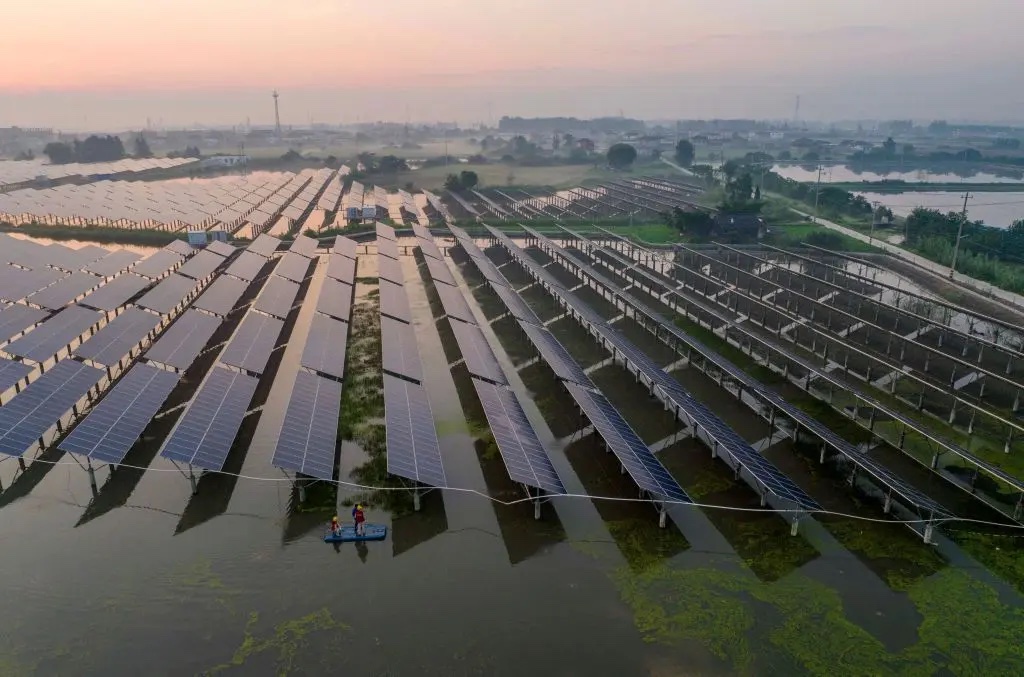
The consequences of the blind expansion in the mainland’s solar industry continue to emerge. As of early August this year, 1266 projects in various locations that have been long-term inactive, not connected to the grid, or have ceased generating electricity have been included in the clean-up scope. At the same time, a total of 22 listed solar companies are expected to collectively incur losses of between 18.3 billion to 21.4 billion yuan.
According to a report by “First Financial,” the aforementioned 1266 projects are spread across Anhui, Sichuan, Guizhou, Heilongjiang, Ningxia, and Xinjiang, each at different stages such as under review for clean-up, termination of record, revocation of grid connection qualifications, or handling of account closures.
Since July, Anhui has identified 789 distributed solar projects that are at risk of being cleared or terminated. In Dazhou District of Dazhou City, Sichuan, among the 2197 projects already on record, 260 have been stagnant or delayed in construction. In Tieli City, Heilongjiang, 204 projects face clean-up as they have not commenced construction despite being on record for two years.
An industry insider mentioned that in the past, grid connection capacity and land quotas held transaction value, with some companies obtaining records but not proceeding with construction. Instead, they held onto the quotas for a long period, waiting to profit from their transfer, resulting in a practice dubbed “land banking without building.”
While numerous projects are left idle, listed solar companies are still deeply entrenched in losses. As of August 4, among the 26 solar-listed companies that have released performance forecasts for the first half of 2026, only 4 are expected to be profitable, while the remaining 22 are collectively expected to incur losses of approximately 18.3 billion to 21.4 billion yuan.
Data from China’s National Energy Administration shows that in the first half of the year, the country’s solar capacity added to the grid amounted to 71.77 million kilowatts, a decrease of about 66% compared to the same period last year. The China Photovoltaic Industry Association reports that during the same period, solar module production was 201.3 gigawatts, a 35.1% decrease year-on-year, while cell production was 260.7 gigawatts, a 21.9% decrease year-on-year.
Bloomberg New Energy Finance analyst Jiang Yali had stated to the “Shanghai Securities News” in February of this year that the solar industry still harbors significant overcapacity, with a slowdown in short-term demand further exacerbating supply chain pressures.
In a previous report by Dajiyuan, senior figure in the mainland capital circle, Xu Zhen, mentioned that solar panels have a long lifespan and are mainly in need of maintenance after installation. After exporting massive capacities to Europe and the US for some time, the market quickly saturated, leading to severe overcapacity among enterprises facing brutal competition and internal conflicts. He stated, “The unrestrained expansion by the CCP will eventually backfire.”
Professor Sun Guoxiang of Nanhua University in Taiwan’s International Affairs and Business Department pointed out that local governments, in order to maintain employment and local economic growth, often provide subsidies or other support to loss-making enterprises, making it difficult to phase out inefficient production capacities. Many businesses have invested heavily in factories and equipment before and exiting would mean incurring significant losses, leaving them no choice but to rely on price wars to maintain competitiveness.
Amidst vicious price wars, the Ministry of Industry and Information Technology of the CCP claimed in July 2025 that it aimed to regulate the solar industry’s “low-price disorderly competition.” However, data from the China Photovoltaic Industry Association shows that in the first ten months of that year, solar component production in mainland China still grew by 13.5% year-on-year, indicating the issue of oversupply and low product prices remained unresolved.
The related news has sparked skepticism among netizens. One netizen commented, “Rushing into projects recklessly, local leaders seek political achievements, regardless of the chaos that follows after their promotion.” Another netizen stated that blind expansion ultimately leads to massive waste of funds and resources.