
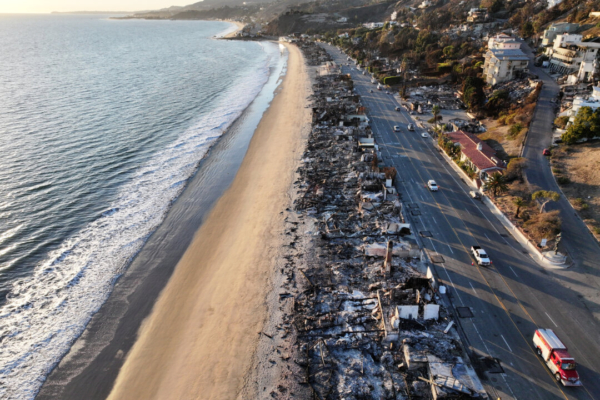
The Bureau of Alcohol, Tobacco, Firearms and Explosives (ATF) experts stated to the federal grand jury this week that fireworks could not have been the culprit behind the Palisades Fire in 2025.
On the other hand, 29-year-old Jonathan Rinderknecht is charged with starting a fire in the Santa Monica Mountains that investigators believe ultimately escalated into the devastating Palisades Fire, causing significant casualties.
ATF explosives enforcement officer Kevin Miner testified in court that if fireworks had been ignited and fallen in the area, people present at the time would definitely have seen them because fireworks are very bright, producing a lot of colors, flames, and sparks. In addition, fireworks can reach a volume of 140 decibels, more than twice the threshold for ear damage, so they would surely have been heard.
Miner stated that his conclusion was based on surveillance footage, witness testimony, and analysis of sound characteristics, terrain, and weather conditions.
Rinderknecht is currently facing three federal arson charges related to the property damage caused by the Pacific Palisades Fire. The blaze resulted in the death of 12 individuals and the destruction of over 6,000 homes in the coastal community. Prosecutors argue that the disaster was actually the result of the continued burning of the Lachman Fire that occurred in the early hours of January 1, 2025, and investigators believe that Rinderknecht sparked the fire using a Bic lighter as an act of “social revenge.”
Defense attorneys, on the other hand, insist that the government has no “reliable evidence” to prove that Rinderknecht started the Lachman Fire on January 1. They claim that Rinderknecht merely stumbled upon the fire and made a goodwill call to 911, and that fireworks are a more likely cause of the ignition.
ATF investigators presented evidence in court refuting the theory of fireworks causing the fire. Miner acknowledged that in theory, aerial fireworks could indeed trigger a fire similar to the Lachman Fire, but given the actual conditions on the ground and the absence of any witnesses, including the defendant himself, seeing fireworks, the likelihood is very low.
Federal fire investigators also ruled out ground fireworks, malfunctions, or smoldering fireworks, as well as cigarettes, lightning, and electrical equipment as potential causes of the fire.
Rinderknecht’s lawyer Steve Haney attempted to raise reasonable doubt, pointing out that if the Lachman Fire on January 1 was indeed an arson case, the scene should have been a crime scene, but the area remained unprotected and open to the public. Aircraft dropped large amounts of water and fire retardant on the fire site, and another fire later burned through the area, possibly destroying physical evidence.
Miner stated that they relied more on sound analysis, surveillance footage, and witness statements. In many cases, physical remnants of fireworks are not found after the fire is extinguished, so this situation is not uncommon.
Investigators determined that the fire was deliberately set, directly igniting the vegetation. This conclusion was drawn from surveillance footage, witness testimony, and statements made by the defendant.
Retired ATF fire investigator Derek Hill stated that the defendant admitted to carrying a lighter up Buddha Hill at the time. Investigators believe that the Lachman Fire started burning from that area, stating that “the defendant correctly identified the point of origin, information that was not publicly disclosed at the time.”
Investigators used cell phone location data to reconstruct Rinderknecht’s movements and cross-referenced it with the surveillance timeline. Hill stated that all findings were consistent with the investigation results, including a detailed analysis of the fire’s spread, direction, and intensity.
Hill led a team of 11 federally certified fire investigators and 5 wildfire experts in this investigation. The team arrived at the Palisades Fire site on January 13 and conducted a meticulous search in the suspected ignition area, sometimes crawling on burnt ground to find clues.
Ultimately, they narrowed down the ignition area to a specific location, even pinpointing a shrub. Hill said, “We found burnt roots, some exposed, some still buried underground.”
Firefighters described how the sparks and embers from the Lachman Fire dispersed from north to south. Investigators stated that detailed analysis showed that the fire on January 1 had smoldered underground until resurfacing seven days later and evolving into the Palisades Fire under strong winds.