
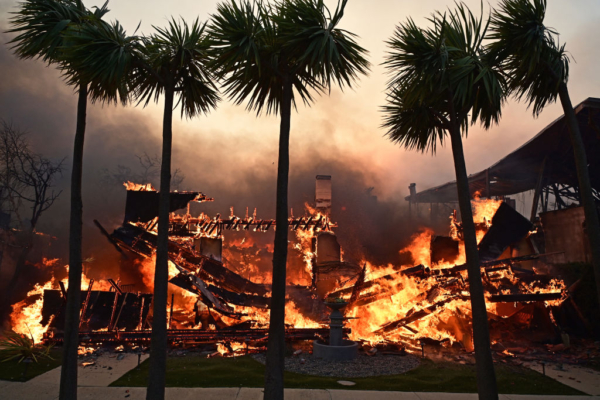
A behavioral analysis expert testified before a federal grand jury on June 17th that social isolation and accumulated anger prompted 29-year-old Uber driver Jonathan Rinderknecht to set fire to bushes, sparking the devastating Palisade Fire that resulted in significant casualties.
ATF retired supervisory special agent Dr. Kevin Kelm stated that Rinderknecht’s motive belonged to the “expressive” category, characterized by emotional and opportunistic social retaliation psychology. Kelm, specializing in arson behavior analysis and criminal profiling, said, “In my judgment, the defendant’s behavior aligns with the characteristics of retaliatory or socially retaliatory arson cases.”
The prosecution stated that in the months leading up to the fire, the defendant’s mental state deteriorated gradually, and he developed increasingly strong obsessions with issues such as income inequality, climate change, and vigilante justice, all of which indicate his motive.
Kelm cited the FBI’s arson motivation classification theory, pointing out that arsonists with a motivation for social retaliation often face numerous problems in life and dwell on these issues, and pressures like deteriorating relationships and social isolation only exacerbate their negative emotions.
“These pressures continue to accumulate,” Kelm stated, and arson behavior can provide them with “some emotional release and temporarily shift their focus away from the problems.”
Electronic records obtained during the investigation revealed that Rinderknecht was deeply immersed in a worldview where the wealthy and powerful in society were at odds with the common people and the environment, leading to a strong sense of loneliness and powerlessness. Passengers who rode in his Uber vehicle testified that he had made hostile and threatening remarks, displaying abnormal behavior.
However, his lawyer Hani argued that these factors were insufficient to prove his client was the arsonist. Many people feel dissatisfaction towards large corporations, politics, income inequality, or climate change.
Kelm commented that these phenomena indeed occur in many individuals. But if these circumstances dominate someone’s daily life, repeatedly resurface, and permeate various aspects of life… they will gradually shape a person’s behavior, which then becomes a reaction to these issues.
According to the FBI’s classification theory, socially retaliatory arsonists typically don’t meticulously plan their actions in advance.
“This type of behavior is highly impulsive. In this case, the defendant personally went to the scene, turned off work calls, and headed to a familiar remote location,” said Kelm, noting that most arsonists choose environments they are familiar with or are within their comfort zone to commit the crime.
He mentioned that investigators determined the defendant used a lighter rather than accelerants or other ignition methods, which aligns with the characteristics of expressive arson cases.
The defense emphasized that Rinderknecht had called 911 multiple times. However, investigators believed this could be a calculated effort to portray a cooperative image and divert suspicion. Kelm stated that such actions are not uncommon in arson cases.
Authorities also suspected the defendant tried to cover up his crime. He recorded footage of the 911 call and asked ChatGPT if he could be held responsible if the fire was caused by a discarded cigarette, attempting to conceal his actions.
Kelm pointed out that while the defendant was making the 911 call, he was “calmly walking down a hill,” showing a reaction that is “completely unlike someone who has just discovered a fire.”
He believed that posing such questions to ChatGPT was an “unnecessary behavior” and “quite unusual, not in line with what most people would do when trying to report a fire and get away from danger.”
Kelm mentioned that after leaving the scene, Rinderknecht returned to film the fire and firefighters, indicating that the fire brought him excitement, which is another typical characteristic of a different type of arson motive.
Hani further inquired whether anger-driven arsonists seek to destroy property.
Kelm replied, “Not necessarily. Their true intention is often just to ignite the flame itself. Many times, the consequences exceed their expectations, causing panic reactions because things don’t develop as they originally imagined.”
Lastly, Hani asked if, in his over half a century of professional experience, Kelm had encountered retaliatory arsonists like the defendant who made a total of 17 calls to 911.
Kelm answered, “That is very rare. It certainly caught my attention.”