
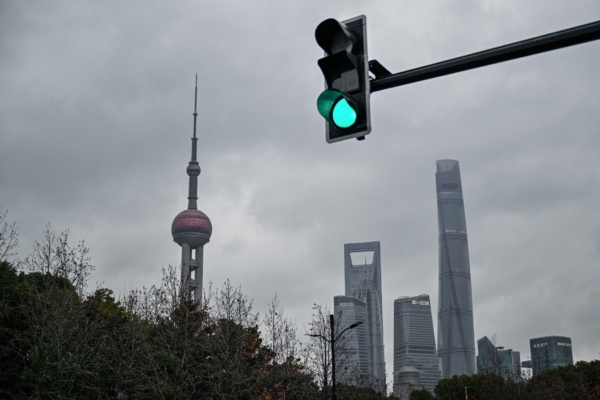
The Chinese economy continues to struggle, even in first-tier cities like Shanghai. Shopping malls are empty, crowds are thinning, unemployment is rising, and property prices are falling. Many residents lament that they have never seen Shanghai so desolate and depressed.
Zhang Hong (pseudonym), who has lived in Shanghai for nearly seventy years, told Epoch Times that the current bleak scene is unprecedented in decades. “It’s very bleak. We have a landmark building called ‘Aegean Sea,’ a large commercial center in a bustling area. All the shops inside have closed down, and people have disappeared. At night, it still looks brightly lit from the outside, but all the shops inside are closed.”
Many netizens in the comments section also express their astonishment at the rapid decline of Shanghai.
A resident in Jing’an District said, “At noon, I went to Changping Road for lunch, and all the catering shops on one side of the street were closed. Even the popular ‘Come-again Burger’ for office workers has also shut down. Now, even the city center is so desolate.”
Not only are commercial areas deserted, but even densely populated transportation hubs are now noticeably quieter.
Shanghai Hongqiao Railway Station is one of Shanghai’s most important railway transportation hubs, and its plaza used to be one of the busiest areas in all of China. However, its popularity has since clearly declined.
Zhang Hong mentioned that there used to be an underground passage at the railway station lined with bustling shops. Currently, out of ten storefronts, only one is open. “Nine out of ten are closed, with no customers. The difference from the lively days before is like night and day. I have never seen Shanghai so desolate.”
In addition to the economic downturn and weak consumer spending, the population in Shanghai is also noticeably decreasing. One Shanghai netizen commented, “When I visited Nanjing Road in Shanghai ten years ago, the crowds I saw then were at least ten times more than now!”
Zhang Hong believes that the decrease in Shanghai’s population has several reasons: young people in Shanghai are increasingly forgoing love, marriage, and having children, with many of his relatives and friends still single. “In the past, many kindergartens and elementary schools were opened, but now they are either closed or merged due to the continuous population decline.” Secondly, the economic decline has led to population outflows. Thirdly, many people died during the COVID-19 pandemic, with falsified statistics from the Chinese Communist Party.
Moreover, Shanghai’s property prices have also been impacted by the collapse of China’s real estate industry, continuously decreasing.
Sun Xiao (pseudonym), who has been working in the IT industry in Shanghai for nearly a decade after graduating from university, mentioned that Shanghai, as an international metropolis, used to give the impression of being economically prosperous. However, many circumstances are actually very dissatisfactory.
Since the COVID-19 pandemic, property prices in Shanghai have been consistently falling. “Most of the old public housing in Shanghai has dropped by around 40%, and some even by 50%.”
In addition to property prices, the job market continues to deteriorate, with even the IT industry and large tech companies starting to lay off employees. “The impact is definitely there, with many people losing their jobs.”
Sun Xiao was unemployed in 2025 and stayed at home for 8 months. His relatives and friends who worked in large tech companies were also rarely laid off.
“Many people have been unemployed for a long time and unable to find work. This is unprecedented, including among IT professionals, which I have seen more of. Some colleagues have been unemployed for a long time, which was unheard of before.”
One mainland Chinese netizen commented, “As a mainland Chinese, what makes us feel hopeless is the employment issue. Many small and medium-sized enterprises are closing down, and there are mass layoffs in the market, reflecting the rapid concentration of funds to the wealthiest individuals domestically. The wealth gap will only continue to widen, with the rich fleeing this bottomless pit of a future.”