
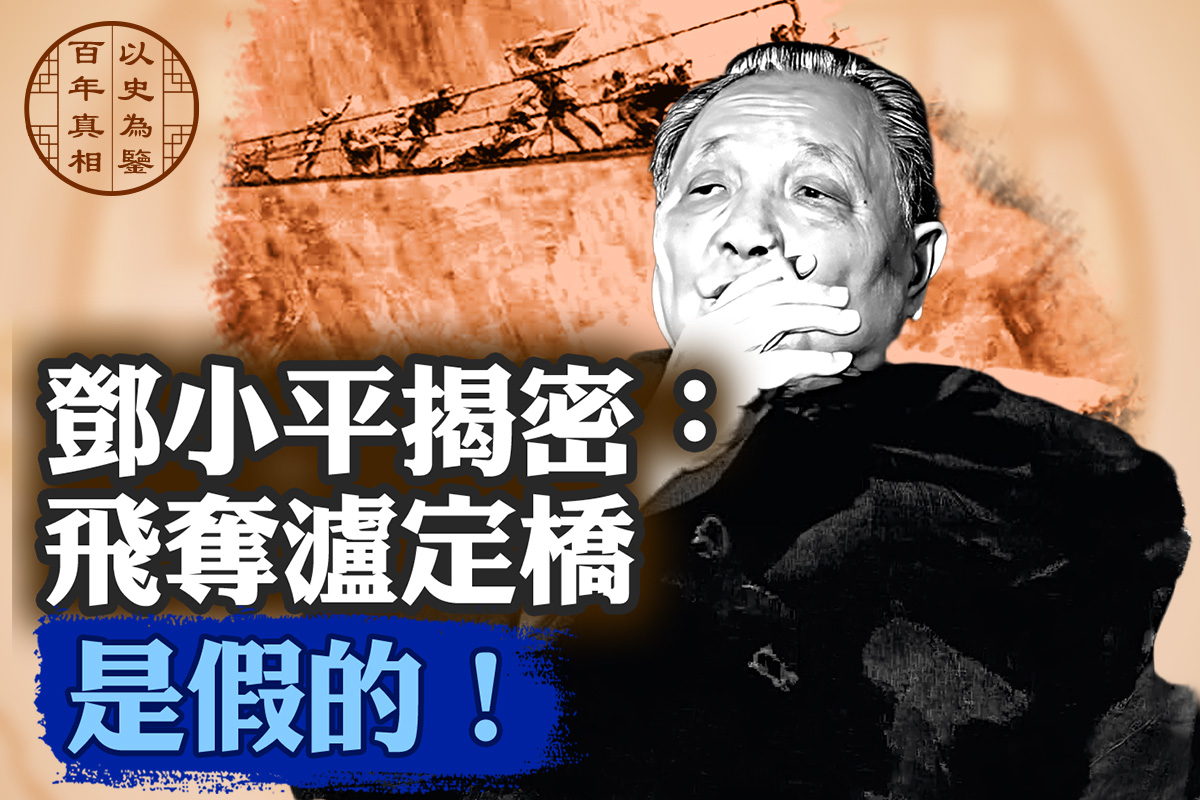
Hello, viewers, welcome to “Century Truth”.
For decades, the CCP has glorified the story of “Flying to Capture Luding Bridge”, incorporating it into textbooks, making it into a movie, and shaping it as the most thrilling battle on the Long March.
But did this so-called “life-and-death battle” really happen?
As more eyewitnesses speak up and more historical archives are unearthed, the story that the CCP mythologized for decades begins to show flaws.
So, what really happened at Luding Bridge in May 1935? Today, we will uncover the concealed truth.
Before diving into the topic, let’s first understand the situation of the Dadu River and Luding Bridge.
The Dadu River is located in the western part of Sichuan, surrounded by high mountains and gorges, with swift and turbulent waters. By late May each year, the river roars and swirls with whirlpools, sharp rocks scattered on the riverbed, making it nearly impossible for people to ford the river.
At that time, the only crossing point was Luding Bridge.
Built in the early 18th century, Luding Bridge was a crucial transportation route from Sichuan to Tibet. The bridge was approximately 101 meters long and over two meters wide. It was constructed with 13 thick iron chains holding it up, with two side rails and 9 chains forming the bridge deck, topped with wooden planks for people and horses to pass through.
In the CCP textbooks, this bridge became the stage for a “life-and-death battle.”
The text of “Flying to Capture Luding Bridge” describes it as follows: In May 1935, the Red Army on the Long March reached the Dadu River. The Nationalist Army dispatched two regiments to guard the bridge and brought in two additional regiments to reinforce, preparing to annihilate the Red Army at the bridge.
At that time, 22 Red Army “heroes,” under machine gun fire from the Nationalist Army, climbed forward by grabbing the iron chains. Some were shot and fell into the river, while others continued advancing, eventually capturing the bridgehead.
In 1936, American journalist Edgar Snow interviewed Mao Zedong, recording Mao’s account in the book “Red Star Over China.”
Mao said that half of the wooden planks on the bridge were removed from one end to the center, leaving only bare iron chains. On the eastern end of the bridge, an enemy machine gun emplacement was aimed at them. The Red Army, like madmen, charged forward along the bare iron chains.
Mao recounted that the first soldier was shot, falling into the river; the second followed suit, and then the third… The enemy even poured kerosene on the bridge planks, setting them on fire.
At that moment, about twenty Red Army soldiers crawled forward on their hands and knees, throwing hand grenades one after another into the enemy’s machine gun emplacement.
Thus, the story of “Flying to Capture Luding Bridge” was written into CCP history as a legendary tale on the Long March.
In reality, the so-called “Long March” itself was fabricated by the CCP. It was not a strategic shift northward to resist Japan but a frantic escape after being surrounded by the Nationalist Army. To conceal its own defeat and retreat, the CCP turned this retreat into a “heroic epic,” fabricating one “heroic battle” after another along the escape route to cover up its failures.
Many years later, a British-Chinese historian, Zhang Rong, conducted detailed research on “Flying to Capture Luding Bridge.”
She wrote a book titled “Mao Zedong: The Unknown Stories.”
In the book, she examined numerous Nationalist Army telegrams and military records from that period, and specifically visited Luding Bridge for on-site investigation. Her conclusion was that there was no intense battle at Luding Bridge.
In the thirteenth chapter of her book, Zhang Rong wrote that the Red Army arrived at Luding Bridge on May 29, 1935. In fact, there were no Nationalist Army troops guarding the bridge at that time. Looking at the extensive telegrams and deployments of the Nationalist Army during that period, the claims by the CCP about the Nationalist Army’s defense at Luding Bridge were baseless. The Nationalist Army’s 24th Regiment’s 4th Brigade led by Li Quanshan, as claimed by the CCP, wasn’t even in Luding City but rather in the distant area of Hualinping.
At that time, the only troops stationed at Luding were the 2nd Brigade led by Yu Songlin. But before the arrival of the Red Army, this unit had already left and was moved to Kangding, fifty kilometers away. Subsequently, the commissioner of the Luding and Kangding region clearly stated in a June 3 report that the 2nd Brigade was “concentrated near Kang City” and not at Luding.
Furthermore, numerous communication records left by the Nationalist Army at that time made no mention of any battle at Luding Bridge. The records only mentioned skirmishes as the Red Army approached and crossed Luding Bridge.
When the vanguard of the Red Army reached the bridge, the command post was set up in a Catholic church not far from the bridge, and cannons were fired from there towards Luding City across the river, where there were no Nationalist Army troops remaining. Many locals were Catholics, and there was a woman who ran a tofu shop near the bridge.
By 1997, this elderly woman was 93 years old, but her memory was sharp. She recalled that the Red Army “fired shots in the air alternately” at the time, and then “slowly crossed the bridge,” with no actual combat occurring during the crossing.
It is true that some of the bridge’s wooden planks were damaged at the time and may have been removed. The old lady remembered that the Red Army borrowed door panels from the local people to repair the bridge.
She also mentioned that Luding Bridge only had a period where the iron chains were bare, not due to the battle at the time but because the CCP removed some wooden planks for filming the propaganda movie “Wandering over Mountains and Rivers” depicting the Long March.
In her book, Zhang Rong also highlighted another crucial detail: when the Red Army crossed the bridge, there were no casualties. The first group of 22 people to cross the bridge on June 2 received rewards afterward: a Lenin suit, a pen, a bowl, and two pairs of chopsticks.
Apart from this perspective, there is another widely circulated version mentioned in some media reports from mainland China.
The “Southern Metropolis Daily” reported that the so-called “Flying to Capture Luding Bridge” incident actually occurred between Liu Wenhui’s forces and the CCP Red Army.
Liu Wenhui was the commander of the 24th Army of the Nationalist Army, holding the rank of Lieutenant General. Before the Anti-Japanese War, he also served as the military and political leader of the Chuan-Kang Province and later defected to the CCP.
Liu Wenhui’s brother was even more renowned, being smeared by the CCP as a “hated landlord,” namely Liu Wencai.
Liu Wencai’s second son, Liu Yuanhua, mentioned that he had heard from some old soldiers that Luding Bridge had deliberately let the Red Army pass under the command of his uncle, Liu Wenhui.
Liu Yuanhua’s son, Liu Xiaofei, shared that in their hometown of Anren Town in Dayi County, Chengdu, there was a soldier named Yang Dehui who served under Liu Wenhui in guarding Luding Bridge. Later in his life, Yang often recounted the past in local teahouses. He said Liu Wenhui’s troops had an agreement with the Red Army to fire shots in the air, then retreat, allowing the Red Army to pass the bridge.
Additionally, there’s another account. A professor surnamed Zhang from Sichuan University once relayed Liu Yuanxuan’s words. Liu Yuanxuan, Liu Wenhui’s nephew who acted as the acting commander of the 24th Army of the National Army, passed away.
According to him, during a phone call with Chiang Kai-shek, Liu Wenhui was ordered to cut the iron chains of Luding Bridge directly. However, Liu Wenhui responded that the bridge was built with the approval of Emperor Kangxi. While Chiang Kai-shek was contemplating, Liu Wenhui added, “It’s okay; I’ll just remove the wooden planks from the bridge.”
However, in truth, not all the planks were removed, only a few were taken off.
Liu Wenhui’s son Liu Yanyan later mentioned that some company and platoon leaders under his father had told him that Luding Bridge was actually opened up for the Red Army to pass through, not to be defended to the last man. Without allowing the passage, the Red Army wouldn’t have been able to cross because the bridge was very long.
He explained that Liu Wenhui had his own motives for this decision at the time. He feared that Chiang Kai-shek would send the central forces under the pretext of pursuing the Red Army, which could jeopardize his position in the Western Kang region.
Regarding the incident of “Flying to Capture Luding Bridge,” there is an intriguing piece of history.
In 1982, during a meeting with Zbigniew Brzezinski, the national security advisor of American President Carter, Deng Xiaoping discussed this matter. Brzezinski mentioned that he had visited the Luding Bridge site and was deeply impressed, considering the Red Army’s combat capabilities were strong.
To everyone’s surprise, Deng Xiaoping replied, “Well, that’s how it is in our propaganda. We need to showcase the fighting spirit of our troops. In reality, it was a very simple military operation, nothing extraordinary. On the other side were warlord troops with outdated rifles, and their numbers weren’t that great, but we felt the need to dramatize it.”
This conversation was disclosed by English-language media at the time.
Later, journalist Edgar Snow gradually realized that what he heard during his interview with Mao Zedong was, in fact, a one-sided account from the CCP. In his later years, Snow recollected his deep regret when writing his book “Red Star Over China.”
From Zhang Rong’s field research, the eyewitness accounts of local residents, to Deng Xiaoping unintentionally leaking information in front of foreign dignitaries, all evidence points to the same conclusion: the so-called “Flying to Capture Luding Bridge” never actually happened in history.
There were no fierce battles, no hail of bullets, no heroic sacrifices. Instead, there were bizarre tales that were repeatedly propagated for decades.
Well, that’s all for today’s show. Thank you for watching. If you enjoyed our program, don’t forget to like, subscribe, and share. See you in the next episode.