
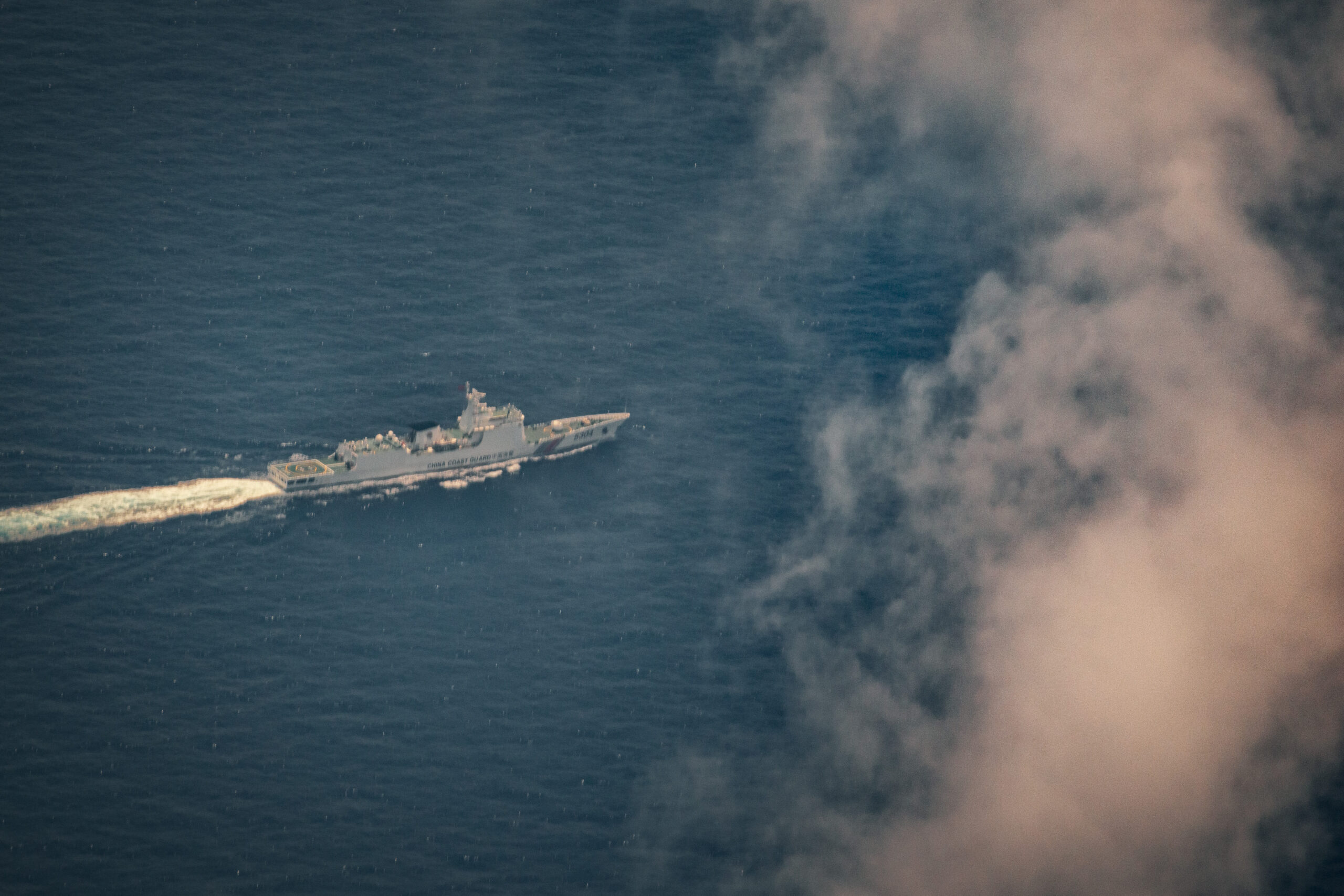
In the past, U.S. Coast Guard vessels deployed in the Middle East are now operating from bases in Singapore and the Philippines to assist allies in curbing the strong expansion of the Chinese Communist Party (CCP) in the Pacific region.
According to a report by The Wall Street Journal on Wednesday (July 15), six 154-foot fast-response patrol boats have been stationed in the Western Pacific. They are part of the U.S. Coast Guard’s restructured “Expeditionary Cutter Squadron.” This squadron has the capability of global flexible deployment, marking the first deployment of such lightweight, fast patrol boats in this area.
Over the years, as the CCP has escalated its “gray zone” operations, attempting to demonstrate control in the waters around Taiwan and in the sovereign-disputed South China Sea, the situation in the region remains tense. The U.S. move is a direct response to CCP provocations.
These patrol boats have been authorized to operate at least until September of this year from bases in Singapore and Subic Bay on Luzon Island in the Philippines for rotation and logistic support.
Historically, Subic Bay was once one of the largest overseas naval bases of the United States. After the end of the Cold War in 1992, due to rising Philippine nationalism and the expiration of lease agreements, the U.S. military withdrew from the base and it was turned into an economic zone. However, in recent years, with the increasing military threat from the CCP in the South China Sea, the Philippines has reopened its doors to the U.S. military. Through strengthening alliance cooperation, the U.S. military is expanding its presence and rotational deployments in the region.
The South China Sea, one of the world’s most important maritime arteries, annually carries trillions of dollars in international trade shipping, while the region harbors rich fisheries and oil and gas resources. For the U.S., maintaining the “freedom and openness” of the South China Sea is not only about the sovereignty of Southeast Asian allies, but also a strategic core for safeguarding global supply chain security and freedom of navigation.
Analysts point out that while the U.S. military is fully engaged in the Middle East, the Coast Guard’s involvement demonstrates America’s strategic acumen of being able to multitask effectively.
Currently, Iran continues to provoke in the critical Strait of Hormuz, causing disruptions to global trade, soaring oil prices, and leading to the breakdown of the ceasefire agreement signed by U.S. and Iranian leaders in June. In order to maintain international order, the U.S. military is conducting successive strong strikes against Iran.
On Wednesday, the U.S. Central Command (CENTCOM) carried out another round of daytime strikes, inflicting heavy damage on Iran’s coastal defense systems, cruise missile depots, and launch sites around the Strait of Hormuz to ensure the smooth flow of this global energy artery.
Euan Graham, a non-resident senior analyst at the Australian Strategic Policy Institute (ASPI), stated: “When the U.S. Navy appears stretched thin in the Strait of Hormuz and the Middle East, the Coast Guard is a perfect way to maintain U.S. military presence.”
Coast Guard vessels are considered “law enforcement forces” rather than direct “military warships,” with lower sensitivities, making them more acceptable partners for countries like Vietnam and Pacific islands that do not have their own military forces. Compared to relying solely on the navy, this allows the U.S. to flexibly engage in anti-illegal fishing, anti-smuggling, and maintaining maritime order in a wider range.
Despite the CCP’s significant investments in its maritime law enforcement forces in recent years, equipping larger and more powerful vessels, and utilizing “maritime militias” for gray zone harassment, the U.S. has evidently made ample preparations, having sufficient strategic tools and strength to counteract the CCP’s malicious expansion.
The U.S. is dispersing its military footprint, upgrading front-line airfields in the Indo-Pacific region, deploying advanced missiles, and conducting highly complex joint military exercises with allies such as the Philippines, Japan, and Australia to build an impregnable line of defense.
The U.S. Congress has approved an investment of approximately $25 billion in the Coast Guard to build new advanced vessels and aircraft, with the “Force Design 2028” strategy significantly expanding by 15,000 military personnel, marking recruitment numbers at a new high in decades.
With bases in Guam and Hawaii as the rear area, coupled with front-line deployments in Singapore and Subic Bay, the U.S. Coast Guard is closely collaborating with the U.S. Indo-Pacific Command to advance the defense line.
Regardless of how the CCP attempts to change the status quo in the South China Sea and the Taiwan Strait, the U.S. military and its allies have the determination and strength to ensure the freedom, openness, and stability of the Indo-Pacific region.