
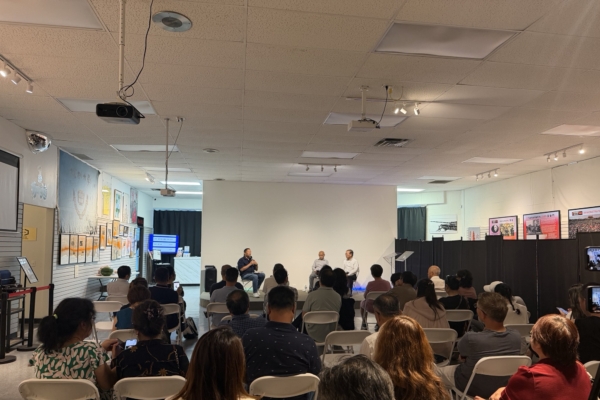
Last Sunday, July 12th, the main organizers of the once-active “Chinese Poetry Society” (C.P.S.) in the Chinese literary community in the United States, including Jiang Pinchao and Wang Dan, together with over forty literary friends from Southern California, invited renowned Chinese-American scientist Professor Liu Yongchuan to host a lecture on “Literature and Social Trends” at the “June Fourth Memorial Hall” in Los Angeles. On that day, they also officially announced the revival of the “Chinese Poetry Society” after a period of suspension.
The Chinese Poetry Society was founded in November 2004 by poets Wang Dan, Jiang Pinchao, Sheng Xue, and others, along with Nobel Peace Prize lifetime judge and sinologist Ma Yueran, and Taiwanese literary figure Yu Guangzhong, as an online literary organization. The society had initiated a collection of masterpieces of new Chinese poetry and was later discontinued for a period of time.
The event was hosted by June Fourth poet and National Library of Congress archivist Jiang Pinchao. He mentioned that the revival of the Chinese Poetry Society is a way to pay tribute to the literary predecessors who supported them while continuing their past aspirations. Through a combination of online and offline literary activities, they aim to connect and develop friendships among poets and contribute to Chinese poetry creation.
The keynote speaker of the event, Wang Dan, is not only a political activist but also a prolific writer and poet, with over thirty published books including essays and poetry collections. His poetry collection was the recipient of the first prize in poetry at the World Chinese Literature Association’s inaugural World Chinese Literature Awards.
During the discussion, Wang Dan reflected on his creative process over the years. He shared his passion for literature from a young age and how literary works provided him with spiritual support during challenging times, even composing a poem during his university years that was turned into a song by Taiwanese singer Chang Yu-sheng.
He emphasized the importance of freedom in literary creation, stating that those who love writing and literature are inherently yearning for freedom. Wang Dan stressed the role of literature as a medium for self-expression, allowing individuals to find solace and balance amidst political pressures.
In response to questions from fellow writers, Wang Dan humorously pointed out a significant difference between China and the United States, highlighting the freedom of expression present in the U.S. compared to the restrictions in China. He expressed his fondness for Beijing’s street food, acknowledging the affordability there, yet his belief that civilization and progress follow the flow of immigration, favoring places where people seek better opportunities.
Since his exile from China to the United States, Wang Dan has been unable to return to his homeland.
Another keynote speaker at the event, Liu Yongchuan, a former Chief Data Scientist at companies like IBM, TRG, and Yapstone, and a consultant for Harvard University’s Data Technology Magazine, discussed the intersection of artificial intelligence (AI) and literature. Liu highlighted that while AI can serve as a valuable tool for writers, it cannot replace the unique creative essence of poets and writers, as it lacks the ability to access the emotional depth and subconscious aspects of human beings that are essential in literary creation.
Drawing examples from American law firms utilizing AI for legal document review, Liu suggested a growing trend where individuals proficient in AI technology may replace those who are not, emphasizing the need for a balanced utilization of AI in creative processes.
He also emphasized the enduring significance of classical literary works, such as the play “Death of a Salesman” by American playwright Arthur Miller and China’s Four Great Classical Novels, attributing their lasting appeal to their ability to reveal profound insights into human nature beyond the reach of scientific theories like sociology, depths that modern AI technology struggles to attain.
Throughout the event, two prominent Chinese singers from Southern California performed nostalgic songs, adding a touch of artistry and allowing the audience to experience the power of music and art.