
In the 1980s, on a clear morning in a village school in the Baoji area of Shaanxi Province, China, students who came to school for classes stood at the classroom door, hesitant to enter because there were many dead infants inside the classroom.
The day before, this classroom had been used as a makeshift abortion room, and the desks where students usually sat were now operating tables for pregnant women undergoing abortions. Pregnant women who were forcibly taken to the school lay in rows inside the classroom waiting to undergo the procedure. The aborted fetuses were directly thrown into buckets.
Later, the principal had two teachers bury the fetuses, and only then did the students re-enter the classroom.
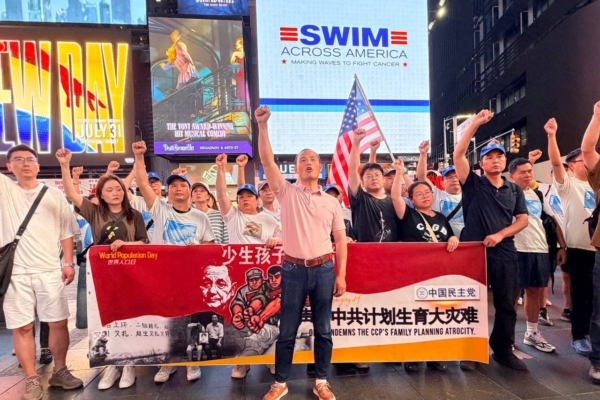
This scene was deeply imprinted in the mind of a new immigrant named Shi Yahui. On World Population Day, July 11, Shi Yahui recalled this past event at Times Square in New York to Epoch Times. “There were many such incidents back in those years,” he said at the event held by the Chinese Democratic Party to “condemn the population disaster caused by the CCP’s family planning policy.” “At that time, slogans promoting family planning like ‘It’s better to have ten graves than one extra child’ were posted everywhere in the village. Just being seen by them could result in being captured.”
At the event, several witnesses of the CCP’s family planning policy from different provinces in China shared their experiences.
Chinese Democratic Party member Hao Fangfang recalled that when she was young, her mother was pregnant with her younger sister and was close to delivery. Suddenly, family planning officials came to the village to arrest people, but her parents managed to escape. A few days later, her sister was born. “If they hadn’t escaped, my mom would have been taken for forced abortion, and my sister wouldn’t have had the chance to come to this world,” she said.
Hao Fangfang explained that during that era, to protect the children in their wombs, many couples had to hide and leave their young children with the elderly at home. Upon returning, some found their houses demolished, some children were born for years without legal household registration, and others faced heavy fines for “exceeding births.”
Since the late 1970s, the CCP has implemented strict family planning policies, including the “one-child policy,” and enforced various population control measures. These measures included strict birth control orders, punishment for exceeding births, restrictions on household registration, among others. The CCP officially claimed that the family planning policy had prevented around 400 million births and considered it a government accomplishment. However, in recent years, due to changes in the population structure, the CCP has adjusted its policies and encouraged Chinese people to have a second or third child.
Shi Yahui recalled witnessing a pregnant woman bringing her child to the village for a visit, but because she had already given birth to one child and was pregnant again, family planning officials found her and forcibly took her for abortion. In another household, the sister-in-law ran away when pregnant, and family planning officials couldn’t catch her, so they forcibly took the younger sister-in-law for sterilization surgery.
Chen Yunhua from Taizhou, Jiangsu Province, shared that he was the “excess birth” child in the family. His mother was forcibly sterilized shortly after giving birth to him, resulting in complications due to the primitive medical conditions back then, torturing him with physical pain for decades. He was six years old before he obtained household registration.
After getting married, Chen Yunhua faced difficulties in getting approval for a second child despite already having a daughter. He had to appeal everywhere before finally receiving a “birth permit.”
“They make you give birth when they say so; you can’t give birth if they say no,” Chen Yunhua said. The CCP treated the people as tools to control rather than individuals with autonomous choice.
Li Yonghong from Jiangxi expressed that her family had experienced all the sufferings caused by the family planning policy: fines were imposed when her siblings were born, her mother underwent forced abortion, and when she gave birth to her second child, she was fined over 20,000 yuan. After the second child was born, she was afraid to bring the child back to her hometown and had to rent a place outside to avoid detection. Just a month after her cesarean section, someone came to urge her to be sterilized. All these experiences left shadows in her life, even when she arrived in the United States.
“Now, in the US, there are free gynecological check-ups every year, but I have always refused to go,” Li Yonghong said. “Just seeing the gynecological examination bed or the delivery bed reminds me of the past hardships.”
Li Yonghong’s husband, Du Hairong, mentioned that apart from forced abortions, house demolitions, and other measures, large fines made it difficult for many families to cope.
“My family was fined 20,000 yuan, while my younger brother was fined 38,000 yuan,” Du Hairong said. At that time, their monthly income was less than 1,000 yuan, and these fines were equivalent to their savings for many years. In order to evade detection, their family had to live in rented accommodations with their children for a long period.
Participants in the event expressed their hope that sharing their personal experiences would raise awareness. They emphasized that this history was not just a few lines in a textbook but a real suffering experienced by numerous Chinese families. They hoped that this painful history would not be forgotten and that more people would come to understand the population disaster caused by the CCP’s family planning policy and its anti-human nature.