
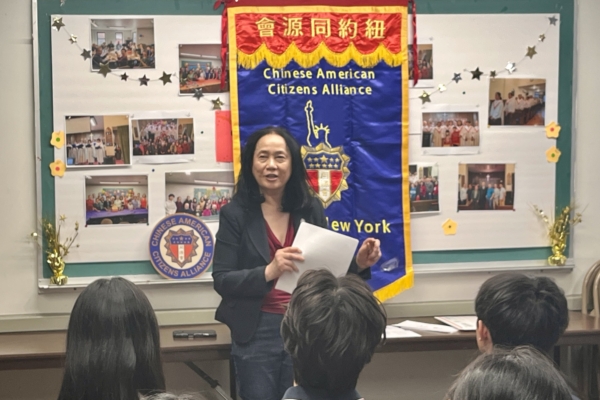
“America has always welcomed immigrants, so ICE deportation actions are not in line with the spirit of America,” said the prompt for this year’s New York Same Origin Association writing competition. A group of students from special high schools and middle schools in New York had to express their views using facts and logic within a limited time frame without internet access or AI assistance. The award-winning works in this writing competition included both supporters of ICE enforcement and advocates for humanitarian treatment, with the judges emphasizing the ability to construct arguments based on facts rather than the stance taken.
The CACAGNY writing competition in New York requires students to use facts, logic, and critical thinking skills to delve into issues related to the Chinese and Asian American communities, aiming to cultivate their critical thinking, analytical skills, and written expression abilities. After the judging process, several students from special high schools and middle schools in New York received awards. The association held an award ceremony in Chinatown on the 13th.
The organizers stated that the purpose of the competition was not to find the “correct answer” in support of or against ICE enforcement but to nurture students’ abilities in independent thinking, analyzing public policies, and discerning the authenticity of information.
President of the New York Same Origin Association, Chen Huihua, mentioned in an interview that the selection of this controversial topic was due to the frequent appearance of immigration and deportation issues in the news and social media in recent years. However, many young people often only receive fragmented information.
“Students encounter these issues every day, but they may not necessarily hear all the facts. We hope they don’t just rely on a single statement from television but learn to utilize facts, logic, and analytical skills to deeply understand the true impact behind policies,” Chen Huihua explained.
Chen Huihua indicated that the competition adopted an on-site timed writing format where students were unaware of the topic beforehand and couldn’t search for information online. Even with computers, they were not allowed to access the internet, aiming to ensure fair competition and test students’ genuine critical thinking abilities.
“What we want to see is how students organize arguments, use facts, and construct arguments, rather than relying on internet searches or artificial intelligence tools to complete their essays,” she said.
Regarding the characteristics of this year’s award-winning works, Chen Huihua mentioned that the most outstanding essays were not about having a unanimous stance but about staying on-topic and forming a coherent argument through facts and logic.
“Some students supported the arguments in the topic, while others opposed it. However, the most crucial aspect is that they could support their viewpoints with facts rather than relying on emotions or feelings in their writing,” she mentioned.
One of the co-first prize winners, 15-year-old Lu Huaichong, expressed that this was his first time participating in the Same Origin Association writing competition. When he first saw the topic, he didn’t have much relevant background knowledge and was unsure how to start.
“At the beginning, I really didn’t know what to write, but later I found that it’s easier to voice my thoughts if I can connect the issue with my emotional experiences,” he mentioned.
Lu Huaichong has a passion for literature and writing, often composing poetry and prose. He shared that upon seeing the name of the organizing entity, he speculated that the topic might be related to immigration or the lives of Chinese American families, hence drawing upon his family stories.
In his essay, he used his grandfather’s experience of sustaining a living by collecting recyclables after immigrating to the US from Vietnam as the starting point. He depicted the journey of immigrant families fighting hard and gradually establishing roots in America, using this to explore the connection between immigration issues and personal life experiences.
“If an essay only consists of logical arguments, it may be correct, but what sets it apart from others?” Lu Huaichong remarked. “I believe adding personal stories enables readers to understand why something is important, making the essay truly impactful.”
Accompanying Lu Huaichong at the award ceremony was his brother Aiden, who had previously won the Same Origin Association writing competition first prize last year but did not win an award this year. He expressed that the most significant gain from participating in such events was not the prize money but the development of independent thinking abilities.
“In reality, people rarely have the chance to pause and organize their thoughts. Writing provides a space to contemplate the world and societal issues,” Aiden shared.
Their mother, Stephanie Tan, stated that the brothers’ consecutive participation in the competition was not solely for winning but to learn to observe society and articulate viewpoints through writing.
She believed that writing competitions could train children in reading, analysis, and organizational skills, as well as help them view public issues from different perspectives.
During the award ceremony, several award-winning students shared their insights on writing. Some students chose to support the ICE deportation policy, seeing enforcement actions as part of the legal system; while others advocated for a more humane and balanced perspective on immigration issues.
Co-first prize winner Zheng Yalin believed that social media and news reports often favored dramatic content, urging people to prioritize fact-checking when consuming information and not blindly accept online claims.
Chen Huihua stated that this was precisely the most important objective of the Same Origin Association hosting the writing competition.
She pointed out that in today’s rapidly evolving era of artificial intelligence, misinformation and unverified content spread extensively. Without the ability to make independent judgments, young people might easily be misled.
“We hope students learn to question information, search for the truth, rather than taking a post, video, or tweet at face value,” she explained.
Chen Huihua further emphasized that although different opinions can coexist in society, discussions must be based on a foundation of common facts.
“Everyone has the right to their opinions, but no one has the right to their facts.”
She stressed that through this competition, the Same Origin Association aims to educate young people on fact-checking, critical thinking, and respecting differing viewpoints in complex public issues rather than being swayed by emotions or ideologies.
“The key takeaway we want students to have is not a specific answer,” Chen Huihua said, “but to learn how to think, judge, and find the truth.”
Following the selection process, Zheng Yalin, a 10th-grade student from New Utrecht High School, and Lu Huaichong, a 10th-grade student from Stevenson High School, received the co-first and second prizes. Laughing Wang, a student from Stevenson High School, received the third prize. Outstanding awards were given to Sophia Zheng from the Bronx Science High School and Ping Dinglin from the Mark Twain Gifted School. Excellent work awards were presented to Jialin Liu from Brooklyn Technical High School, Zhixiao Liu from Stevenson High School, and Yimo Zhang from the East District Middle School.